

Where to Ski at Thanksgiving: What Three Seasons of Terrain Data Show Us
Three weeks into November 2025, we had the opportunity to do some early season skiing in Banff. We spent two full days at Lake Louise, sandwiched around a day at Banff Sunshine Village.
Our only previous experience with such early season skiing was in Colorado over a decade ago, and it consisted of tedious laps of a single trail that had opened with mostly artificial snow. And that trail was swarming with skiers of questionable ability and even more questionable manners. It truly was the infamous White Ribbon of Death.
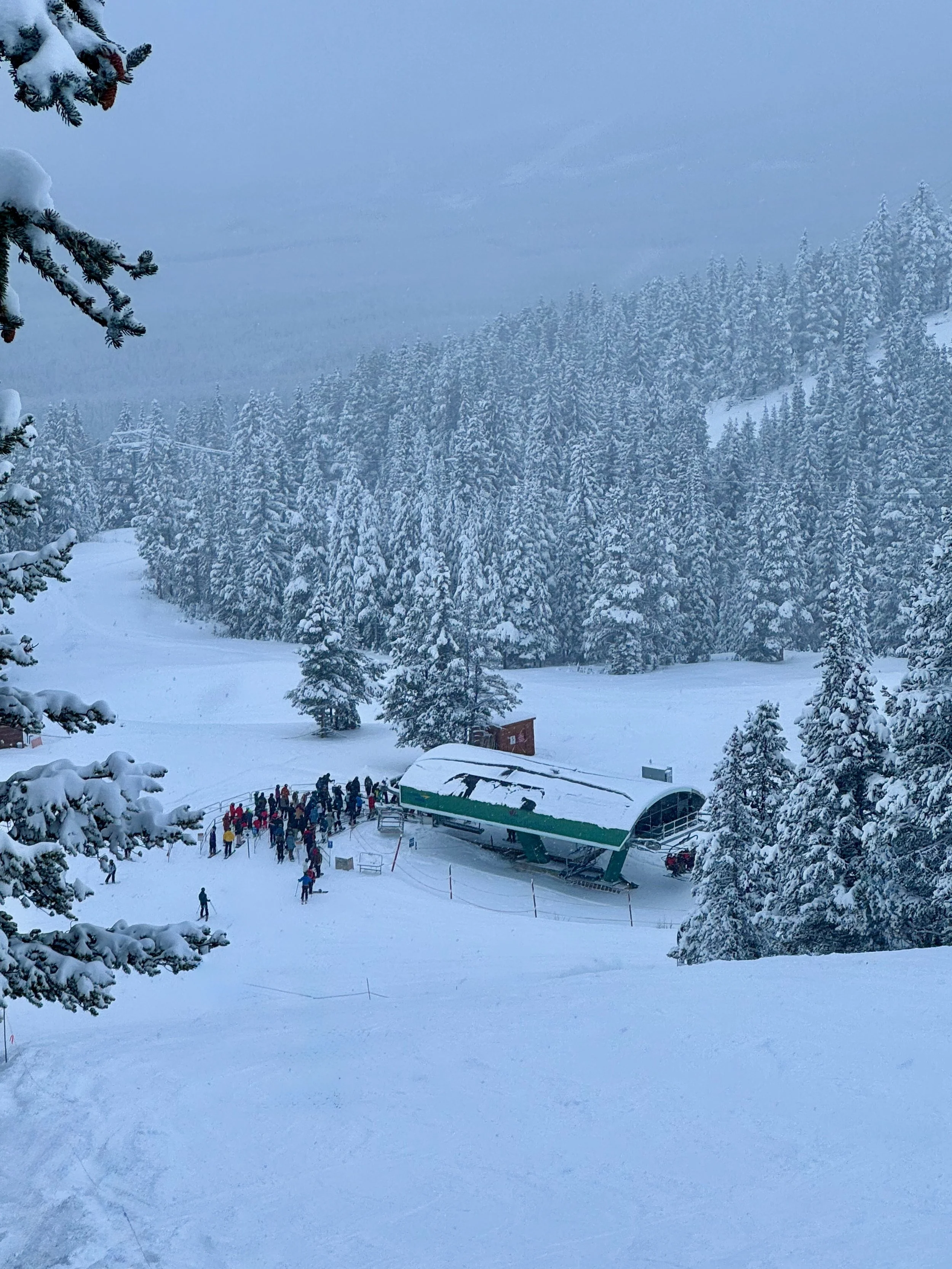
Lake Louise Ski Resort - November 25, 2025
Our experience in Banff was completely different. There were dozens of trails open, fresh powder on all three days, and we even lucked into some rope drops.
We have skied at both of these resorts before, and are well aware that this was just a small fraction of what they offer when fully open. But, considering this was just a few weeks after their respective opening days, there was more than enough open terrain to keep us occupied. It certainly scratched the ski itch that had been bedeviling us over the long summer layoff.
We flew back to the U.S. a couple of days before Thanksgiving, and crossed paths with a friend who was headed to Tahoe on a Thanksgiving trip with family. He was planning to ski at Heavenly, but was growing concerned about the conditions that awaited him.
Early reports from the American west were not sounding good, with resorts opening with very limited terrain — or not opening at all.
Heavenly had in fact already opened for Thanksgiving week (on Monday), but when he managed to get out on the mountain it was — in his words — "one run with 10,000 people on it, so I bailed...it was too dangerous."
Some major destination resorts delayed their openings significantly: Park City, Alta, and Jackson Hole among them. None of those resorts were able to open in time for Thanksgiving 2025. And to make things worse, some only announced their delays a day or two before the holiday. Far too late for people to change plans.
Now, we have long advised our friends and family to avoid planning a major ski trip in the early season unless fully aware of the experience they are likely to have (a disappointing one) and understand the risk that they may not even be able to ski at all.
But the truth is, skiers want to ski. And for many American skiers, the week of Thanksgiving is their first, best chance at kicking off their season. With school and work holidays, the opportunity can seem too good to pass up. And let's face it, skiers are risk takers by their very nature.
So — if you've made up your mind and want to roll the dice on a Thanksgiving week ski trip, what resort or region is the safest bet? We've been mulling this question over for the past nine months.
Based on our recent experience, Banff certainly seemed like a good choice. But we can't in good conscience give out advice based on one single experience.
As it turned out, 2025-2026 was one of the worst — if not the worst — seasons for snow in much of the western United States. And it just so happens that the Banff resorts had historically great seasons — with Sunshine Village even reopening in June and July for summer skiing for only the second time in memory.
Perhaps this was just a weird year! What about other years? What if it was an "El Niño"? What if Thanksgiving was almost at the end of November? It was clear we couldn't draw any conclusions from just some anecdotal evidence from one season. We needed to actually look at hard data, and much more of it.
So, we put on our thinking helmets and cranked up the laptops. We ended up reviewing three years' worth of early-season terrain data (and 20 years of weather and climate averages) from eight different resorts in four separate regions.
We had thought we'd find Banff was the clear safest bet, and were prepared to abandon our mission if the data proved otherwise. But as it turned out, it isn't that simple — Banff had a bad early season in 2023, and one U.S. resort matched it every year we looked. Ultimately, we concluded that there is no "safest bet" — there is enough risk this early in the season that even the coldest and most snow-reliable resorts could struggle to open in a particularly bad year.
But, we didn’t let ourselves abandon our mission at all — instead we dug deeper: what are the factors that affect early season openings, which resorts or regions have the best chances at a strong opening, and which popular choices carry more risk than their reputations may suggest?
We arrived at some interesting conclusions — findings that may help you plan a future Thanksgiving trip that actually pans out. Continue reading to see our full breakdown, or choose from the following quick links to jump directly to a section of your choice:
Jump to a Section
What We Found
What the Data Doesn't Tell You
The Research
What We Found
As much as we had hoped that our research would tell us some easy, straightforward truism such as “plan your Thanksgiving skiing at Banff — it’s never failed!”; unfortunately real-life is more complicated than that. Opening a ski resort is a complex undertaking by itself, but getting substantial terrain open as early as late November requires organizational fortitude, favorable weather, and a lot of luck. The data ended up telling us a more complex story, but we were still able to draw some significant conclusions:
Opening dates are important, but tell you nothing about what your experience will be
Regional risk is more correlated than you may think
Latitude beats altitude
Two places delivered — for different reasons — and neither is a lock
Opening dates are important, but tell you nothing about what your experience will be
It goes without saying that a resort actually needs to be open in order to ski. But even a record-early open doesn't guarantee that when you arrive around Thanksgiving, you'll have the experience that you want (even for early season skiing). In 2023, Vail opened on November 10th and touted it as their "earliest opening since 1998" — but by Thanksgiving day you still had to take a bus back from Vail Village if you were trying to return to Lionshead. And that "earliest opening since 1998" claim was also heavily marketed in the two prior seasons. Look at the dates and you can see why: Thanksgiving fell on November 25th in 2021, the 24th in 2022, and the 23rd in 2023 — and Vail opened on the 12th, the 11th, and the 10th. Exactly thirteen days before the holiday, every time. The record kept falling not because Vail got better at making snow each year, but because Thanksgiving kept arriving earlier. "Earliest since 1998" is a byproduct of the calendar.
Vail moved snowmaking 2,000 feet up the mountain in 2019 to take advantage of the colder temperatures at altitude. With that same system in place for the past three seasons, Vail has reliably opened exactly 13 days before Thanksgiving. But, the terrain that was open on Thanksgiving Day in each of those years has varied considerably. The resort was able to open 5 lifts in 2023 and 7 lifts in 2024, but only 4 in 2025. Vail is an enormous resort with 27 aerial lifts plus a number of surface lifts (Vail itself claims 32 lifts, a metric that includes both types). 4 lifts out of 27 by Thanksgiving last season is a small portion of their lift fleet at only 15%, and the terrain footprint was much smaller — approximately 80 acres out of over 5,300.
This is by no means limited to Vail. The data we found is filled with examples of resorts that opened more or less “early” but delivered a less-than-ideal experience:
Heavenly 2023: The resort opened on November 21st (2 days before Thanksgiving Day), but even that was a delay from their planned open on November 18th. On Thanksgiving Day the gondola from town led only to Big Easy — one beginner lift, one run, and "no access to CA or NV" (in other words, no route to either of the two base areas of Heavenly) per their mountain operations Twitter/X account.
Beaver Creek 2025: Until the resort opened on the Sunday after Thanksgiving, guests were directed to the free shuttle to Vail, where those four lifts we just referenced were all that awaited them.
Copper Mountain 2025: Copper opened November 7th — a full 20 days before Thanksgiving — on a single chairlift, and the resort said plainly it would “not offer on-mountain beginner terrain for guests” and nothing more opened for the next two weeks, that we could find. More lifts and a “top-to-bottom” run of the mountain arrived just before the holiday, but a family that booked off that November 7th date, expecting easy greens for new skiers, would have had a rough trip.
Of even more concern are the resorts that set their opening date for Thanksgiving week itself. Several resorts target that week (sometimes even one of the days after Thanksgiving Day itself) for their big opening for the year, with little fall-back time if Mother Nature doesn’t cooperate. We saw this with both Beaver Creek and Jackson Hole in 2025. Jackson Hole targeted a November 28th open (the Friday after Thanksgiving Day) and Beaver Creek targeted Thanksgiving Day itself. Ultimately, Jackson Hole could not open until December 4th, and while Beaver Creek technically made it open by “Thanksgiving Week” it was only on the last day possible to make that claim (Sunday, November 30th) after many vacationers were en route home.
The conclusions we reached are two-fold:
Not all “open resorts” are equal; the terrain that is open and the experience of getting to and from that terrain matters the most. An early season guest at Vail shouldn't reasonably expect to be skiing the Legendary Back Bowls — but it's not asking too much to be able to ski back to Lionshead instead of taking a shuttle. And a group with novice skiers is going to have a pretty miserable vacation if they get to their "open" resort and find no beginner terrain is accessible. We recommend checking what terrain was actually open in prior seasons before you commit.
Announced opening dates cannot be relied upon, and if the scheduled opening is on or around Thanksgiving Day itself, there is considerable risk that the mountain may not be able to open at all.
Regional risk is more correlated than you may think
It can be tempting to look at a region teeming with resorts and think “well between snowmaking and microclimates, something is going to pan out around here.” Don’t be fooled. So many of the factors that have to come together for early season terrain openings are regional — cold temperatures, precipitation, favorable weather patterns. If any of those factors do not materialize, resorts across the region are likely to have suboptimal offerings or not open at all. Consider these three examples:
Lake Tahoe: Home to more than a dozen prominent ski resorts, seven of which were open by Thanksgiving 2024. But in 2025, only two were able to open by the holiday, and even those were extremely limited.
Utah: High-altitude resort Snowbird remained closed the entire holiday weekend in 2025, while Park City Mountain Resort pushed out its planned November 21st (pre-Thanksgiving) opening all the way to December 5th.
Banff 2023: Sunshine Village opened November 11th with a single Magic Carpet and no aerial lift — which was both a delayed start and a disappointing experience for those used to big openings. Over in Lake Louise, they had a similarly slow start, with their Top of the World lift not coming online until the Saturday after Thanksgiving Day and the Summit Chair — the lift that opens the very top of the mountain — not spinning until after the holiday weekend was over. Both resorts sat at four lifts on Thanksgiving Day, against eight apiece the following season.
The takeaway is: don’t rely on a single resort’s reputation for “early season” skiing to plan a trip. Be aware of what has happened historically in that region and watch for warning signs: prolonged warm weather to start off November, resorts announcing delays in the final week, regional neighbors that haven't opened or delayed, and a base area that remains closed even after a resort opens.
Latitude beats altitude
There is a reason the Rocky Mountains of Colorado are dotted with world-class ski resorts, and it’s altitude. High terrain can cure any variety of winter-weather ills: mountains force passing air upward, cooling it down and squeezing additional snow from even modest storms, while temperatures generally drop about 3.5°F for every 1,000 feet of elevation gained.
A quick, real-world example of the power of altitude: a number of years back we took a summer trip to Colorado and visited Rocky Mountain National Park right around the Fourth of July. It was quite hot even at the park entrance station (8,200 feet). The thermometer at the gate read 86 degrees Fahrenheit. But when we reached the highest points of the Trail Ridge Road (over 12,000 feet), there were snow flurries in the air and the remains of last season's snowpack still lay in patches by the roadside.
When we started looking at our early season data, we made sure to include some particularly high altitude resorts in our sample (Copper Mountain, Snowbird in Utah) under the theory that they will likely be the most snowsure resorts even in the early season. But — despite all the advantages that altitude has — the data is clear: altitude simply cannot compete with latitude.
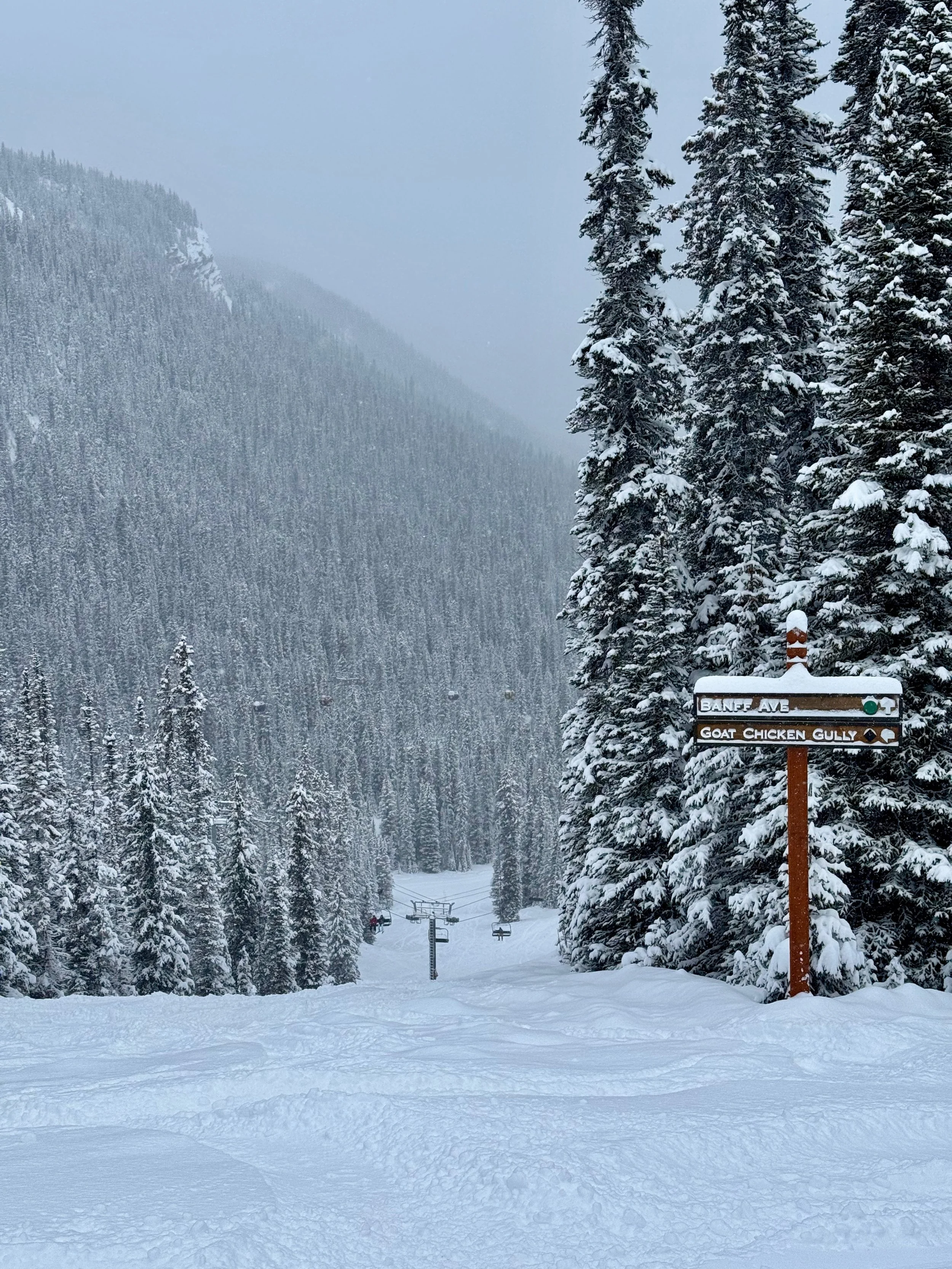
Snow on November 24, 2025 at Sunshine Village — even at the lower elevations.
Lake Louise Ski Resort in Alberta lies at 51.4° N latitude, 824 miles farther north than Copper Mountain. And the Lake Louise base at 5,401 ft is colder in late November than Copper's at 9,708 ft — and it's also colder than Copper's mid-mountain at 11,011 ft.
Cold temperatures are essential for turning rain to snow, of course. But more importantly for November skiing, they are also essential for making snow. Although humidity levels also affect snowmaking, a general rule of thumb is that if your daily temps are at or below about 28°F, you can make snow all day instead of only at night. Based on 20-year temperature averages, Lake Louise's base typically passes that threshold in the 1st week of November. At Copper — 4,300 feet higher —it doesn't cross that threshold until week 3 (on average).
This is why the Banff resorts open from the bottom while so many U.S. resorts in our dataset open from the top and ask you to download. They just can't make enough snow in early November to get sufficient coverage on their lowest elevations. The Banff resorts may not be quite as elevated but their proximity to cold arctic air and the lower sun angle at northern latitudes in winter help drop temperatures well below snowmaking thresholds early in the fall.
It's worth saying that none of this is about effort. There's a persistent theory in ski forums that resorts sit on terrain, or leave the snow guns off, for reasons of their own. We reconstructed the early seasons of these eight mountains day by day for three seasons and saw no sign of it. Every one of them would probably open fully tomorrow if they could — closed terrain is lost revenue, and the operations posts we read are full of teams working through unseasonable warmth to open one more run. Vail spent a fortune moving its snowmaking 2,000 feet uphill for exactly this reason.
Two places delivered — for different reasons — and neither is a lock
Our original premise was that planning a Thanksgiving week ski trip to Banff may be the safest bet in North America, and after a detailed analysis of the data we believe that this is almost true. It is indeed a safer bet — but it is not without risks of its own. And what’s more, another resort that many may not even consider for early season skiing emerged as a viable competing option, and that was Mammoth Mountain in the Sierra Nevada of central California.
Here is what we were able to conclude from the data analysis:
Banff Sunshine Village and Lake Louise Ski Resort (Banff, Canada)
Thanks to an ideal combination of latitude and altitude, the climate at both of these resorts is ideal for early and expansive openings. Both resorts average close to 40 inches of snowfall by Thanksgiving week (at Mid-mountain) and temperatures are cold and steady. And per our 20-year average temperature data, both resorts cross our 28°F “all-day snowmaking” threshold by the end of October at the summit and mid-mountain, and in the first or second week of November at their bases. No other resort in our dataset (including Mammoth) can boast such numbers.
Those advantages showed up on the mountain. In 2024 both resorts had eight lifts running on Thanksgiving Day. It sounds modest until you realize that Lake Louise only had 9 total lifts in 2024, meaning almost their entire lift fleet was operational. And Sunshine Village kept pace with 9 of 10 lifts running.
In 2025 — the season much of the American West lost — Lake Louise had six lifts and 24 runs on the Thursday, then opened up West Bowl over the weekend and finished the holiday with an eye-popping 104 runs. Sunshine ran nine of its ten lifts and about 71 runs. We would consider that good coverage for late December skiing, let alone the last week in November!
And then there's 2023. Sunshine opened November 11th on a single Magic Carpet and Lake Louise had an uncharacteristically slow start. Both resorts sat at four lifts on Thanksgiving Day (Lake Louise managed to have 8 open by that day the following year, and Banff was up to 9). Every advantage we just described was still true that November. The latitude hadn't moved. The snowmaking hadn't gotten worse. It just didn't snow enough, early enough, and no amount of structural advantage fixes that.
Mammoth (Eastern Sierra, California)
The surprise (to us) on our list is Mammoth. Looking at 20-year snow and temperature averages, you’d never expect Mammoth to be vying with the Banff resorts this early in the season. Mammoth ranks 7th out of 8 resorts in our dataset for cumulative snow by Thanksgiving, eking out just 16 inches at their low-elevation base (Eagle Base) by Thanksgiving week on average, which isn’t sufficient for them to open from that base. They do get more snow higher up, averaging 24 inches at mid-mountain and 26 inches at the summit. The elevation is certainly higher than Banff but it’s farther south than any of our Colorado comparables. And of the resorts we examined, it has the lowest latitude of all.
Nevertheless, if you look at our terrain opening data from the past three seasons, Mammoth can boast a surprisingly consistent pattern of opening terrain in advance of Thanksgiving each year.
Given their geographical challenges, how do they pull this off? Two things, and one of them we can't fully account for.
The first is where the snowmaking is. Mammoth has around 700 acres of it, and critically it reaches the summit at 11,054 feet. That matters because of where Mammoth's cold is: its base averages 34°F in late November and its mid-mountain 32°F, both above the all-day snowmaking line. Only the summit gets there, and only in the last week of the month, at 26°F. Mammoth's early season is a summit operation on a summit cold enough to run one — which is also why guests start from Main Lodge at 8,900 feet rather than the lower base.
The second is the timing of Sierra storms. Mammoth's four November weeks average 2, 4, 5 and 8 inches at mid-mountain — meaning nearly a third of what falls all autumn shows up in the last week before Thanksgiving. Lake Louise's four November weeks run 6, 6, 8 and 6, a slow and steady accumulation.
That number of inches may not seem too far apart, but it’s enough to make a difference. A run needs a certain minimum depth before anyone can ski it, and a few inches a week may never get it there if some of it melts or blows off in between. Or — even worse — it rains. But a single big storm can push a lot of runs over that line at the same time. Mammoth's snow tends to arrive in exactly that way, and right when they need it.
Whatever the reason, it worked three years running. Mammoth had 6 lifts open on Thanksgiving Day in 2023, 12 in 2024, and 15 in 2025 — the only resort in our dataset whose holiday terrain grew every single year. It never closed, never delayed into the weekend, and never dropped below six lifts.
There's a cost to that, and it's worth knowing before you book. Mammoth has three base lodges, but Eagle and Canyon typically don't open until mid-December — in late November, Main Lodge is the mountain. If you've booked lodging on the Canyon or Village side, expect to shuttle across to Main every morning rather than ski from your door. It's a milder version of the same problem that stranded Heavenly guests on the California side and had Beaver Creek directing guests to the Vail shuttle, but it's the same problem.
What we can't tell you is how much of that is the mechanism and how much is three well-timed storms. Three seasons isn't enough to separate a structurally good early-season mountain from a lucky one, and we'd rather say so than pretend otherwise.
The takeaway is: if you're going early, the question isn't which resort is the safest bet — it's whether your alternate is truly a different bet. Banff and Mammoth both generally did well over these three seasons, but for opposite reasons. Banff is cold and steady; Mammoth is warm at the base and depends on a storm arriving in the right week. They failed in different years over this time period, which is exactly what makes them useful as alternatives to each other rather than as a ranking.
One practical note if you do go: Both are on the Ikon Pass, along with several of the resorts we compared them to, so adding one to your consideration set may not cost you anything.
What we set out to prove, and what happened.
Our original hypothesis was that the Banff resorts would be the clear “winner” from this analysis, and that it would be a simple exercise to prove it. Neither proved to be entirely correct. Very quickly, we realized that Banff's 2023 season was the weakest of the three seasons we looked at — and that Mammoth's 2023 was not. So our alternate hypothesis was that Mammoth would end up being the “safest bet” for a Thanksgiving trip. But as we dug into what Mammoth’s early seasons actually looked like, we realized that we couldn’t confidently prove that one out, either.
So what did we prove? Well, we proved that just because a resort is open, doesn’t mean you’ll want to ski there. Of all the data we gathered, perhaps the most common situation we saw were resorts that managed to squeak out an opening before Thanksgiving but with incredibly limited terrain. Certainly not enough terrain for us to confidently recommend that someone travel to ski there for a holiday.
We also learned that there is a tremendous amount of variance — between regions, between neighboring resorts, and at the same resort from one year to the next. Weather patterns have the potential to make or break an early season virtually anywhere on the map, and we found no resort that was totally immune to that.
But we did find some that were better insulated than others. Sunshine Village and Lake Louise take advantage of their geography: high latitude and cold temperatures give them a longer snowmaking window and a base that holds what falls on it. Mammoth gets there a different way, building snowmaking high enough on the mountain to reach the only elevations that stay cold enough to use it in November.
What the Data Doesn’t Tell You
All of our conclusions above came from what we could interpret from the data (snow and temperature averages, historical open dates, terrain records). But there is more to it than numbers and figures. These next few things came from planning trips and from having actually been there, and they matter as much to whether a trip works as the numbers, charts and figures do.
Thanksgiving isn’t a November holiday in Canada
For the Americans reading this: Canadians also have a Thanksgiving holiday, but it's in October. The fourth Thursday of November —American Thanksgiving — is an ordinary work week in Alberta. And mostly an ordinary early season week at the ski resorts.
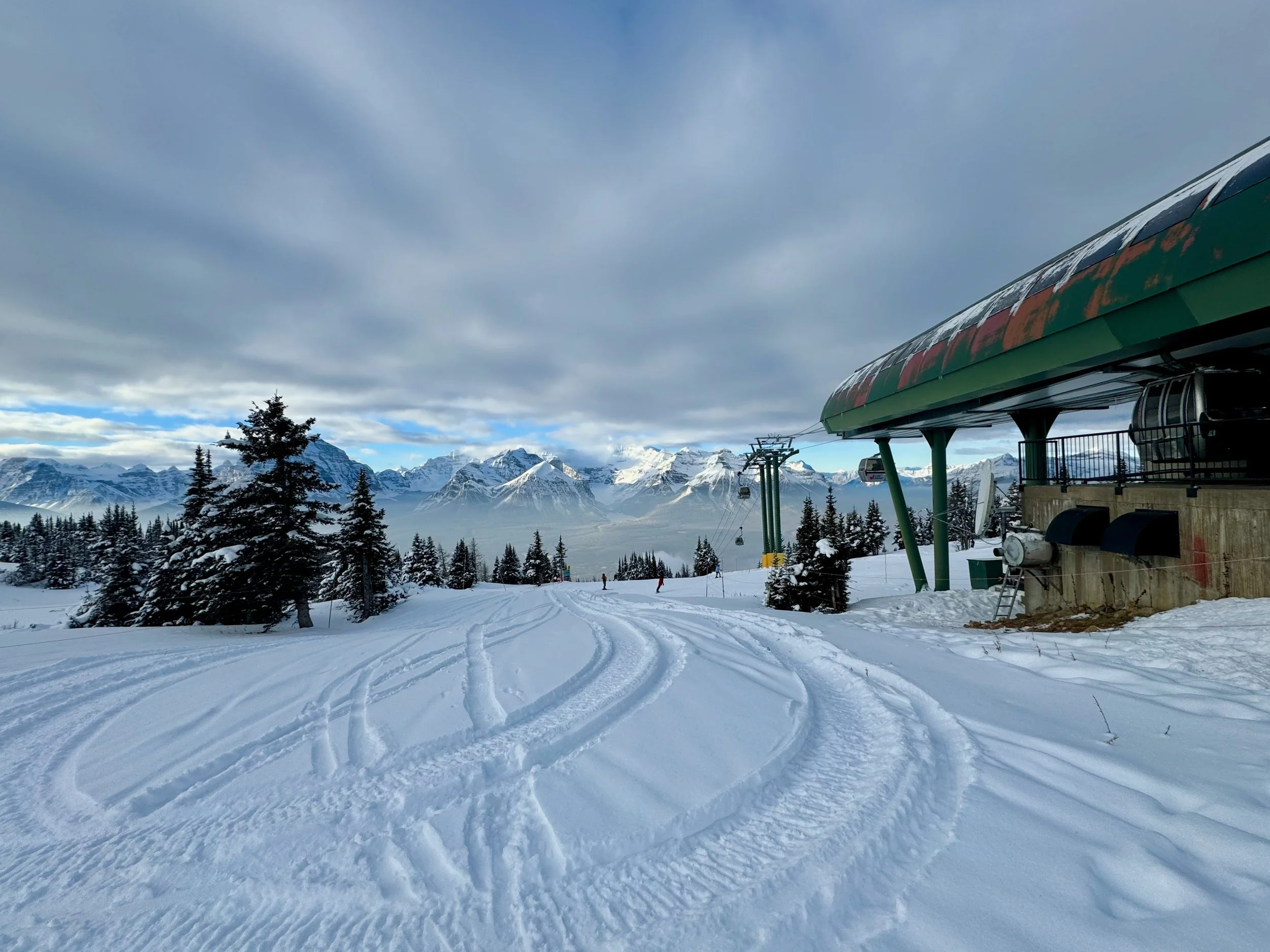
Fresh powder but not many people at Mid-Mountain in late November at Lake Louise Ski Resort. This photo was taken November 25 at midday.
Don't expect any domestic holiday surge, and there will likely be a different crowd profile at the resort (particularly weekdays, as many locals will be at work or school). And expect to see typical lodging and lift pricing for this time of year. When we were in Banff in 2025 I asked a few people at the resorts and at our hotel if they expected to see an influx of Americans the following week — everyone I spoke with knew it was the week of American Thanksgiving but they also expected it to lead to only a minor increase in guests.
Contrast that with the U.S. resorts in the set, where Thanksgiving will be their first big revenue week of the season. Combine a big jump in crowds with a potentially small footprint of skiable terrain, and you get two things: lines, and dangerous conditions. This is exactly what happened to our friend who tried to ski at Heavenly around Thanksgiving 2025 — "one run with 10,000 people on it."
Getting there cuts both ways
Banff National Park has long been a crown jewel recreation area for Canadians, and in recent years they've witnessed an absolute explosion in international tourism. But that growth has been heavily concentrated in the summer season. The winters (which is what we care about!) are still overlooked by many U.S. and other international visitors.
A few months ago we were lamenting the poor 2025–26 season in the western U.S. with some ski friends and we mentioned our early season trip to Banff. They immediately discounted it as "too hard to get to" under the assumption that it would take up a day of travel just for the flights to Calgary, and hours of driving to get up into the mountains.
It is not nearly as difficult as some people may assume. Calgary is a major international airport, roughly 90 minutes to Banff — potentially less friction than Denver to Vail on I-70 in holiday traffic. Calgary is a relatively short hop from the Midwest and Pacific Northwest, a longer haul from the Southeast. We recommend trying to connect through Minneapolis (MSP), which is a large international hub.
Once in Banff, it's about another 25-30 minutes north to get to Lake Louise.
Travel-wise, Mammoth is the mirror image — straightforward from Southern California, awkward and complicated from the East Coast.
Neither is “far” in the abstract but both are far from somewhere. Consider the travel commitment when making a plan, but don't automatically assume that one is easier to get to than the other.
Crossing a border
Introducing an international destination as an option raises additional things to contend with. Passports are now required for everyone in the group, including kids. Even if you have them already, check the expiration (and build in a 4-6 month buffer). This is something that seems trivial for seasoned travelers but will require major lead time for a family that hasn’t left the country. And passports aren't free — those fees can add up.
On the other hand, the currency exchange rate has generally favored U.S. visitors lately. This can mean seemingly "discounted" rates on just about everything — lift tickets, lodging, food, and vehicle rental. The exchange rate benefit can seem substantial, but the rate constantly moves so keep an eye on the current values.
Banff is a national park, not a resort town
The contrast between Mammoth (or Vail, or most of the other U.S. resorts in our sample) and the Banff resorts couldn't be more stark than when comparing bases.
Lake Louise has an impressive, wood-timbered lodge right at the base. But other than the enormous parking lot, that is it. No hotel, no walkable village, certainly no ski-in/ski-out condos or slopeside luxury chalets. In fact, there is no lodging at all at Lake Louise Ski Resort. The closest is in the nearby village of Lake Louise (just 10 minutes down the mountain from the ski resort), and even that is minimal compared to some of the massive resort towns in the United States. There just aren't many choices for food or après near Lake Louise.
Sunshine Village isn't much different. There is a small upscale hotel at the main base (which could be a cool experience, since you'd have to arrive at that hotel via gondola!), but otherwise there are no lodging options at all within the resort. Again, the closest options would be in the nearby Town of Banff. That being said, the town is a destination in and of itself with incredible views of the surrounding Canadian Rockies and a huge variety of shops, restaurants and bars.
Many travelers also choose to stay in Canmore, which is right outside the park, and typically comes with more affordable rates. The trade off is a much farther commute to the slopes, and very little of the "mountain vibe" that you would get in the Town of Banff or the village of Lake Louise.
Mammoth is the opposite arrangement. The town of Mammoth Lakes is a true four-season resort community, and the Village at Mammoth is a purpose-built pedestrian plaza with something like fifteen restaurants and a dozen shops. Lodging inventory runs from slopeside condos to budget motels on Main Street. In January, it's exactly what an American destination skier expects.
But almost none of that works in November. The Village Gondola — the free lift that connects the Village to Canyon Lodge — typically doesn't start running until mid-December, the same time Eagle and Canyon lodges open. So the walkable village with the restaurants and the après scene has no ski connection during the period we studied. Whatever you've booked, you're getting to Main Lodge by car or shuttle. Mammoth's village experience sounds great; it just isn't available for a Thanksgiving trip.
One thing we should be straight about
We have skied in Banff multiple times, including the early season experience referenced in our introduction. We do not have the same depth of experience at Mammoth. But one thing that we do know is that in our many years of talking to skiers about travel, destination skiing, and the ins and outs of various resorts, we have never once heard anyone in our orbit tell us they were flying to Calgary or Mammoth for a Thanksgiving trip. This is just an observation, but it’s the reason we are researching and writing this article in the first place.
Data Deep Dive
All the data-driven conclusions above came from three charts’ worth of underlying data, and if you’ve read this far you’d probably like to see it. Here’s what we tracked, and how to read it.
There are three charts below. The first is Thanksgiving Day 2025 — the season that started this whole project — resort by resort. The second puts all three seasons side by side, which is where the year-to-year swings become obvious. The third is the temperature data that explains most of what the first two show.
Our primary unit of measure is aerial lifts running on Thanksgiving Day — chairlifts, gondolas and trams. We count magic carpets separately and note that when we can, because a resort “opening” on a carpet and a resort opening a chairlift are not the same event, and lumping them together would hide exactly the kind of thing we set out to find. We also excluded gondolas running for sightseeing only. That last rule isn’t ours: Heavenly’s own operations account listed its gondola among the open lifts each morning and then clarified, in the same message, that it was sightseeing only. We followed the resort’s distinction - if you can’t ski when you get off the lift, it doesn’t count.
The natural question is: why lifts? Why not trails or acres? Well, it’s simple: this was the only number available consistently across all eight resorts and all three seasons. Some resorts post trail counts, some post acreage, some post neither. Lifts were the common currency.
But there is a flaw in this approach — and we want to be up front about it, because it’s a real one: one lift is not one unit of terrain. When Lake Louise opened its Top of the World chair in November 2023, they named the eight runs that were opening along with it. When Vail opened Avanti Express that same month, it only opened three. Resorts with efficient lift layouts look worse under lift counting than they deserve — and as it happens, that cuts against the Banff resorts, both of which have surprisingly small fleets over a lot of terrain. We've included trail counts and acreage where resorts published them, but too many gaps remain to build our entire analysis on that data.
We can also point out that even if we did have trail counts, we would run into the same problem. Opening a summit-to-base trail would count the same as a bunny hill (one) — just counting trails doesn’t give you enough information to judge the quality of what’s open. So we elected to stick with the best data we had: lift counts.
One last thing before the numbers. Fleet sizes vary enormously — for example, Vail has 27 aerial lifts, Mammoth has 26, Sunshine comes in at 10, and Lake Louise 9 (the smallest fleet in our sample). Four lifts at Vail and four at Sunshine are not the same fraction of a mountain. Where possible we tried to account for that in our analysis and the bars below show what proportion of each fleet was running, with the raw count underneath — because four lifts at Vail and four at Sunshine are not equivalent.
Our Methodology and Assumptions
It really seemed like this was going to be easy. Take a look at when a few resorts opened over the last few years, make some snap judgements and bang out this article. Simple!
We had the foolish hope that there was a die-hard skier with a head for numbers out there, who lives to track opening dates resort-by-resort, lift-by-lift and trail-by-trail. And that they were putting all online in a publicly available database for the public good.
Unfortunately, we never found anything remotely like that, so we knew we had to figure it out for ourselves.
Comparable Resorts
We knew one side of our comparison (the Banff area resorts) but needed a set of resorts to compare to. We wanted strong comparables, otherwise the research shows nothing. As we stated in the intro, we decided early on that if the data disproved our hypothesis we would abandon our project. So we wanted to compile a list of resorts that would really challenge our contention — not cherry-pick the resorts that would walk us into the conclusion we wanted.
We considered, and rejected, the following:
Jackson Hole — Although Jackson is at a higher latitude than many other U.S. ski resorts, a quick look at historic open dates told us it didn't typically open until around or after Thanksgiving, thus not a great comparison.
Arapahoe Basin, Loveland — Aggressively try to open as early as possible, but these are primarily day areas, typically not destinations for the type of family trip often planned over Thanksgiving.
Park City — We identified what we felt was a stronger Utah comparable at a higher elevation (Snowbird, see below). With its lower elevation, we felt it would be difficult to draw conclusions from Park City.
Keystone & Breckenridge — As you will see, we ended up with Vail and Copper Mountain in our population. Keystone and Breckenridge would have been duplicative with no real additional insight to gain.
Other Tahoe resorts — considered and rejected as a set, initially. Thanksgiving 2025 was one of its worst in years: only Heavenly and Mt Rose were open during the holiday week.
On the Canadian side, we decided to focus our research on Banff Sunshine Village and Lake Louise Ski Resort and not delve deeply into Mt Norquay. Although typically open by Thanksgiving weekend, Mt Norquay is much smaller, at a lower altitude, and doesn’t open terrain as aggressively as the other two. Ultimately it should be considered as an “add-on” for a trip to one or both of the other resorts rather than a destination by itself, particularly in the early season.
After ruling out the above candidates (and more) we selected our comparables, in phases:
Initial selections: Copper Mountain and Snowbird
Why Copper and Snowbird? A few reasons:
We wanted geographic diversity, so we didn’t only look at Colorado, for example.
Both are on the same Ikon pass system as Sunshine Village and Lake Louise, so may share some common objectives regarding how aggressively they target an early season open.
Copper Mountain has a reputation for an early opening date (though some of the mountain may be closed to the public for race training in early November), and Snowbird is the highest altitude and often one of the more snow-sure resorts in Utah’s Cottonwood Canyons.
These seemed like good comparisons to start with. But after seeing the initial data come in we realized we needed to expand our sample set. We were concerned we might be suffering from too small of a sample and needed more diversity: different operators and more regional spread to try to account for specific weather patterns.
We added additional resorts as follows:
Mammoth Mountain — Also on the Ikon pass. Mammoth was identified as a strong addition to our sample set because it’s situated in a completely different mountain region with different weather patterns.
Vail Mountain — The flagship of Vail Resorts’ portfolio, this gave us a data point from a different operator and an in-region comparison to Copper Mountain.
Heavenly Resort — One of the two Lake Tahoe resorts that opened for Thanksgiving 2025, and another Epic Pass (Vail Resorts) perspective. Due to this, we felt Heavenly was a “best-case” representative for the region.
Beaver Creek Resort — Another Vail Resorts property. We determined it was a good 2025 example illustrating how resorts had to compensate for the lack of November snow. It also offered a relatively high elevation data point.
Collectively, that gave us 8 world-class destination resorts for our analysis representing four different regions and multiple operators.
Timeframes and Seasons
We also felt like we needed to set some goalposts, since “early season” is a vague term anyway. We decided to focus on the American Thanksgiving weekend (which is the fourth Thursday of November, through the following Sunday). Although the actual date of Thanksgiving shifts from year-to-year, it’s a popular holiday for traveling with Americans and many U.S. ski resorts make this four-day period a hard target to get open at all costs. We also set our look-back period to be three ski seasons, as that seemed feasible to research, we had enough data, and three seasons should cover multiple seasonal weather patterns.
To level-set, here are the timeframes we looked at:
Sourcing data
We thought we could potentially use the Internet Archive’s Wayback Machine to pull trail condition reports from each resort’s websites for all the days in question. But after researching each of our eight sample resorts, we were unable to find a single report that had been archived for any of the dates we were looking at. We also looked for archived versions of aggregation sites (such as OnTheSnow or OpenSnow) but came up empty again.
We looked at local publications (local news sites, for example). We found they generally did a good job of writing about opening day including what would be open, but after that their coverage was sporadic and incomplete.
Finally, we hit on the idea of social media posts. Each resort in our sample set had daily or multiple daily posts during the time period where we were looking. It’s in their best interest to generate excitement and attract guests, so if they planned to open terrain they usually posted about it. Looking at these posts, we could piece together a story for each resort’s early season — up to and including Thanksgiving weekend.
So that’s what we did — scrolling back through hundreds (or thousands) of posts to manually recreate the terrain openings each season, for all eight of our resorts. We don’t mind telling you, this wasn’t fun. But it got the job done.
We ended up with a lot of information to synthesize (and normalize). Some resorts only posted lift openings, others would also mention trails. Some discussed the number of trails that would be open, others listed acres of terrain. We turned to AI to help us standardize — manually reviewing and correcting the data as we progressed. We ended up with 11 incrementally improved versions of our dataset, made up of over 800 discrete data points plus notes and comments. It was quite an undertaking, but worthwhile to make accurate conclusions.
Assumptions and Warnings
We had to make a number of assumptions in order to draw conclusions from the data we were able to pull together, and we want to be as transparent as possible:
Not all sources are equally reliable
As we dug in, we found that our sources fell into four tiers, with a decreasing level of value. Best were the dedicated mountain operations accounts — Heavenly’s and Copper’s both typically post several times daily with lift status, terrain openings and weather. And — importantly — they appeared to report problems or lift/terrain closures as readily as the good news. Our second tier were the resort social accounts (Facebook, Instagram, primarily) — which tend to have more of a marketing tilt. They announce plans, celebrate openings, include a lot of beautiful and enticing photography, and rarely dwell on what didn’t happen or what may have gone wrong. Tier three is the local press, which is reliable on opening day but sporadic afterward. And in one case, a corporate press release, which we consider our lowest tier. It was clearly written to sell passes, but did contain some much-needed timestamped information for our effort.
This matters more than it might sound, because the tiers aren’t evenly distributed. Two of the U.S. resorts in our set have dedicated operations accounts, but neither Banff resort has one that we could find. So the resorts our original hypothesis favored were documented from the more promotional social media source, while those two U.S. resorts were documented from the more candid one. We recognized that this may have artificially flattered the Banff numbers relative to the American ones, so made every effort possible to confirm the data. But ultimately, the resort social media accounts were our primary source for all resorts except Heavenly and Copper. We want to be transparent about this.
Announced isn’t the same as confirmed
Resorts frequently posted that they planned to open a lift or a trail, without ever confirming afterward that it actually opened. We generally had to take them at their word. We flagged these separately in our own working data, and where a planned opening was the only evidence we had, we’ve said so.
We only know about closures if somebody posted about them
Our working assumption is that once terrain opens for the season it stays open. That’s usually true, but not always — we found three separate instances from three different resorts where terrain opened and then closed again. Heavenly shut its gondola and beginner lift for four days immediately after Thanksgiving 2023. But unless we had evidence to the contrary, we assumed that opened terrain (or lifts) stayed open.
A lift opening is a proxy for terrain
If a lift was running, we assumed the terrain it serves was skiable unless we had more detailed data. Sometimes resorts listed specific trails and we could be precise; more often we couldn’t. This is the single biggest soft spot in our numbers.
Weather figures are modeled averages
Our snow and temperature data comes from snow-forecast.com’s 20-year climate averages, not from gauges on the mountain or official measurements. Since these metrics all came from the same source, they’re good for comparing resorts against each other. However, they’re not precise measurements. Similarly, what snow-forecast.com calls a resort’s “base” is simply a coordinate on a map — not necessarily where you start skiing. The most obvious example of where this may be misleading is at Sunshine Village. The altitude of what they call the “base” at Sunshine is the gondola base station (right by the parking lot) — well below the village where you actually click in. Mammoth’s is Eagle Lodge, which isn’t even open in November.
Three seasons is a small sample
We’d rather have ten. Three was what we could research thoroughly, and it’s enough to show variance — but it isn’t enough to distinguish a structurally reliable resort from one that got lucky three times running. Prior to 2023 our source data (mainly the social media data) was too sporadic for us to consider adding it.
Conclusion
So: should you book a Thanksgiving ski trip?
If you’re asking whether there’s a resort that will reliably deliver a real mountain in late November, our answer after nine months of thinking about this is no. Not Banff, not Mammoth, not anywhere we looked. Every resort in our set had at least one holiday weekend that may have disappointed somebody who flew in for it.
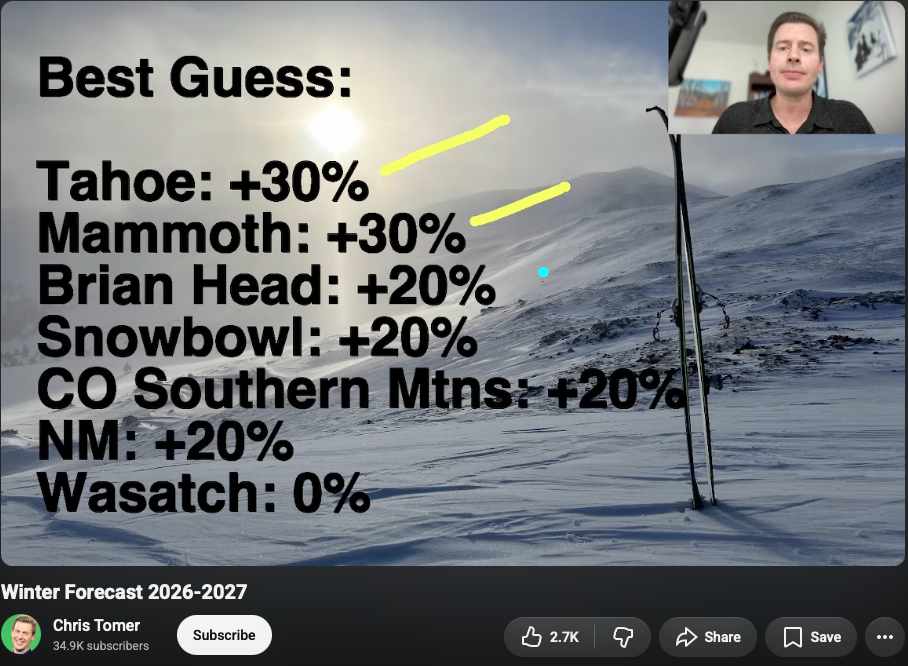
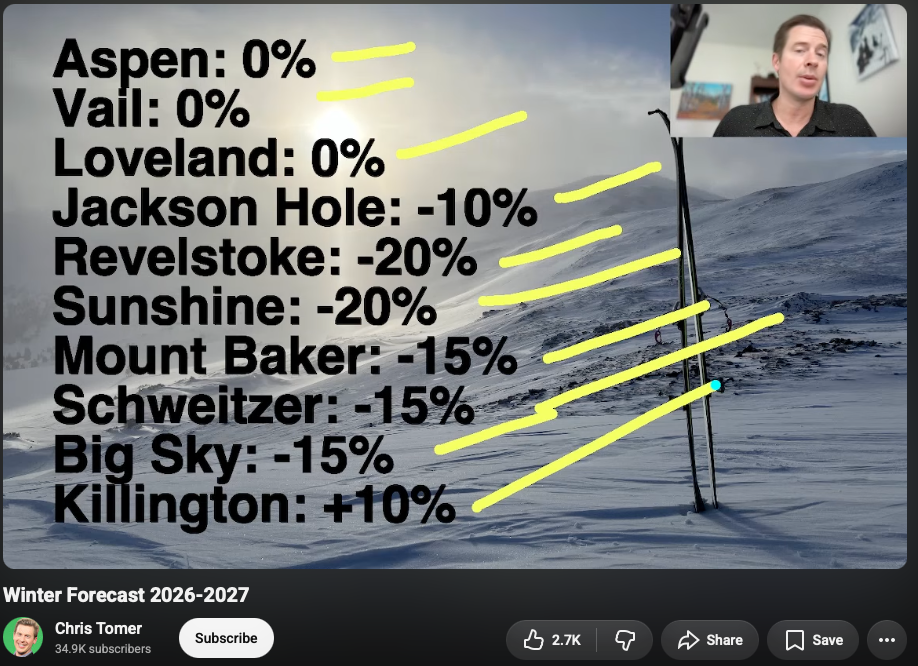
And 2026 may be quite an unusual year. As of mid-August, NOAA's Climate Prediction Center puts the odds of a very strong El Niño through fall and winter above 90%, with a 69% chance that the October–December period exceeds anything on record since 1950. Mountain-weather meteorologist Chris Tomer, who tracks these patterns closely, is already calling for the pattern to favor the Sierra and go light on Alberta this year — which, if it holds, is close to the opposite of what we found across our three seasons. NOAA is careful to say a strong event makes El Niño-typical impacts more likely, not certain, and Tomer's read is one forecaster's early-season call, not a settled outcome. But it's worth sitting with for a second: the two places we just told you have the best structural odds could, in a single unusual year, be the two that struggle.
We are not walking back the data. Three seasons told us Banff and Mammoth have real, different advantages — geography for one, engineering for the other — and that neither is a lock. A season where a global weather pattern outweighs both of those advantages is precisely the kind of variance this whole article has been about. We'd rather flag it now than have you find out in November.
But that’s not the same as saying don’t go. It means going in with the right expectations, and it means the questions you ask before booking should change. Not “is the resort open?” — almost all of them will be — but how much of the mountain has actually been running this week in past years, whether the open terrain connects to where you’re staying, and whether there’s anything for the beginners in your group. Know what you may be getting yourself into going in, and set your own expectations accordingly. Decide for yourself if you will be happy if only one lift is running or (even worse) the resort simply cannot open at all.
And if you’re hedging, hedge properly. Two resorts three hours apart in the same range aren’t two bets, they’re one. The reason Banff and Mammoth both came up in our data isn’t that either is a sure thing — it’s that they fail for different reasons in different years, which is the only kind of alternative that’s actually worth having.
You can't eliminate the risk of finding yourself on the White Ribbon of Death on Thanksgiving Day, but you can know what you're accepting.