

Destination Guide: Beaver Creek, Colorado
Our Destination Guides are written for first-timers, not locals or returning visitors — this is what we wish we'd known before our own first trip to each resort.
At a Glance
Location
Avon, CO
Year Opened
1980
Size
2,082 acres
Altitude
8,100–11,440 ft
Trails · 167 Total
Lift Fleet
24 lifts
Longest Run
2.75 mi
Pass

Jump to a Section
On the Mountain
Village and Stay
Beyond Skiing
Beaver Creek is forever in the shadow of big brother Vail Mountain, and we don't think it would have it any other way. With an air of exclusivity and a reputation for eye-popping price tags, Beaver Creek intentionally keeps the crowds down.
Geography helps in this endeavor. As the farthest of the I-70 resorts from Denver, it takes a certain dedication to keep driving past all the other world-class resorts to get to Avon. Why add another 35 minutes on the road, plus a crossing of the notoriously weather-prone Vail Pass, to reach Beaver Creek when you could already be unloading your skis at the much larger (and likely more affordable) Breckenridge?
Well, those with the wherewithal to get there and the means to stay for a few nights may find Beaver Creek to be a delight. With miles of impeccably groomed cruisers, very approachable bowl terrain, and noticeably lighter crowds than most comparable Colorado destination resorts, Beaver Creek could be the perfect choice for skiers who prioritize an enjoyable day on the slopes over extensive off-piste terrain.
Is This Mountain Right for You
Despite its size, notoriety and prominence as one of Vail Resorts’ "flagship" properties, there are some who still consider Beaver Creek to be a bit of a hidden gem. We have met Colorado locals who have skied in Summit and Eagle counties for decades and yet have never made a single turn at Beaver Creek.
Some of that is related to the location — there are simply too many great options for skiing along the highway to keep driving. But it may also be due to the market positioning that Beaver Creek has adopted, which is fairly narrow and deliberate: a family-focused, upscale ski resort that doesn't make the guest work too hard to have a good time — hence its longtime association with the infamous "not exactly roughing it" tagline.
Beaver Creek knows its target market, and based on our visits, it's a fantastic destination for the right travelers.
Who This Mountain Is Good For
Families. This is Beaver Creek’s whole reason for being. The resort was built around a family-first ski school reputation from day one, and it shows in everything from the terrain layout to the base area itself — kids and beginners aren’t tucked away on some forgotten corner of the mountain, they’re front and center.
Groups with a wide range of abilities. If your ski trip includes a mix of a confident intermediate, a nervous beginner, and someone who wants a challenge, Beaver Creek’s layout makes it easy for everyone to ski together and reconvene without anyone having to fake enthusiasm about a run they hated.
Skiers who love long, immaculately groomed cruisers. This is the mountain’s signature. Mile after mile of corduroy, wide enough that you’re never fighting for space, groomed with a level of consistency that turns an ordinary intermediate run into something truly fun to lap all day.
Anyone who wants to avoid crowds. We mean this literally — even during peak weeks, lift lines here are minimal. Combine that with the resort’s built-in exclusivity (distance, price, positioning) and you get a mountain that rarely feels like it’s fighting you for space.
Travelers who want minimal hassle getting on and off the mountain — and who already hold an Epic Pass. Ski-in/ski-out lodging, escalators up to the base (yes, really), and a village designed so you’re never far from a chairlift. And if you’re already an Epic Pass holder, here’s the detail you need to know: although Beaver Creek is at the top tier for walk-up pricing, there is no “surcharge” to ski here if you already have one of the Epic passes that includes Beaver Creek. Just be sure to check your pass details for blackout dates or access restrictions.
Those who want an upscale, refined experience. Long known for the tagline “not exactly roughing it,” Beaver Creek leans into pampering rather than roughing it — heated walkways, an outdoor escalator, and a chocolate chip cookie tradition that’s become as much a part of the brand as the skiing itself.
Who Should Avoid This Mountain
Off-piste skiers. If your idea of a great day involves jumping off-piste and hunting for untouched pockets of trees all day long, you’ll find slim pickings here. Beaver Creek’s terrain is largely groomed and managed, not wild. There are glades in several pockets around the resort, but the resort leaves little room for freelancing.
Experts who only want double blacks or steep glade skiing. There’s advanced terrain here, but it’s not the mountain’s identity the way it is at some neighboring resorts. If steep and gnarly is the only thing that gets you excited, you’ll ski it out fast and wish you’d gone elsewhere.
Young adults or anyone looking for a party scene. Beaver Creek’s après culture is refined, not rowdy. If you’re after late nights and a loud bar scene, this isn’t your mountain.
Bargain shoppers. Walk-up lift ticket prices here are similar to Vail Mountain and among the highest in Colorado — and lodging follows the same logic. This resort was built for a specific budget, and it’s not a modest one.
Anyone hoping to stay farther out and day-trip in. Beaver Creek’s design encourages guests to stay inside the resort. While they certainly accommodate day skiers, accessing the slopes as a day skier is not as easy as it is at many resorts.
Early- or late-season skiers. Beaver Creek’s season runs shorter than most of its I-70 neighbors. This shorter season appears to reflect deliberate positioning as much as snowfall. The resort generally focuses on a curated peak-season experience instead of chasing every possible day of early or spring skiing.
Getting There
As we’ve noted, Beaver Creek is the farthest west of the major I-70 Colorado ski resorts. But that doesn’t mean it’s inaccessible, or even particularly difficult to get to. It may not be the closest resort to Denver, but travelers who choose Beaver Creek for their ski trip have several reliable ways to get there and start their vacation without much friction.
Nearest Airports and Drive Times
Eagle County Regional Airport (EGE) — 29 miles, about 35 minutes
Not only is EGE the closest airport to Beaver Creek, Beaver Creek is also the closest major resort to EGE — a rare case where the resort’s remote position along I-70 actually works in its favor. Once you land, you’re closer to the lifts than almost anyone flying into Denver.
EGE has grown considerably in recent years. For winter 2025–26, the airport offers nonstop service to 16 destinations, with American, United, Delta, and Alaska all running routes — including newer additions like nonstop flights to New York and Charlotte, and Alaska’s now-second season of service to San Diego and Seattle. It’s still a smaller airport than DEN, and flights fill up fast during peak weeks, so book early if EGE is part of your plan.
Getting from EGE to Beaver Creek is simple, with a few good options depending on your budget and preferences:
Rental car — the most flexible option for the short drive, and you’ll have a car on hand for the rest of your trip.
Epic Mountain Express — the region’s dedicated shuttle service, running scheduled shared-ride shuttles as well as private SUVs directly from EGE to Beaver Creek. Epic Pass holders get 20% off through the Epic Mountain Rewards program.
Rideshare or private driver — widely available near the airport itself and a reasonable option for the trip from EGE to Beaver Creek.
One caveat: EGE is a small, high-altitude mountain airport exposed to severe winter weather, so disruptions can have an outsized effect on its limited flight schedule. Build in some buffer if possible.
Denver International Airport (DEN) — 2.5 to 3 hours
Denver is one of the busiest airports in the world and easy to reach from nearly anywhere. I-70 runs straight through the Rockies from DEN toward Beaver Creek, but the drive includes several stretches of significant grade and high mountain passes — including Vail Pass, which we’ll come back to.
Because Colorado’s ski resorts (and other winter recreation) draw such heavy traffic, I-70 has earned a reputation for backups, particularly on Friday afternoons, Saturday mornings, and Sunday afternoons as everyone heads back to Denver. Winter storms only make it worse, drawing out powder hounds at the same moment the roads get hardest to drive. CDOT works around the clock to keep the corridor clear of snow, ice, and accidents, but during a busy weekend or a heavy storm, delays are still common. Once you do reach the Beaver Creek exit, though, the resort entrance sits right off I-70 — the hard part is the drive itself, not the final approach.
Travelers coming from DEN have a few good options:
Rental car — the most flexible option, and you’ll have a vehicle on hand for the whole trip. The tradeoff is that the traffic and mountain driving described above become your responsibility.
Epic Mountain Express — the same shuttle service that runs from EGE also offers scheduled shared and private rides from DEN, with the same 20% discount for Epic Pass holders.
Bustang — Colorado’s state-run bus service runs a West Line connecting Denver’s Union Station to Avon and Vail along I-70, along with Pegasus, a smaller express shuttle that uses I-70’s express lanes for a faster, fewer-stop ride on the same route. Both can be paired with RTD’s A Line train from DEN to Union Station for a fully car-free trip — a solid option if you’d rather not drive the mountain passes yourself, or if you’re traveling on a budget.
Look for our forthcoming article comparing the tradeoffs of flying into Eagle County versus Denver International in more detail.
Do You Need a Rental Car
If you are staying within the Beaver Creek resort itself (see our Lodging Overview section), the answer is refreshingly simple: probably not. The resort runs Village Connect, a complimentary on-demand shuttle that functions like a private rideshare app built into the resort itself. Open the app, request a ride from wherever you are to wherever you want to go, specify the number of passengers, and a shuttle bus will be dispatched to pick you up. The driver takes you practically anywhere in Beaver Creek, Bachelor Gulch, or Arrowhead — including straight to the base of a lift (or as close as the road will take you). It runs daily from 7:00 a.m. to midnight, which comfortably covers everything from an early first chair to a late dinner in the village.
It's hard to overstate how convenient and easy the Village Connect service is — over the course of three Beaver Creek ski trips we've never had to wait longer than 10 minutes for a called shuttle and it's typically less than five. And more often than not, the shuttle buses themselves are completely empty when they arrive, with no other passengers at all. And even if there are a few fellow travelers on board, it can be a great opportunity to share information on trail conditions, weather or even restaurant recommendations. Locals who live in Beaver Creek use the service extensively and love to pass on insider knowledge and experience.
If you want to ski at Vail while you're on your Beaver Creek vacation, they make it quite easy as well. Eagle County's bus system (Core Transit) operates the completely free Vail/Beaver Creek Express route that will take you from the village center to the Vail transportation hub. The same bus system can also take you to Avon if you need to get off the resort.
Between Village Connect, the resort’s walkable base areas, Core Transit, and the free parking-lot shuttles for day guests, most travelers staying within Beaver Creek itself never need to get behind the wheel once they’ve arrived. That being said, on each of our last three trips to Beaver Creek we have rented a car! Our reasoning could resonate with you if you are in a similar situation as we have been:
Some members of our group were driving up after flying to Denver and others were flying into Eagle/Vail. It was more cost-effective to share the rental car costs than to purchase individual shuttle trips
Our lodging included a covered parking spot and a full kitchen in our condo — we wanted the ability to easily go grocery shopping for our group
We wanted to explore the restaurant scene in Avon and Edwards, instead of staying completely within the resort and the bus system was a bit limiting
We planned to ski at least one day of our trip at Vail (utilizing the Express Shuttle), but also preferred to keep our options open in case we wanted to go further afield such as Breckenridge or Keystone.
One of our group made an appointment with a custom boot fitter (there are world-class custom fitters in both Avon and Edwards!) and we wanted to be able to easily get to and from the shop.
Your own trip may look different, but the pattern generally holds: if you're staying entirely within the resort and keeping things simple, skip the rental and let Village Connect or public transit handle it. The moment your plans stretch beyond Beaver Creek's borders — extra ski days elsewhere, exploring Avon or Edwards, splitting costs across a mixed-arrival group — a rental car starts paying for itself fast.
Best Time to Visit
There's no shortage of opinions among Colorado natives about the best time to visit for winter sports. Ask ten skiers what the best month is and you'll likely hear ten confident but slightly different answers — nevertheless, a few patterns hold up.
Although a few Colorado resorts try to open as early as October, that's for the locals — sometimes just a single trail on manmade snow, not a vacation-worthy mountain yet. No one should be investing the time and money in a destination ski trip until December at the earliest.
January brings reliably cold, consistent snow and the lightest crowds of the season, if you don't mind bundling up. February is the season's sweet spot: base depths are at their deepest, storms keep rolling through, and conditions are about as good as Colorado skiing gets. March often brings the most total snowfall of the winter, paired with longer days and warmer temperatures — though crowds pick up as spring break travelers arrive.
Beyond the calendar, Colorado is home to all ten of the highest-elevation ski resorts in the U.S., and on average, its resorts sit higher than anywhere else in North America. That elevation does a lot of the heavy lifting — keeping snow cold, dry, and long-lasting in a way lower-altitude resorts can't match. That's the general picture, but at Beaver Creek specifically, a few things are worth knowing before you pick your dates.
Snow and Weather Patterns
That general Colorado picture holds true at Beaver Creek, with a few local wrinkles. Beaver Creek’s own published figure is around 325 inches of snow annually — a serious amount by any standard. But anyone who paid attention to snowfall across the West during the 2025–26 season knows that an “average” can hide enormous swings from year to year: Beaver Creek received only 126 inches that season, per Powder Magazine — significantly below normal. Compare that to the winter of 2007–08, when the resort set an all-time record with 430 inches, part of a historic season that broke snowfall records across the Central Rockies.
So it’s safe to say that Beaver Creek is generally reliable when it comes to natural snow, but no mountain is completely immune to a bad winter. What keeps Beaver Creek dependable regardless is its combination of elevation and infrastructure: skiresort.info rates it a five-star “Top Resort” for snow reliability, and the resort backs that up with heavy investment in snowmaking and grooming to smooth over the years when nature doesn’t fully cooperate.
Beaver Creek does receive somewhat less snow than its neighbor Vail — 325 inches a year on average, compared to Vail’s roughly 350–365 inches. The exact reasons are debatable (and meteorologists enjoy that debate), but the point is that while this is a real gap, it is not one that should particularly worry you. 325 inches a year is still an enormous amount of snow, and Beaver Creek’s north-facing terrain helps preserve snow quality and coverage longer into the season than south-facing slopes would.
If you’re chasing the deepest snow of the season, late March is actually your best bet — historically the single snowiest week of the entire year at Beaver Creek, not December or January as you might assume. That said, December through February remains the most consistent stretch, when the season’s heaviest storm systems tend to roll through most reliably.
On temperature: at the base, average midwinter highs are around 30°F, with overnight lows commonly in the single digits. Conditions near the summit can be considerably colder and windier. We’ve experienced wind chills in the negative teens at the 11,000-foot summit during a January cold snap — a good reminder to dress for the top of the mountain, not the parking lot.
Season length follows the same “average hides the variability” pattern as snowfall. Beaver Creek typically runs late November through mid-April, but the actual timing shifts from year to year. The 2025–26 season saw a delayed opening due to unusually warm temperatures and low early snow, pushing well past the resort’s usual pre-Thanksgiving target. On the closing end, Beaver Creek shut down for the season on April 13, 2025, while Vail Mountain — same valley, same storms — stayed open a full week longer, until April 20. That gap says less about snow totals than it does about Beaver Creek’s whole approach to the season: as we’ve noted, this is a resort built around a curated, reliable window instead of squeezing out every possible ski day. Large-scale patterns such as El Niño and La Niña can influence western storm tracks, although no single climate pattern explains an individual resort’s season.
Peak vs. Shoulder Season
As with most Colorado resorts, Beaver Creek's calendar breaks down into predictable peak and shoulder windows. Peak season covers Christmas/New Year's week, MLK weekend, and Presidents Day week — the timeframes when lift ticket prices, lodging rates, and crowds all hit their annual high. Shoulder season is everything immediately surrounding those peaks: still excellent conditions, thinner crowds, and noticeably better pricing.
Here's the thing about Beaver Creek, though: even "crowded" doesn't mean what it means at other resorts. This is arguably the mountain's best-kept secret. Thanks to its air of exclusivity, deliberately self-contained village that limits lodging options, remote position along I-70, and price point that keeps casual day-trippers away, Beaver Creek simply doesn't draw the volume of skiers that a place like Vail or Breckenridge does — even during the busiest weeks of the year. You'll notice more people in the lift lines and around the village during peak season, certainly, but "busy for Beaver Creek" still compares quite well to an average day almost anywhere else in the state.
The one exception to that rule is early season, when only a handful of trails are open. With less terrain to spread skiers across, even modest crowds can make the mountain feel more congested than the numbers alone would suggest — so don't assume light overall visitation means light lift lines if you're visiting before most of the mountain has opened.
If you're looking for one potential sweet spot, consider the stretch of late January between MLK weekend and Presidents Day. We have skied Beaver Creek during this window for two years running, and even during this past season's disappointing snow totals, conditions were surprisingly good and crowds were thin. It's a quiet pocket in the calendar that most vacation planners overlook entirely, wedged between two of the season's busiest weeks.
One date worth building your trip around — or avoiding, depending on your goals — is the Stifel Birds of Prey World Cup, typically held the first weekend of December. We have heard that it is a fantastic spectator experience if ski racing interests you: free to watch, with a full village festival of concerts, athlete meet-and-greets, and fireworks built around it. But if your priority is simply skiing, it's probably not the week to book. The event draws big crowds, shuts down portions of the mountain for the race course and related events, and eats up a noticeable chunk of the resort's lodging inventory. On our early-season visits, the race-course build appeared to command a substantial share of the resort’s snowmaking attention. We cannot say whether that directly reduced snowmaking elsewhere, but visitors should expect race preparation to affect nearby terrain.
And as we've mentioned elsewhere in this guide, don't count on Thanksgiving or general late-November skiing at Beaver Creek. The resort's season consistently starts later and more conservatively than some of its neighbors, and a pre-Thanksgiving opening is far from guaranteed. If you're planning a trip this early in the calendar, treat it as a gamble, not a plan.
Ideal Trip Length
By most measures, Beaver Creek is a large resort. Most people investing the time and money in a destination ski trip like this are doing so because their local ski resort (if they even have one) does not offer the size, vertical, or terrain diversity that a resort like Beaver Creek provides.
Metrics and measurements that describe Beaver Creek vary by source, but the published stats from the resort itself state that there are 2,082 skiable acres and 167 trails. Skiresort.info shows that this equates to 93.2 miles of trails — by almost any account, that is a substantial number.
But let’s put that into context when it comes to just resorts in Colorado. Based on Wikipedia’s statistics, Beaver Creek’s skiable acreage ranks 8th among Colorado's ten largest resorts. And Beaver Creek’s trail mileage from Skiresort.info's Top 10 in Colorado has it ranked in fifth place.
So, Beaver Creek is big — but not overwhelmingly big. At least not by Colorado standards. It doesn't take a week to hit every trail multiple times.
If you are an average skier, we recommend planning to ski about three days at Beaver Creek. For most, that is enough time to explore all areas of the mountain and identify some favorite spots for getting some laps in.
Due to the short or nonexistent lift lines that one often encounters at Beaver Creek, you could ski practically nonstop if you really want to. As long as your legs can hold out, you can ski from first chair to last chair and only stop for bathroom breaks and a lunchtime bowl of chili. Under those conditions, you may satisfy your curiosity in just two days. But most skiers — especially those who choose Beaver Creek for their trip — are not that hardcore. At a more leisurely pace with maybe a late start or an early end to your ski day, we recommend three days.
That's not to say we recommend you plan only a three-day trip. You could work in an extra day or two at Vail very easily — the free shuttle takes you straight from Beaver Creek Village to Vail. Now, keep in mind that Vail is considerably larger than Beaver Creek so don't expect to get the full Vail experience in just a day or two. But it's a great way to break up your Beaver Creek trip, or an opportunity to tack on some extra days at the end without changing your lodging. And Vail is significantly different in atmosphere and terrain as compared to Beaver Creek. It's nice to experience both.
Major Mountain Clusters
If you take a look at an old trail map for one of the early Colorado ski resorts, you’ll notice they look quite a bit different than Beaver Creek’s first trail maps. Most of Beaver Creek's I-70 neighbors — Vail, Breckenridge, Keystone, Copper Mountain — all sprang up within a few years of each other in the 1960s and early '70s, back when "ski resort design" mostly meant cutting a trail straight down the fall line and adding another one next to it when the first got crowded. Beaver Creek’s development was much more intentional from the very beginning.
Because Beaver Creek opened more than a decade after several of its I-70 neighbors, its planners could draw on years of lessons from earlier Colorado resort development. That later start turned out to matter. Instead of growing organically (and haphazardly) trail by trail, Beaver Creek was master-planned from day one, with runs deliberately routed to wind and flow down the mountain instead of just pointing downhill. It's one of the earliest resorts in North America built this comprehensively from the start, and it's a big reason the mountain still feels so cohesive today. Despite what the expansive trail map might suggest, we have found Beaver Creek surprisingly intuitive to navigate once you're actually on the mountain.
There are six major mountain clusters at Beaver Creek that we will break down in further detail, roughly equating to different summits or distinct terrain areas located within the resort: Beaver Creek Mountain (the original core), Grouse Mountain, Larkspur Bowl, Bachelor Gulch, Arrowhead Mountain and McCoy Park. These are roughly in left-to-right geographic order as you look at the trail map, with the exception of McCoy Park, which is the most recently developed cluster and is best discussed at the end for navigational reasons.
Beaver Creek Mountain
The original core of Beaver Creek resort when it opened for skiing in 1980, Beaver Creek Mountain is the largest and highest-elevation cluster. Topping out at 11,440 feet, it's the first area to open each season and typically holds its snow the longest, thanks to a combination of altitude and snowmaking. It's also the resort's central hub — home to the main village access, the ski school meeting point, and a robust lift infrastructure that lets you lap a favorite run all day without ever leaving the area.
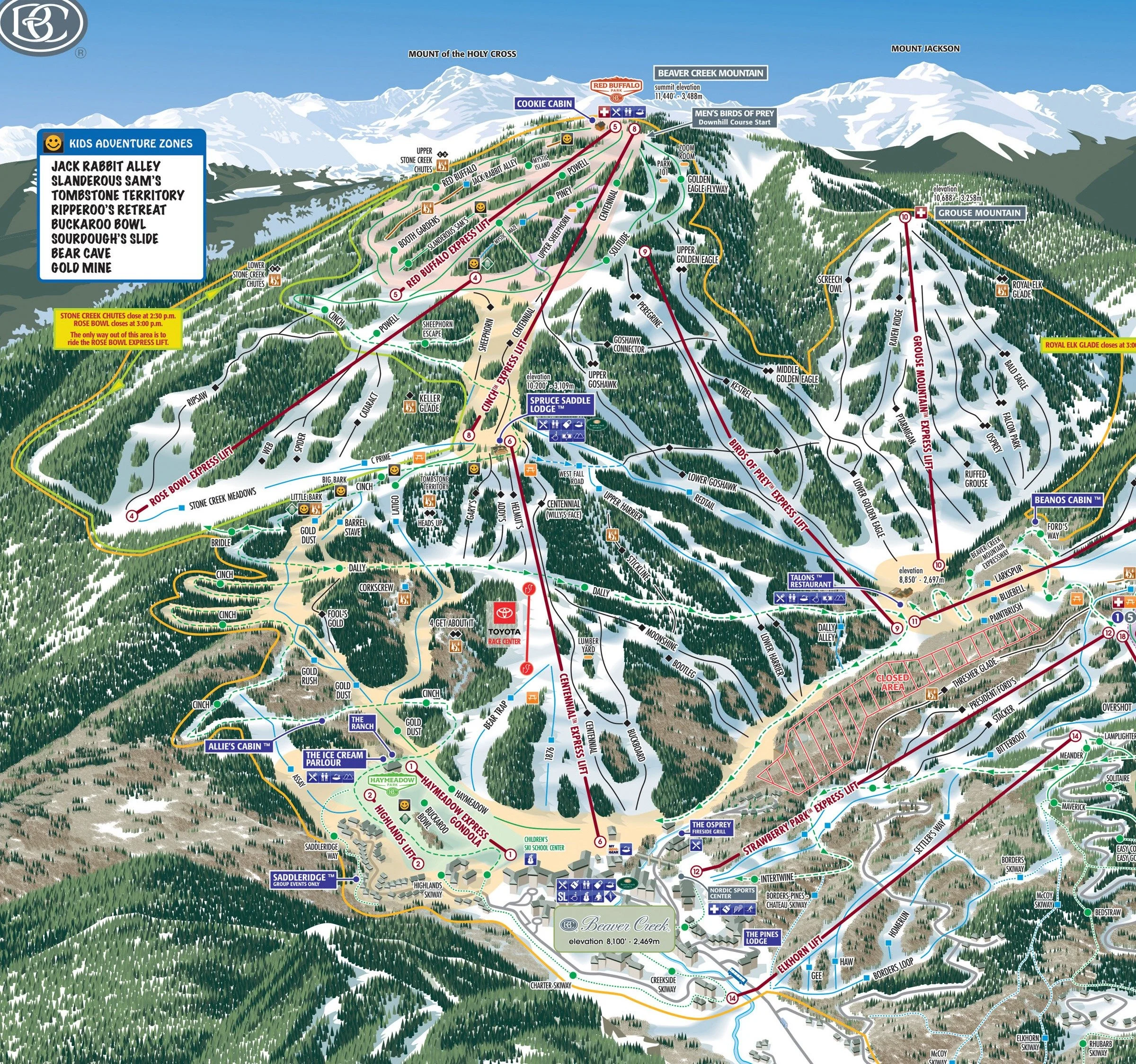
Depending on where you draw the boundary with neighboring Grouse Mountain, somewhere around seven or eight lifts serve this cluster alone, including Centennial, Cinch, Red Buffalo, Rose Bowl, Highlands, and Haymeadow. The loading station for the Strawberry Park Express is down in the village, but the top station is all the way over towards Bachelor Gulch, making it debatable which cluster “owns” that lift. We will cover it in both sections.
Because it's the resort's original core, Beaver Creek Mountain covers the widest range of terrain and difficulty of any single cluster. Near the village, gentle green runs make it an easy, low-stakes place for beginners and the ski school to get started. In fact, the Haymeadow Express is a short gondola intended to make it easy for new skiers to make it up the mountain without loading and unloading a chair lift. Entire ski school classes can also head up together with just one instructor, solving a common problem that many other resorts wrestle with. The resort labels this as “Haymeadow Park” on the trail map and you’ll notice the prevalence of learning skiers and “Slow Down” signs throughout this portion of the resort.
Located in the center of the village, Centennial Express is both the flagship lift of the resort and the primary route up to mid-mountain from the base. It is actually a “chondola” (gondola cabins interspersed among the six-pack chairs), which makes for a high-capacity lift and allows for the occasional non-skier to head to the mid-mountain restaurant (the Spruce Saddle Lodge) for events or just to grab lunch.
Once at mid-mountain, skiers have the choice of heading back to the base via a variety of trails, continuing on the Cinch Express to the summit, or branching off to the west, which puts you at the bottom of the Birds of Prey lift, Larkspur Express lift, or even back to the village and the Centennial Express. What you cannot get to directly is the Strawberry Park Express lift, despite what a quick glance at the tiny trail map attached to the lift safety bar might suggest.
Continuing up to the summit on the Cinch Express gives skiers of all abilities options. One of the best things about Beaver Creek is the variety of terrain you can access even from the highest point in the resort. For the beginner skier, Red Buffalo offers great, unobstructed views of the surrounding mountains. Truly breathtaking in the right conditions. This is the key trail in “Red Buffalo Park” — a designated beginner zone that is high atop the mountain, a bit of a rarity even among high-altitude Colorado resorts.
Also from the summit, skiers can choose to take the trail directly under Cinch Express named Centennial. Beaver Creek's longest run at 2.8 miles, Centennial offers a long, scenic cruise from summit to base that's hard to beat for pure distance. But be aware that what starts as an easy green at the summit eventually turns into a black diamond — although in our experience it is often groomed and very approachable even for intermediates.
There are options for experts as well, accessible from the summit. And at the upper edge of the cluster sits Birds of Prey, the resort's most famous run and one of the most respected downhill courses on the World Cup circuit, hosting the annual Stifel Birds of Prey race each December. For something even more serious, Rose Bowl's Stone Creek Chutes offer true expert terrain with tight lines, large cliffs and real consequences for those chasing it. Entry to the Chutes is gated, and the area closes early. It is best to tackle these in the morning if possible. Next to the Stone Creek Chutes is the Rose Bowl Express lift, which is a shorter, mid-mountain lift to get you partway back up the mountain. There are some additional black diamond trails accessible from the top of this lift. Once you're down in Stone Creek Chutes or Rose Bowl, the Rose Bowl Express lift is your only way back out — so budget your time accordingly, especially since the Chutes close as early as 2:30 p.m. and the remaining terrain in Rose Bowl typically closes at 3:00 p.m.
Given that range, Beaver Creek Mountain is realistically where many visitors will spend the bulk of a first trip. It has enough terrain across every ability level to justify a full day or more on its own, and it's the natural jumping-off point before venturing out to the resort's other clusters.
Grouse Mountain
The size and diversity of Beaver Creek Mountain go out the window as we move over to the next cluster on the map: Grouse Mountain. Grouse opened in 1991 during a decade of steady expansion after Beaver Creek's original debut. This cluster is served entirely by the Grouse Mountain Express lift and sits high on the mountain, just a bit lower than next-door neighbor Beaver Creek Mountain. We like to think that the master planners at Beaver Creek laid out Grouse as a direct response to charges that the original terrain was just too easy — every single trail on Grouse is a black or double-black diamond. This is steep, heavily gladed terrain that is typically left ungroomed. Looking up from the base of the lift or the nearby Talons restaurant, you will see steep fields of sizable moguls (and a few skiers attempting to navigate them…some successfully, but many not).
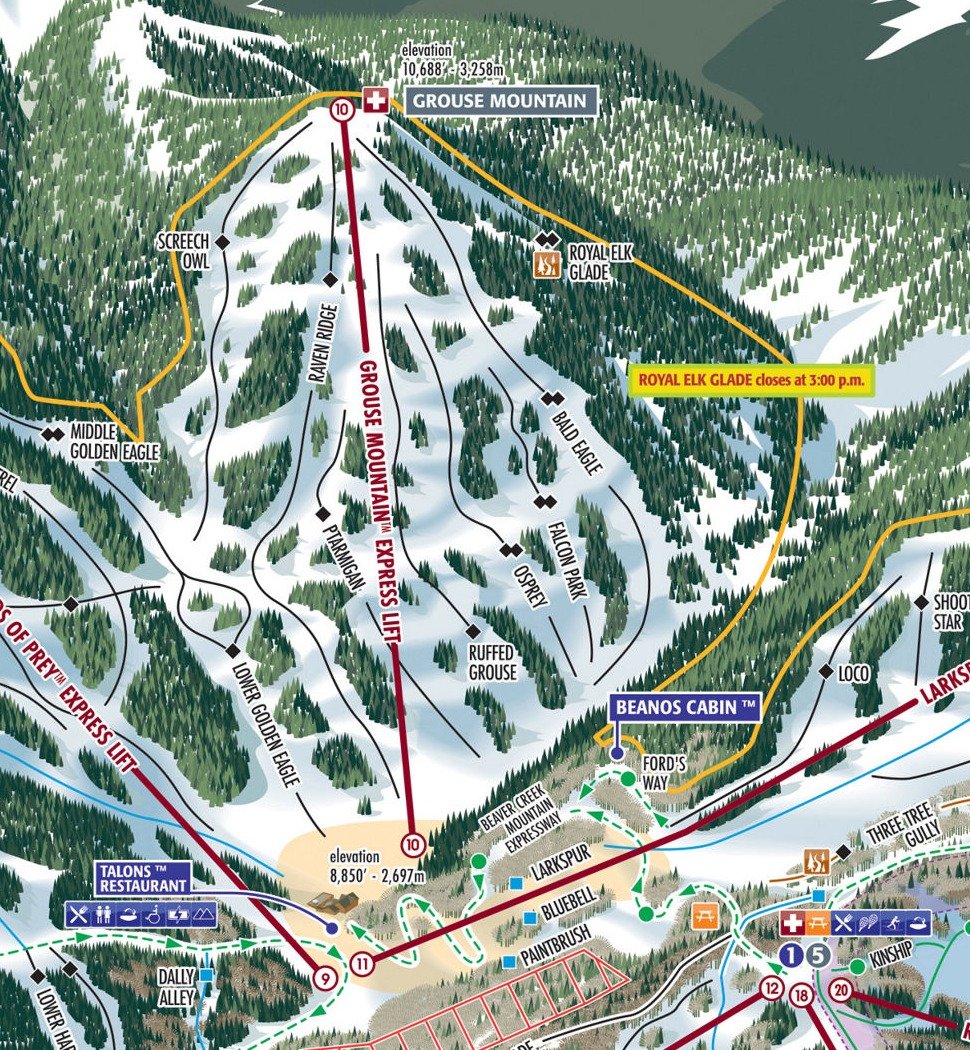
As you may imagine, such challenging terrain comes with another bonus — Grouse is often the least crowded cluster in the resort. The lack of terrain diversity naturally filters out much of the crowd. For the advanced, expert, or simply adventurous, though, it’s a major draw. On a powder day, this is considered the most rewarding pocket of the entire resort — the trails hold snow well and the low volume of skiers makes it feel like a “locals’ secret.”
The loading station of the Grouse Mountain Express lift is best reached by descending the Birds of Prey downhill course from the summit of Beaver Creek Mountain. Redtail, an intermediate trail, will also funnel you towards the bottom of the lift. It’s a little more complicated but you can also reach the lift from the Larkspur cluster if you make a short uphill climb from the Talons restaurant.
Once off the lift, take your pick of open and ungroomed fall-line trails Raven Ridge or Ruffed Grouse, or break off for some true glade skiing in the Royal Elk Glade. For those who can ski this terrain, you could spend an afternoon or an entire day just in this cluster and not get bored.
Grouse Mountain is a clear exception to Beaver Creek's overall reputation as a groomed, family-friendly mountain, and that's the point. If you're the confident expert in a mixed-ability group, this is where you'll want to peel off while the rest of your party sticks to the cruisers elsewhere.
Larkspur Bowl
Larkspur Bowl opened one season after Grouse Mountain, and it is back to the diversified terrain approach that Beaver Creek is more famous for. However, the cost of that approachability can sometimes be longer lines and waits at the chairlift — particularly in the afternoon as people leave the nearby Talons restaurant and drop right down to the lift station.
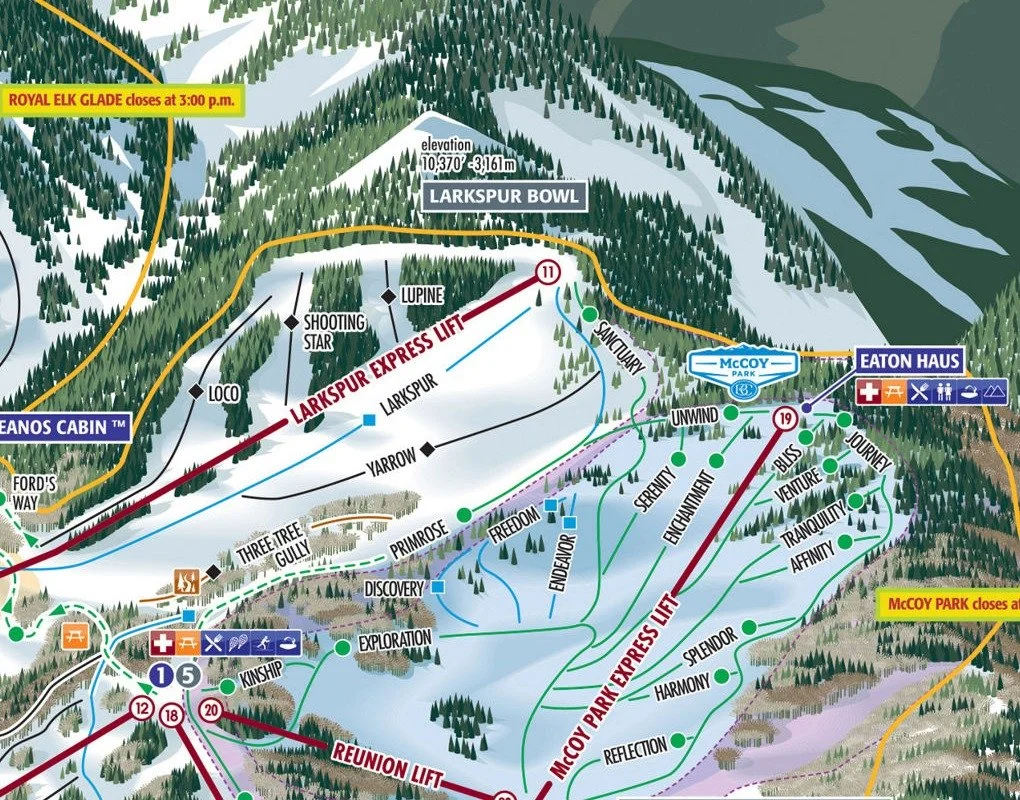
Like Grouse, Larkspur is served by just one lift: the Larkspur Express. And the trail map shows just a handful of marked trails, which gives the impression that Larkspur Bowl is smaller than it skis in real life. The lines on the trail map are just suggestions when you are bowl skiing — feel free to choose the line that best suits you. The wide open portion (labeled as Larkspur) is generally intermediate terrain down the middle, with advanced terrain on either side. Towards the bottom of the bowl, though, there are tree groupings and signposts that naturally guide you toward a set of three intermediate trails (Paintbrush, Bluebell, and the continuation of Larkspur itself) that will get you down to the base of the lift for another lap.
For beginners, Primrose is the one green trail higher in the bowl — it eventually intersects with the Beaver Creek Mountain Expressway (a narrow cat track), which carries you the rest of the way down to the lift. If you continue on Primrose, it will take you out of this cluster and over to Bachelor Gulch.
So from top to bottom you have beginner, intermediate and expert terrain. That range is what makes Larkspur Bowl worth calling out specifically: it's one of the few clusters at Beaver Creek where a mixed-ability group could plausibly ski together for a full session. No need to split up and try to reconvene for lunch.
The Larkspur Express is one of the more centrally located lifts in the resort, accessible from the Beaver Creek Mountain cluster (via Birds of Prey, Redtail or even Dally for beginners), the Grouse Mountain cluster (all trails; just ski past Talons), the Bachelor Gulch cluster via the Beaver Creek Mountain Expressway cat track, and McCoy Park via the top of Reunion Lift and then Beaver Creek Mountain Expressway.
Bachelor Gulch
Bachelor Gulch is the newest of the original three villages, having been developed between 1995 and 1997. In addition to expanding the terrain considerably, it had the added benefit of providing a link between Beaver Creek Mountain and the recently acquired Arrowhead. But it also cemented the Beaver Creek positioning as an upscale and exclusive property. Bachelor Gulch is arguably the most exclusive-feeling corner of this already exclusive resort. The Ritz-Carlton, Bachelor Gulch anchors the village and sets the tone. If you decide to stop in for lunch, don’t expect chicken tenders and pizza slices. The food is excellent, but you won’t be filling up a buffet tray here; this is a sit-down restaurant.
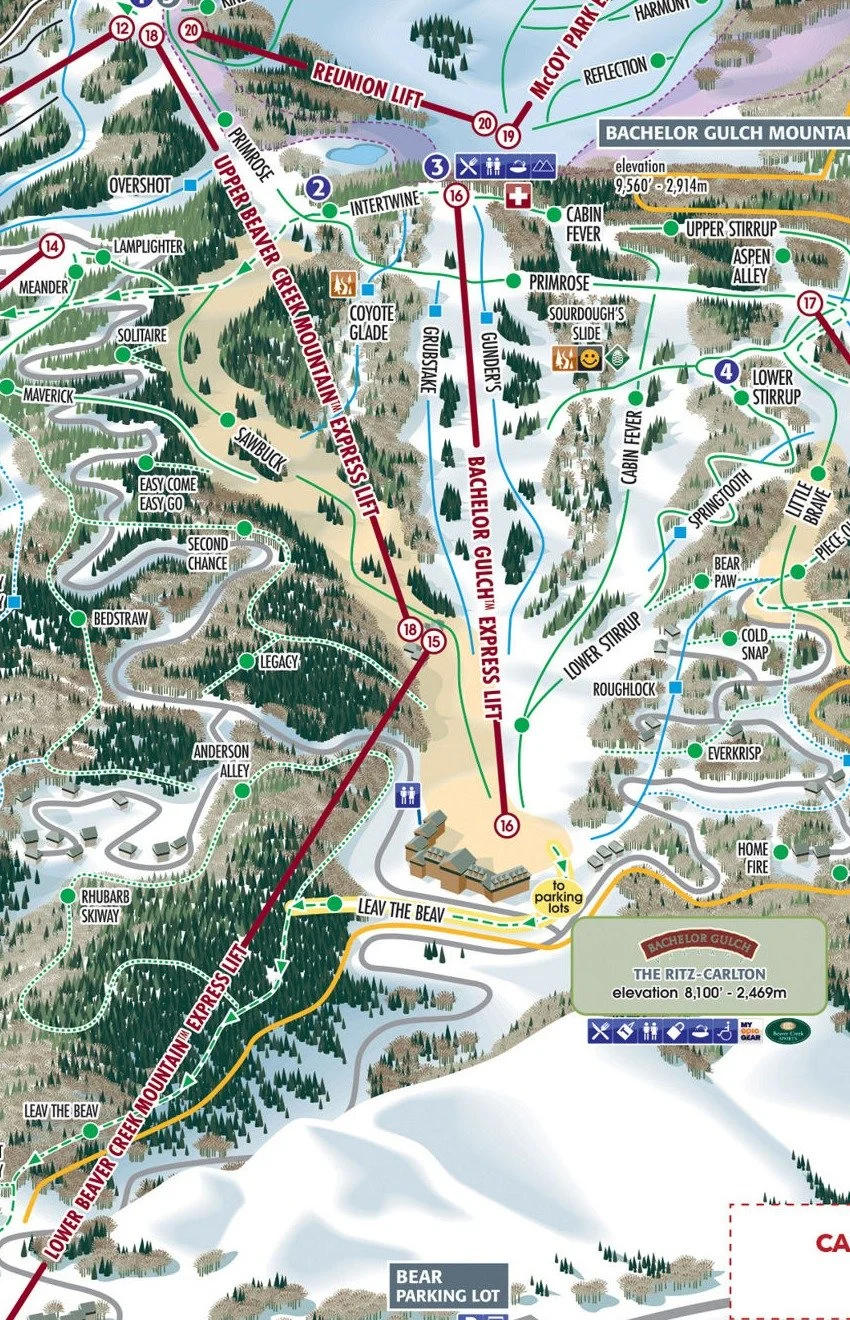
But don't let the atmosphere and clientele of the Ritz-Carlton dissuade you from spending some time in this cluster — the Bachelor Gulch Express lift itself is open to any Beaver Creek guest, no different from any other lift on the mountain. You don't need to be staying nearby to ride it or ski the terrain, and the snow is no different here than in the other villages.
The terrain around the village itself tends to be a little bit open and cruiser-friendly, with green runs like Sawbuck and Cabin Fever offering easy, scenic descents well suited to families and beginners, with some steeper and narrower intermediate terrain through the middle — including some glade skiing rated for intermediates. There are no expert-rated trails directly off the Bachelor Gulch Express lift — it's not where you'll find Beaver Creek's most challenging skiing, but that's not really the point of Bachelor Gulch.
For the purposes of this guide, we are considering the Bachelor Gulch cluster to include much more than just what’s available from the Bachelor Gulch Express lift. To the reader’s left on the trail map, there are several other lifts: both segments of the Beaver Creek Mountain Express, the Elkhorn lift and then finally the Strawberry Park Express. You may remember from the Beaver Creek Mountain cluster breakdown that the bottom station of the Strawberry Park Express could arguably be considered as part of that cluster — but the top station is squarely in what we are considering the Bachelor Gulch cluster. So this cluster — Bachelor Gulch — includes everything between the Strawberry Park Express lift and the Arrowhead cluster — it’s large.
Immediately to the left of the Bachelor Gulch Express lift are a pair of lifts that make up the Beaver Creek Mountain Express (there is a Lower lift and an Upper). These are primarily “transit” lifts, in that the primary purpose is to take skiers from one place in the resort to another place where they will likely load onto another lift before skiing. There are a few trails that one may take off of either segment of this lift, but they are designed for people moving, not lapping. The Lower Beaver Creek Mountain Express is intended to get people from lower down on the mountain up to the Bachelor Gulch village area or to get them to continue on to the next segment which will take them to the top of the Strawberry Park Express. From there they can move on to the Strawberry Park Express trails, Larkspur or even McCoy Park.
In between the Beaver Creek Mountain Express lifts and the Strawberry Park lift is the Elkhorn Lift. This lift is almost entirely intended to bring residents and guests of the condos and housing in this section of the main village up to the trails. There are actually two loading stations — one on either side of a major road — so skiers from either side can be loaded. The trail network around this lift appears to be extensive, but in our experience it primarily serves residents and guests of the on-mountain housing looking to get back to their lodging in the afternoon. We have seen signs indicating “Owners only beyond this point” at the tops of some of these trails. Skiers who use this lift typically offload first thing in the morning and don’t return until they are finished with their day. From the top of this lift, skiers can head towards Strawberry Park Express or to the Bachelor Gulch area.
And finally, we are considering the Strawberry Park Express lift and its accompanying trails as part of this cluster. As a primary route to get to the base and village of Beaver Creek Mountain, this section of the resort tends to get a bit more crowded especially in the afternoons. However, it’s got a nice little set of terrain with a few surprises mixed in. President Ford’s and Stacker are sizable black diamonds to contend with, and there is a lengthy section of gladed terrain here called Thresher Glade (also a black diamond). Bitterroot is a long blue groomer that you can take from top to bottom and get a nice little leg workout in.
At the bottom of Strawberry Park Express, you can take the snow bridge over to the main village if you wish. This is also the access point for several of the Beaver Creek resort’s “skiways” — narrow trails that put the “ski-in” into “ski-in/ski-out” for many guests staying in the village.
The bottom line is this: even if you're not staying near Bachelor Gulch, take a detour one day to check it out. The Ritz-Carlton makes a memorable lunch or après stop, and passing through gives you a taste of just how far Beaver Creek is willing to embrace its "not exactly roughing it" identity. The surrounding terrain is considerable and varied, and worth the effort of navigating the various lifts to get to where you want to go.
Arrowhead Mountain
Arrowhead has the most interesting backstory of any cluster at Beaver Creek, because it wasn't originally part of the resort at all — it was its own independent ski area until Vail Associates purchased it in 1993. A few years later, Beaver Creek connected it to the other existing clusters with the addition of the Bachelor Gulch cluster, giving us the bulk of the terrain that exists today. Arrowhead is the westernmost part of the resort, and farthest right on the trail map.
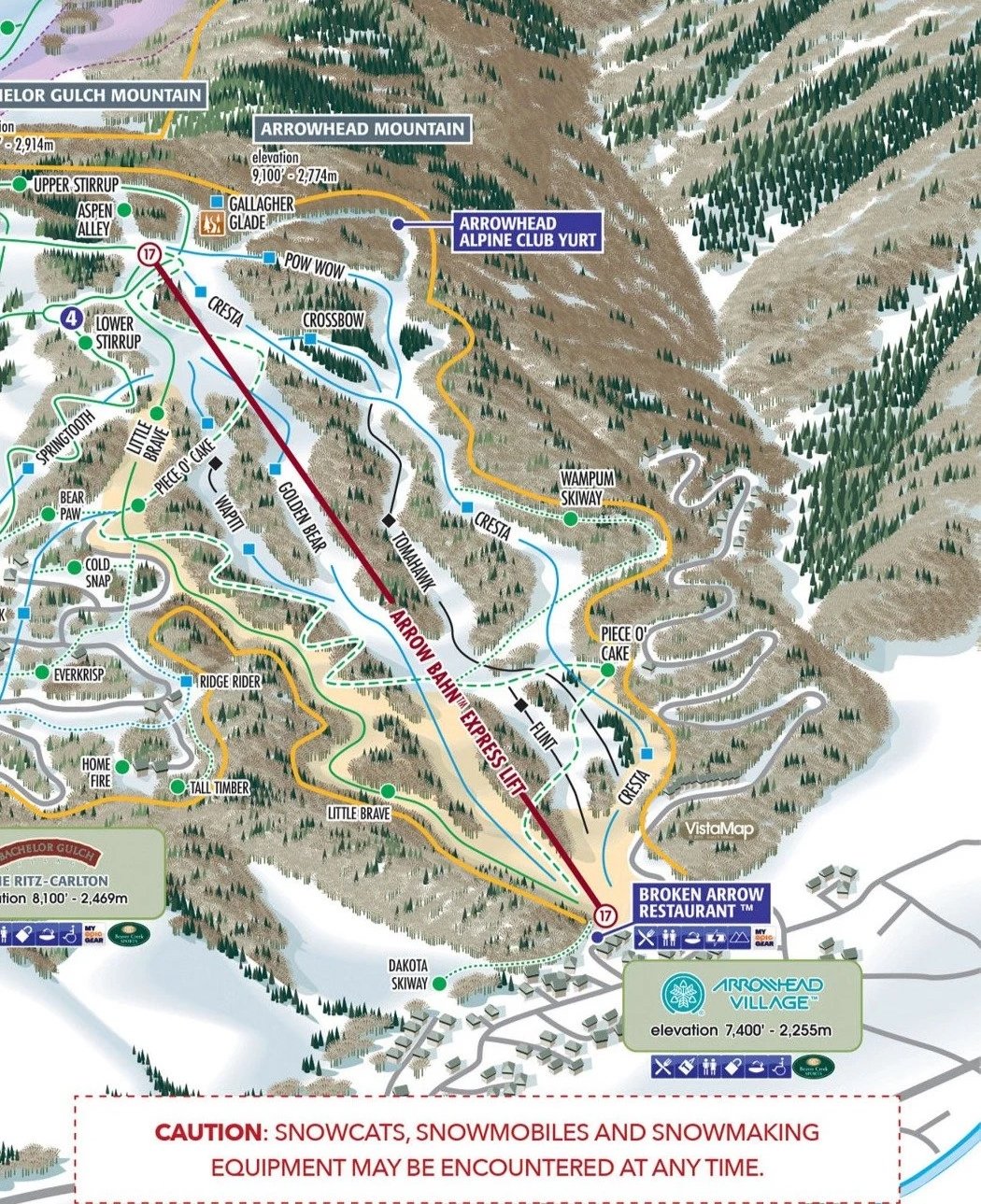
Arrowhead has a specific visual identity that is notable as you make your way over to this terrain. Its welcome sign, lift terminal, and even the trail directional signs all share a distinctive teal color scheme and a completely different font. It's a small detail, but a consistent one — you can tell you've crossed into Arrowhead before you even check the trail map. The geographic distance adds to this — you truly feel like you’ve moved to a different resort. The atmosphere here is quieter too — less foot traffic, a more laid-back village feel than Beaver Creek's main base area. If you're staying in Arrowhead itself, or simply want a calmer home base within a resort that's already relatively uncrowded to begin with, this cluster delivers.
Served by the Arrow Bahn Express, the terrain is largely gentle and approachable, with runs like Piece O' Cake and Little Brave offering easy, confidence-building beginner skiing. For intermediates, Golden Bear and Cresta are medium-length groomers that can be lapped all day long. While there is one expert-rated trail (Tomahawk), this hardly compares to the high-alpine blacks and double-blacks in other clusters at Beaver Creek, so don’t make a special trip just to experience that one.
Overall, we consider Arrowhead to be one of our favorite little areas of the resort. Beginner and intermediate skiers should make the trip over at least once. Between the lack of crowds and the unique vibe, Arrowhead can feel like a different resort entirely.
However, be aware that Arrowhead sits at the lowest base elevation in the resort, 7,400 feet. This brings with it tradeoffs: it's a nice option for guests still adjusting to altitude, but snow quality can soften faster here on warmer days than it does higher up the mountain. It can also mean that this terrain opens a bit later than some of the higher-elevation terrain. In the snow-challenged 2025–26 ski season, most of Arrowhead was still closed when we visited in the last week of January, but a small storm was enough to significantly expand the terrain. Good information to know if you plan to travel to Beaver Creek early in the season, particularly if you decide on lodging situated near the Arrowhead base.
For those staying at the Arrowhead base, accessing the terrain in this cluster is simple enough — just load into the Arrow Bahn Express and get your turns in. But for those coming from other clusters, the only option is to make your way to the top of Bachelor Gulch and take Cabin Fever/Upper Stirrup or Primrose over to the top of the Arrowhead cluster. There is plenty of signage pointing you that way should you choose to make the journey.
McCoy Park
McCoy Park is Beaver Creek’s newest addition, opening in 2022 as a 250-acre expansion with 17 trails and two lifts. Those 17 marked trails are really just suggestions. Much of McCoy Park skis more like an open bowl than a network of intentionally cut runs.
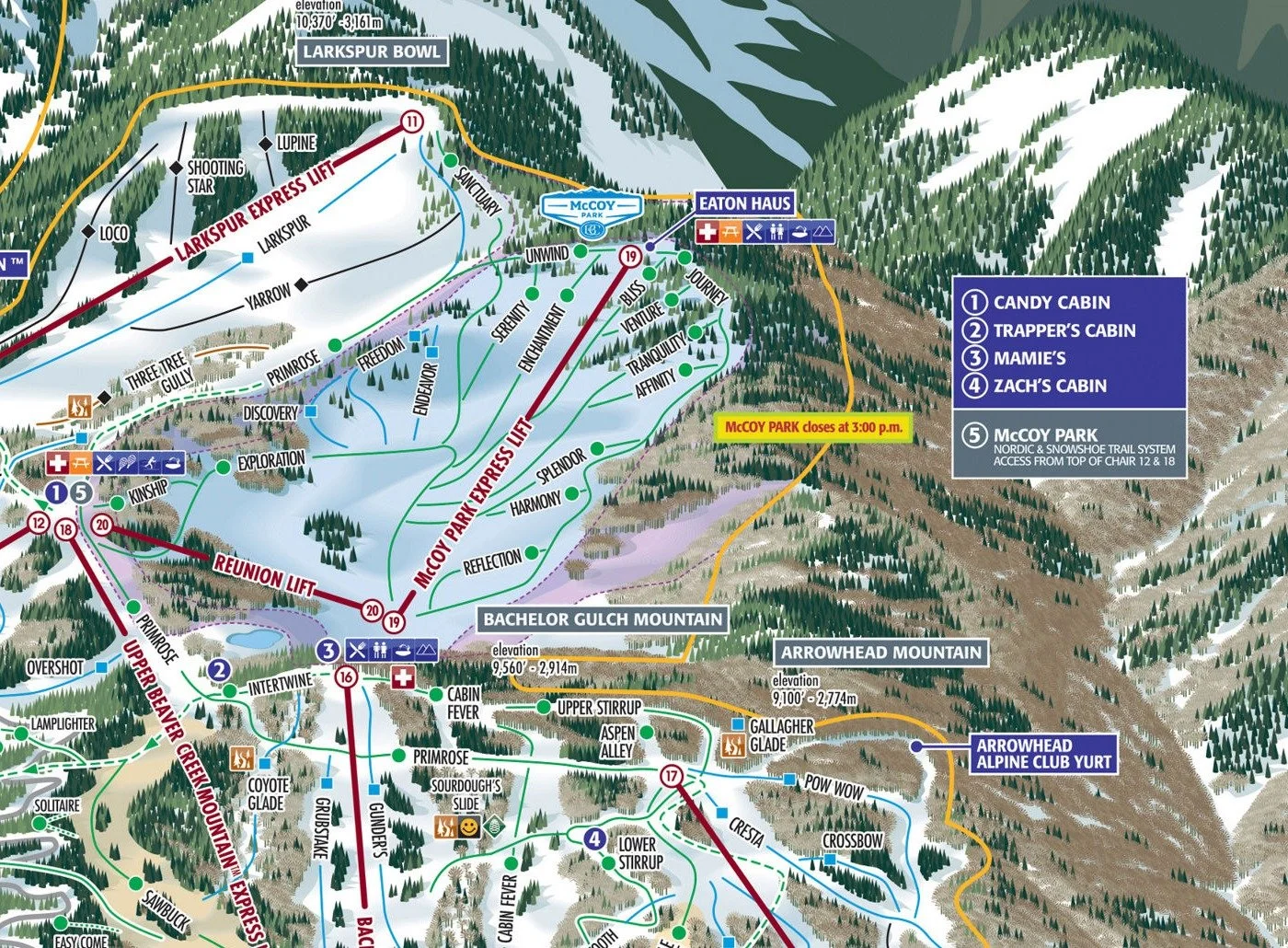
Unlike the resort's other clusters, McCoy Park sits somewhat physically apart from the frontside of the mountain, perched atop a ridge on the opposite corner of the resort boundary from the main village. It is also threaded by Beaver Creek’s longstanding Nordic and snowshoe trail network, which predates the alpine expansion by decades and continues to share the ridge with the newer downhill terrain.
On the trail map, you may notice that McCoy Park has its own designated branding — similar to Red Buffalo Park or Haymeadow Park in the Beaver Creek Mountain cluster. This makes it clear Beaver Creek considers this entire cluster one of its learning parks. The downhill terrain here is intentionally, almost entirely, beginner and family-focused. These are wide, gentle trails designed for building confidence. It's a direct extension of everything we've already said about who Beaver Creek is built for: families with young or beginning skiers get a spacious, dedicated space of their own instead of being squeezed onto whatever beginner terrain happened to be left over near the base.
If you're bringing a confident beginner or a lower-intermediate along on this trip, McCoy Park may be a spot they circle on the map to make sure they check out — and it's a strong argument, on its own, for why Beaver Creek keeps earning its family-resort reputation. We have found that McCoy Park really only works for two types of groups: a homogeneous group of “experienced beginners” or a mixed group that includes one or more experienced beginners who really want to try some bowl skiing. We use the term “experienced beginners” because the journey to get to McCoy Park requires taking at least one lengthy chairlift ride even by the shortest route, and potentially several more for those staying farther from the main village. McCoy Park’s terrain is very gentle, but it’s remote enough to make it impractical for a first-time skier.
For intermediate or advanced skiers, your visit may only last for a few laps. There are some widely spaced trees at the top that can be fun to run in and out of, and there is some intermediate terrain to check out. But all the lines in the park level out considerably as you get towards the bottom of the bowl, and that can get a bit tedious if you are trying to get your adrenaline up. That said, if you have a mixed group and want to stick together, there are worse ways to spend an afternoon than enjoying some wide-open bowl skiing.
Navigation-wise, McCoy Park has been the one area of Beaver Creek where we've struggled to get our bearings a bit. On our initial trip we had trouble both getting in and finding our way back out. On our second trip, we had to piece together our memories from the first trip. Part of the blame belongs to the way the trail map designer has to represent three-dimensional mountain geography on a flat, two-dimensional map — it's not always obvious how the different clusters connect in real life. It helps to understand how the two lifts at the bottom of the McCoy Park bowl actually function, because they serve opposite purposes. McCoy Park Express and Reunion load out of the same small bowl, right next to each other, which makes it natural to assume they're interchangeable ways in and out. They aren't. Think of it this way: McCoy Park Express is really only used to stay in McCoy Park. Reunion is how you leave — the name itself is a fitting clue, in hindsight, since it's reuniting you with the rest of the resort.
If you do load Reunion by mistake, you're not entirely out of luck — two trails off its top, Exploration and Kinship, will bring you back down into the McCoy Park bowl. Those same two trails are also the way into McCoy Park if you're arriving from the top of the Upper Beaver Creek Mountain Express or Strawberry Park Express. Either way, once you're in the bowl and want to keep skiing McCoy Park rather than heading back out, McCoy Park Express is the lift to load — not Reunion. Keep that distinction in mind and you'll save yourself the confusion that cost us more than one lap in the wrong direction.
If you're heading to McCoy Park, the reliable way in is via Strawberry Park Express or Upper Beaver Creek Mountain Express, skiing across to the park and dropping in from Exploration or Kinship. If you arrive from the Larkspur cluster, you can ski around the rim of the bowl, choose your entry point and drop down. To do some laps and explore a bit more, you’ll want to load the McCoy Park Express.
Terrain by Ability Level
We've already covered each of Beaver Creek's six clusters in detail, noting where certain types of terrain are concentrated. Instead, this section steps back and looks at the bigger picture: how much terrain exists at each ability level, what it's actually like to ski, and where to point yourself first.
Of Beaver Creek's 167 trails, roughly 28% are rated beginner, 38% intermediate, and 34% expert. On paper, that's a fairly standard spread for a major Colorado resort. What makes Beaver Creek different is less about the raw numbers and more about how each ability level has dedicated terrain in multiple parts of the resort. Beginner terrain here is not an afterthought squeezed in near the base.
One thing to note: measured by trail length instead of trail count, Beaver Creek skews a bit more intermediate/expert — a reminder that a resort's beginner trails tend to be shorter on average, so a trail-count breakdown alone doesn't always tell the full story.
Beginner Terrain
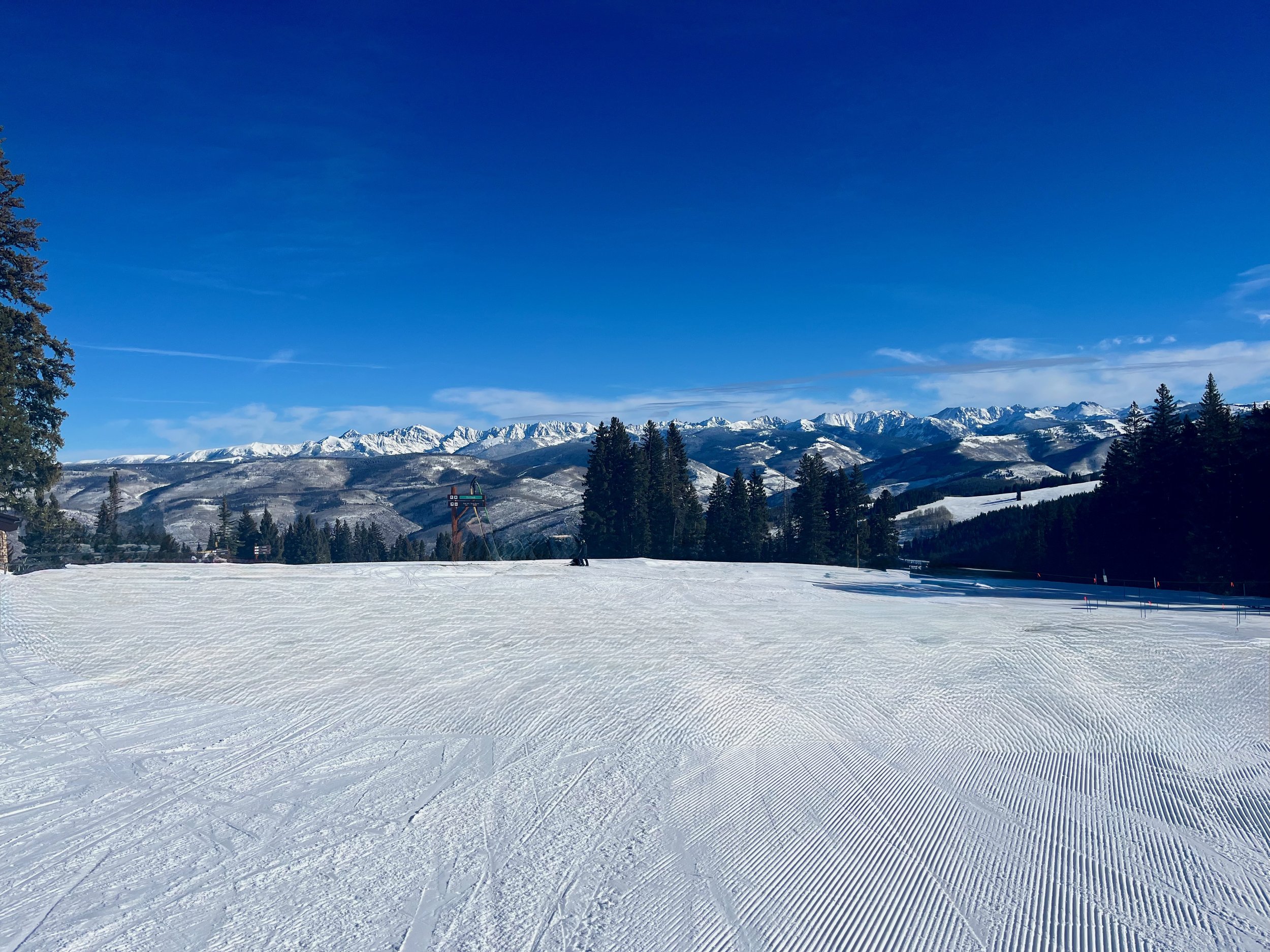
Beaver Creek even offers gentle beginner terrain accessible directly from the summit of Beaver Creek Mountain.
Beaver Creek takes beginner terrain more seriously than almost any resort we've visited, and it shows in the sheer number of purpose-built learning zones scattered across the mountain. Haymeadow Park sits right at the base, an easy, low-stakes place for a first-ever run — and it's served by the Haymeadow Express, which is actually a gondola (not a chairlift), a somewhat unique choice for beginner terrain that lets brand-new skiers get up the mountain without the added anxiety that comes with loading and unloading a moving chair. Red Buffalo Park does something rarer still: it puts easy, wide-open beginner terrain at the very summit of the mountain, with some of the best views in the resort, instead of making new skiers stick to the bottom third of the hill. And McCoy Park, tucked away on its own ridge, offers an entire bowl of gentle, wide-open terrain that feels more like its own resort than a corner of one.
The tradeoff, as we covered in our cluster breakdowns, is that some of this terrain takes some effort to reach — McCoy Park in particular is best suited to a confident beginner rather than someone on their first day. But for families and new skiers willing to venture a little farther, Beaver Creek offers more dedicated beginner space, at more points on the mountain, than most resorts its size.
For families, Beaver Creek also designates a set of Kids Adventure Zones throughout its terrain — specific trails built with banked turns, glades, and other playful features designed to keep young or new skiers engaged. Jack Rabbit Alley is one well-known example, a green-rated run winding through the trees with enough twists to feel like an adventure without ever feeling risky.
Intermediate Terrain
This is where Beaver Creek's reputation as a cruiser's mountain is earned. The resort's signature intermediate terrain is concentrated on Beaver Creek Mountain itself and throughout Larkspur Bowl — mile after mile of wide, consistently groomed corduroy that rewards long, confident turns. If your group is largely intermediate, you could realistically spend an entire trip lapping these two clusters alone and never feel like you'd exhausted the terrain.
Bachelor Gulch adds a different flavor of intermediate skiing: still approachable, but with some steeper, narrower stretches and a bit of glade terrain mixed in for those who want slightly more texture without stepping up to expert-rated trails.
Advanced and Expert Terrain
Advanced and Expert skiing at Beaver Creek certainly exists, but it's a bit more concentrated than we’ve seen at other resorts — and knowing where to look matters more for experts than for almost any other ability level. Grouse Mountain is the headline: every trail on the entire cluster is black or double-black, ungroomed, and often lightly trafficked even on a busy day. If steep, natural, mogul-heavy terrain is what you're after, this is the one cluster at Beaver Creek built entirely around it.
Beyond Grouse, the summit of Beaver Creek Mountain holds the resort's other serious terrain: Birds of Prey, the World Cup downhill course, and Rose Bowl's Stone Creek Chutes, which offer tight lines, large cliffs, and potential consequences for those chasing them. Entry to the Chutes is gated and the area closes early in the day, so tackle this terrain in the morning if it's on your list.
That said, be honest with yourself about what "expert terrain" means here before you build a trip around it. True double-black diamond terrain is limited, and while Stone Creek Chutes delivers actual cliffs and technical lines, it's still lift-accessed. There is no designated hike-to terrain at Beaver Creek. And there is little room to cut your own line through trees or over cliff bands the way you can at some neighboring resorts with more expansive sidecountry or backcountry-light zones. Beaver Creek's expert terrain feels more controlled, managed, and — for lack of a better word — sanitized compared to resorts built around expert skiing. It is entirely lift-served and offers less of the exploratory feel than you may find at other large resorts out west. It's an enjoyable challenge, but it's not the mountain's identity, and serious experts often pass on Beaver Creek for this reason alone.
Getting to the Mountain
Once you’ve made it to Avon/Beaver Creek — whether by rental car, shuttle, or public transit — actually getting yourself to the lifts is refreshingly simple, especially compared to the parking scrums at some larger resorts. But there are a few different options depending on whether you’re staying on-site, driving in for a day trip, staying nearby in Avon, or just stopping by for dinner.
If You’re Staying On-Site
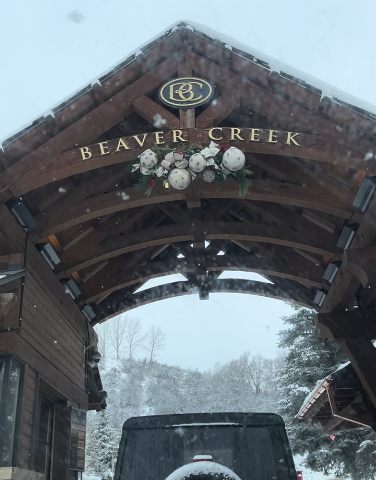
Beaver Creek Welcome Center Entrance
If your lodging is inside Beaver Creek, Bachelor Gulch, or Arrowhead, you likely won’t be dealing with parking or driving to the mountain at all. Between ski-in/ski-out lodging, Village Connect, and the resort’s walkable base areas (covered in our Do You Need a Rental Car section), most on-site guests simply walk or catch a quick shuttle to the nearest lift each morning.
Keep in mind that Village Connect does not run a regular route, is on-demand, and is very often "point-to-point" — meaning you can get picked up in front of your lodging and the driver will often take you straight to your destination. With this being so easy, you don't have to go to the "nearest lift" at all. If you are staying at Arrowhead and want to spend your day at Beaver Creek Mountain, just put in "Centennial" for the destination, hop on the shuttle when it arrives, and voilà.
If You’re Driving In for the Day
A quick note before we get into specifics: everything in this section comes from research, not firsthand experience — we’ve only ever stayed as overnight guests at Beaver Creek, so we’ve never actually parked and skied as a day visitor ourselves.
That said, Beaver Creek does offer legitimate day-visitor parking, even if it doesn’t always feel that way at first glance. There’s no single, obvious surface lot right at the main village the way you’ll find at some resorts — instead, your parking choice actually determines which part of the mountain you’ll start your day on.
Ford Hall and Villa Montane garages — covered, heated parking right in Beaver Creek Village, just steps from the Centennial Express and several other lifts. These are typically open to any visitor, not just lodging guests, but the convenience comes at a cost: rates climb the longer you stay, particularly if you arrive before mid-afternoon.
Elk and Bear lots — lower-cost day parking at the base of Beaver Creek. During the 2025–26 winter season, parking was $13 before 1:00 p.m. and free afterward. Pricing subject to change. Complimentary shuttles run regularly from both lots to the Covered Bridge in Beaver Creek Village, so there is no need to walk uphill with your gear. We have seen comments that there is a “quick shuttle” to the bottom of Lower Beaver Creek Mountain Express lift but this is not noted on the Beaver Creek website, so do not consider this a confirmed option for you.
The village garages typically offer a few free hours in the late afternoon, which makes them a solid option if you’re just driving in for dinner or après and not a full ski day. Check the Beaver Creek website for current pricing if you plan to use a garage.
Beaver Creek is also home to an unusual feature for a ski resort when it comes to getting up to the base: a heated, covered escalator connecting the village garages directly to the village and lifts. We can’t think of another North American resort where we have seen one. It’s a small thing, but it fits the resort’s whole “minimal hassle” ethos perfectly. But by that token, it is also something that can turn off many grizzled “earn your turns”-type ski veterans who think resorts like Beaver Creek are making things too easy for people.
Beaver Creek Landing and Staying in Avon
Beaver Creek Landing — home to the Riverfront Express gondola, the Reception Center, and the base of the Lower Beaver Creek Mountain Express — sits on Beaver Creek’s side of the Eagle River.
The Westin Riverfront Resort & Spa and the surrounding Riverfront Village sit just across the Eagle River in Avon, connected to Beaver Creek Landing by the Riverfront Express — a free, publicly accessible gondola. The gondola is jointly operated by the Town of Avon and the Westin. In about three minutes, it carries guests over the river and up to the Landing, putting them right next to the Lower Beaver Creek Mountain Express lift — from there, you can continue up to Strawberry Park via the Upper Beaver Creek Mountain Express, or ski down into the village on Bitterroot or one of the black diamonds we covered in our Bachelor Gulch section.
It's not quite ski-in/ski-out in the traditional sense — you won't be clicking into your skis right outside your room — but it's about as close as you can get while staying in Avon proper, and typically more affordable than comparable lodging inside the resort boundary. As with any other lift, the opening and closing of this gondola is weather-dependent and there is no guarantee it will be running for your trip — particularly in the early or late season.
The Westin Riverfront lands in a pretty appealing spot between price and convenience. It is not quite the walk-everywhere convenience of Beaver Creek Village or Bachelor Gulch, but certainly more direct than a standard Avon hotel relying on the shuttle system alone. And rates are reportedly a bit more affordable than at the hotels in Beaver Creek Village or the Ritz-Carlton.
Arrowhead and Bachelor Gulch
Travelers report that limited skier parking may sometimes be available at Arrowhead, occasionally without charge. Because Beaver Creek does not advertise this as an official parking option, confirm current access before relying on it.
Bachelor Gulch, by contrast, doesn't offer public parking — the lot there is reserved for residents and guests staying in that village, including the Ritz-Carlton. That doesn't mean the terrain itself is off-limits, though: the Bachelor Gulch Express lift is open to any Beaver Creek guest with a valid lift ticket, the same as any other lift on the mountain. You just can't drive there and park directly — you'll need to ski in from Beaver Creek Village or Arrowhead using the routes we described in the Bachelor Gulch cluster section.
Where to Gear Up
One thing that surprises some first-time visitors: Beaver Creek doesn’t have a single, central base lodge the way some resorts do — there’s no one obvious building where everyone boots up together before heading to the lifts. Instead, gearing up here is a little more decentralized, spread across rental shops and small locker areas throughout the village.
If you’re renting gear, this actually works in your favor: many Beaver Creek rental shops offer complimentary overnight storage with your rental, so you can pick up your skis the afternoon before your first day, get properly fitted without the morning rush, and have your gear waiting at the base each subsequent morning — no hauling boots back to your hotel room every night.
If you brought your own gear, day lockers are available near the Main Ticket Office and Slopeside Lounge, in the hallway leading into the Ford Hall Parking Garage — self-service, credit card only, open 8:00 a.m. to 5:00 p.m. For something more full-service, the Slopeside Lounge offers heated lockers, boot dryers, and a ski/snowboard valet at the base of Centennial Express, complete with coffee and a 3:00 p.m. cookie service, though it comes at a premium and typically requires a reservation.
Realistically, though, plenty of guests — especially day visitors or anyone staying off-property without a locker plan — end up doing at least some of their boot-changing at the car. It’s not glamorous, but it will likely get you on the slopes the quickest.
On-Mountain Amenities
If you're going to position your ski resort as upscale, exclusive and low effort — you’d better have the amenities to deliver that experience. And Beaver Creek does. In fact, we think the resort's focus on providing and marketing these amenities has led many skiers to conclude that you don't go to Beaver Creek to actually ski — you only go to be pampered.

While we don't share that perspective, we can't deny that Beaver Creek makes it pretty easy to take it easy. The resort doesn't just tolerate breaks from skiing — it makes them so inviting it's hard to say no. The most famous example is Cookie Time: warm, fresh-baked chocolate chip cookies handed out free daily at 3:00 p.m. at the base of Centennial Express and partway up the escalator. It's become something of a signature move for the resort, and it's a good shorthand for the whole Beaver Creek philosophy — a small, unnecessary touch of hospitality that costs the resort very little but sticks with guests for years. And the resort really plays up Cookie Time in its marketing campaigns. If your timing doesn't line up with the free 3:00 p.m. handout, the Cookie Cabin at the top of Cinch Express sells the same fresh-baked cookies throughout the day — a good option if you're up on the mountain and craving one outside the usual window.
When it comes to your lunch or snack break while you’re on the mountain, Beaver Creek has several options, although it should not be a surprise to you at this point that the prices don't exactly make for a cheap midday refuel. Even the candy bars and chips are overpriced — but the resort does have a reputation to uphold. Mid-mountain in the Beaver Creek Mountain cluster, the Spruce Saddle Lodge gives skiers an expansive, multi-level cafeteria-style option with a fantastic view. There are multiple stations comprised of just about what you would expect from a Rocky Mountain resort — chili, soups, salads, pizza, mac n' cheese, burgers, chicken, fries, etc. There are typically some more upscale or limited-time menu options as well if you want a break from the norm. We've found it to be a great option when you're skiing this main mountain area, and typically not so crowded that it's impossible to find a seat, even though it's right at a central location in one of the busiest areas of the resort.
Just over at the bottom of Birds of Prey — where Grouse Mountain and Larkspur also funnel to — is the Talons restaurant. Despite their marketing as “Modern Southwest Cuisine” — we have found that it has a similar menu to Spruce Saddle. There is no reason to make a special trip to eat here. It also feels smaller and more crowded, in our experience. However, its central location means it is often the most convenient option for anyone not skiing at the Beaver Creek Mountain cluster.
Arrowhead has its own dedicated on-mountain spot with a distinct personality instead of being a Spruce Saddle clone. At the base of Arrow Bahn Express, Broken Arrow leans casual and local, with a full bar and both indoor and heated outdoor patio seating — though the patio is by far the bigger and more comfortable of the two, with the indoor space tending to fill up fast on cold days. It fits Arrowhead's generally laid-back, less-crowded vibe well.
And down at the base of Strawberry Park Express, the Osprey Fireside Grill offers a step up from standard cafeteria fare — artisan sandwiches, wraps, house-smoked wings, and craft cocktails. Up at the top of Bachelor Gulch Express, Mamie's rounds things out with a Colorado-inspired beer garden feel — bratwurst, pretzels, and craft beer on a sunny deck with views out over McCoy Park.
For something sweeter, the Ice Cream Parlour sits at the top of the Haymeadow Express gondola — root beer floats, ice cream by the scoop, grilled cheese, and tomato soup. They have even added “boozy shakes” in recent years. Due to the location at the top of the gondola, even nonskiers can take an easy ride for a scoop. The Candy Cabin is an old-fashioned candy shop perched at the top of the Strawberry Park Express Lift, overlooking McCoy Park. The cabin is at the junction with Strawberry Park Express, Reunion and Upper Beaver Creek Mountain Express lifts — a convenient stop for kids to scoop up a week's worth of sugar before burning it all off on the slopes.
Beaver Creek also offers a handful of unique fine-dining experiences reachable only by sleigh in the evening — Beano's, Allie's, and Zach's Cabin among them. We cover these in more detail in our Dining and Après-Ski section.
Beyond skiing itself, the resort offers a broad slate of on-mountain activities including a full Nordic system with more than 20 miles of groomed cross-country and snowshoe trails threading through McCoy Park.
Base Village and Town
Beaver Creek Village anchors the Beaver Creek Mountain cluster and is the primary commercial area of the resort. It sits at around 8,100 feet, right at the base of the mountain and, like everything else at Beaver Creek, was specifically designed to support the ski resort. This is not an old mining town that now supports winter sports (such as Park City) or even a modest ski resort base area that slowly expanded. Everything you see is part of a master plan and development is tightly controlled.
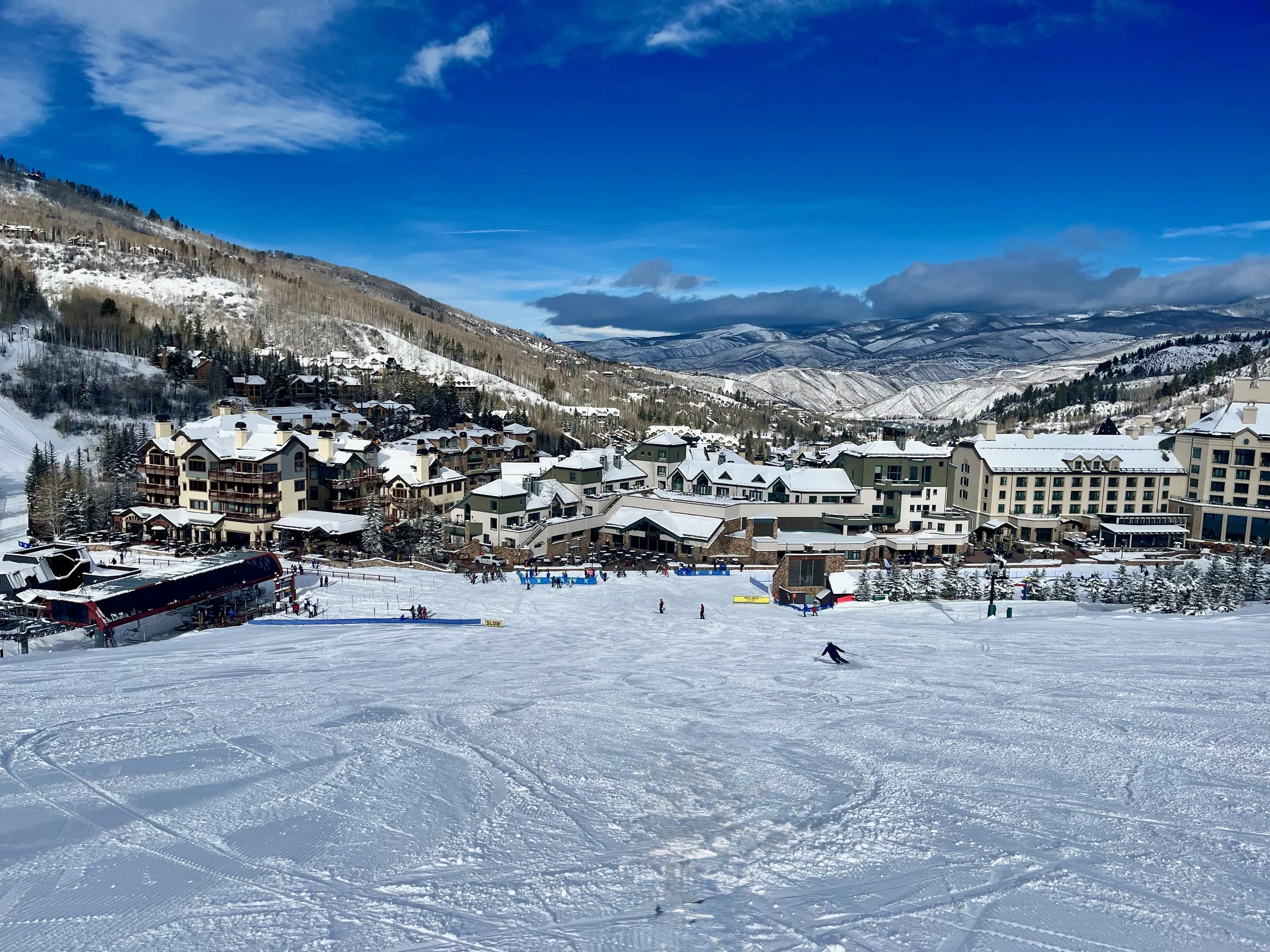
Descending to Beaver Creek Village - Centennial Express chondola loading station visible to the left.
It is expressly designed to function as a single, self-contained hub as opposed to a sprawling town you'd need a car to navigate. Everything is within a few minutes' walk: the main ticket office, ski school meeting points, a cluster of boutique shops and upscale restaurants, and the base of Centennial Express itself.
The village's architecture leans into an alpine aesthetic — stone and timber buildings, string lights, and a central plaza built around the ice rink, which doubles as a gathering spot for après drinks by a fire pit as much as it does an actual skating destination. Although there are a number of restaurants, hotels, rental shops, clothing stores, coffee shops and bars all clustered together in the base village, it feels very compact. One reason is that the architects took great advantage of the steep elevation change from the “bottom” of the village to the top, near the base of the lifts. The buildings, parking garages, access roads and walkways fit together like Jenga pieces and really utilize the available vertical space in a way that reduces the overall footprint.
Beyond Beaver Creek Village itself, Bachelor Gulch and Arrowhead each function as smaller, quieter satellite villages with their own base areas, lodging, and (in Bachelor Gulch's case) the Ritz-Carlton anchoring the whole scene — we've covered each in detail in our Major Mountain Clusters section.
Outside of the resort itself, you have the town of Avon. Anyone going to or from the resort will pass through at least a portion of Avon, and the major highway that you will need to use to get to Beaver Creek (I-70) slices through the town. Avon has its own little universe of restaurants, residential areas, hotels and retail shops. There are also grocery stores and beer/wine shops, outfitters, rental shops (that are much cheaper than at the resort) and medical care.
Walkability
If you're staying inside Beaver Creek Village itself, you likely won't need a car to get anywhere within the resort. The core of the village is compact enough to walk between your lodging, the lifts, dinner, and the ski school meeting point in a matter of minutes, and Beaver Creek helps enable that with its outdoor escalators. After a day of skiing, not having to trudge down a slippery concrete stairway in ski boots is a nice touch.
If you are a bit farther afield than the core of the village, you can also opt to request a Village Connect ride to get you a bit closer, and then walk from there.
Bachelor Gulch and Arrowhead are each walkable within their own smaller footprints, but they're physically separated from Beaver Creek Village itself — getting between the three relies on skiing, Village Connect, or a car, not a casual walk (see our Getting to the Mountain section for the full breakdown).
Do not expect to be able to walk to Avon from the resort, however. If you wish to go to dinner or shop in Avon, you’ll need to rely on public transportation or have a rental car. We have never tried to call an Uber or Lyft from Beaver Creek Village, but reportedly rideshare services are spotty around Beaver Creek, so we do not recommend relying on them.
General Vibe
We’ve established already that Beaver Creek has made a great effort to position itself as upscale and exclusive, and the village is no exception. The drinks are fancy, the shops are boutique, and the prices can be eye-popping. But there is more to it than that. It’s also family-friendly and approachable. You don’t *have* to buy an $800 ski jacket or a $25 cocktail — you are free to wander, people watch or just sit down next to the fire pit and relax for a bit. If there's another word that helps capture Beaver Creek's overall atmosphere, it may be “unhurried.” This isn't a resort built around a bustling, party-oriented base scene — it's quiet, polished, and geared toward guests who want their vacation to feel effortless rather than energetic.
Lodging Overview
Not many ski resorts are as adept as Beaver Creek at convincing their guests to stay on property. While the resort doesn't openly discourage day visitors or those staying down the highway a few miles from parking and skiing, it certainly makes it so much easier for resort guests to take advantage of all Beaver Creek has to offer that the effect is the same.
Beaver Creek positions itself as a premium ski resort, and you'll pay premium prices to ski there. And if you're paying premium prices, you'll expect to take advantage of all the services and amenities that come along with that premium experience. And the only way to do that is to stay within the resort. So we'll start there before covering the more affordable options nearby in Avon.
One note: Epic Pass and Epic Day Pass holders may receive 20% off eligible Vail Resorts-owned or managed lodging, subject to availability and current Epic Mountain Rewards terms. If you do some searches on the Beaver Creek website you’ll likely find that 20% can add up to some significant savings.
Hotels in Beaver Creek Village
The village itself has a handful of standout properties, each with a specific “vibe.” These are not just interchangeable luxury boxes. Some of the notable options include:
Park Hyatt Beaver Creek Resort and Spa — the most centrally located hotel in the village, sitting right at the base of Centennial Express. If ski-in/ski-out convenience and being steps from everything (shops, restaurants, the lifts) matter most to you, this is about as central as it gets.
The Osprey — a boutique, 45-room property that claims to be the closest hotel to a chairlift in North America, steps from Strawberry Park Express. A good fit if your priority is skiing over village atmosphere — smaller, more intimate, less see-and-be-seen than the bigger properties.
The Pines Lodge — set slightly above the village with a more classic alpine, lodge-like character, home to the well-regarded Grouse Mountain Grill (AAA Four Diamond-rated). A solid choice for families wanting a bit more separation from the village bustle while still being ski-in/ski-out.
Beaver Creek Lodge, Autograph Collection — another ski-in/ski-out option in the village, with on-site dining and a pool/hot tub setup that works well for families wanting resort amenities without the top-tier price tag of the Park Hyatt or Ritz.
The Ritz-Carlton, Bachelor Gulch
The Ritz anchors an entire cluster on its own, surrounding the base of the Bachelor Gulch Express lift. As we covered in our section on this cluster, this is a luxury property, with ski-in/ski-out access right at the base of the lift and a reputation for the kind of attentive, buttoned-up service the Ritz brand is known for. It's also become the social hub of that cluster — the mountain-side terrace functions as Bachelor Gulch's main après spot, often with live music. If your budget has no ceiling and you want the single most exclusive-feeling base in the resort, this is it. We have never stayed here, but did stop in for a mid-afternoon warm-up drink on the terrace one day on our last trip and really enjoyed the atmosphere and the view.
Short-Term Rentals: Condos, Townhomes, and Private Homes
Beyond hotels, a significant share of Beaver Creek's lodging options are condos, townhomes, and private residences available through the resort itself, Airbnb, VRBO, or local rental management companies. This is often the more practical option for families or larger groups — full kitchens, multiple bedrooms, and the ability to split lodging costs across more people, which can meaningfully offset Beaver Creek's overall price level. As you should expect at an upscale resort such as Beaver Creek, the short-term rentals we’ve stayed in have all been well-furnished and maintained, with higher-end appliances and furnishings. They typically have a well-appointed indoor ski locker room available for ski storage with room to gear up comfortably in the morning. And most have communal hot tubs and fitness rooms.
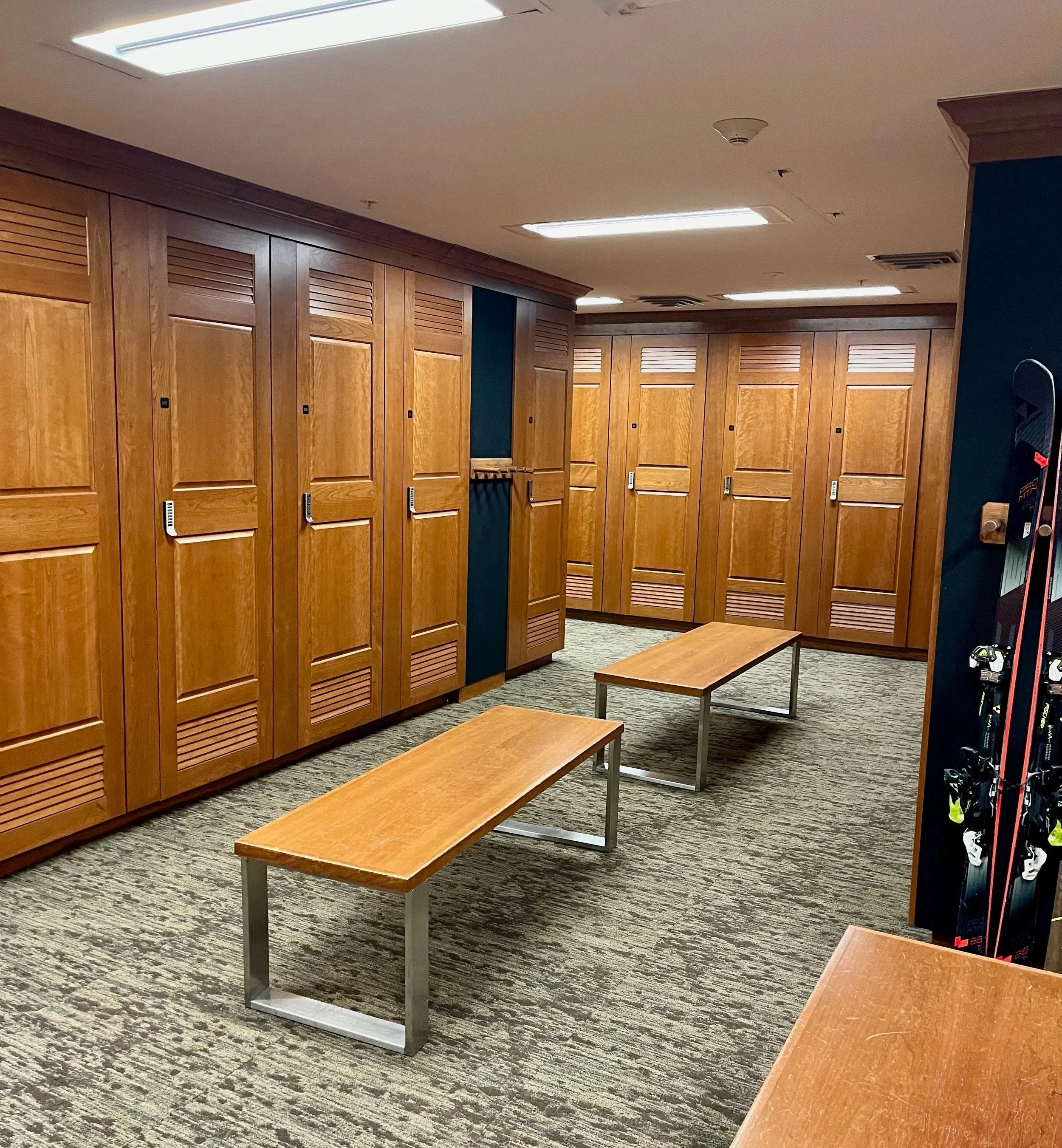
The Ski Lockers at Elkhorn Lodge.
The tradeoff with rentals versus hotels is consistency — a hotel guarantees a certain baseline of service and amenities, while a condo or private home can vary significantly depending on the building, the management company, and how well-maintained the specific unit is. That being said, Beaver Creek Resort lodging deserves some credit for how it manages its condo rentals. Although we have stayed in a hotel at Beaver Creek, on each of our last three Beaver Creek trips we have stayed at resort-managed condo rentals. Our experience was much closer to a “hotel”-style experience than what we’ve encountered with other short-term rentals. We were contacted before the trip to confirm all details and accommodate any special requests; there was a staffed front desk in the building to handle check-in and provide assistance; and we even had cleaning service once or twice during each stay. This was considerably less stressful than working directly with an off-site host as is typical for many short-term rentals, particularly those through Airbnb or VRBO. Locally based private management companies can often claim a bit of a middle ground in this area. They can provide local support if needed, although typically without on-site staffing or midweek cleaning services.
In addition to service and amenities, proximity varies a lot too — which we'll cover next.
Lodging Areas / Proximity Tradeoffs
Not all "staying in Beaver Creek" is created equal — where your lodging sits relative to a lift makes a real difference in how your mornings and evenings actually feel.
Ski-In/Ski-Out
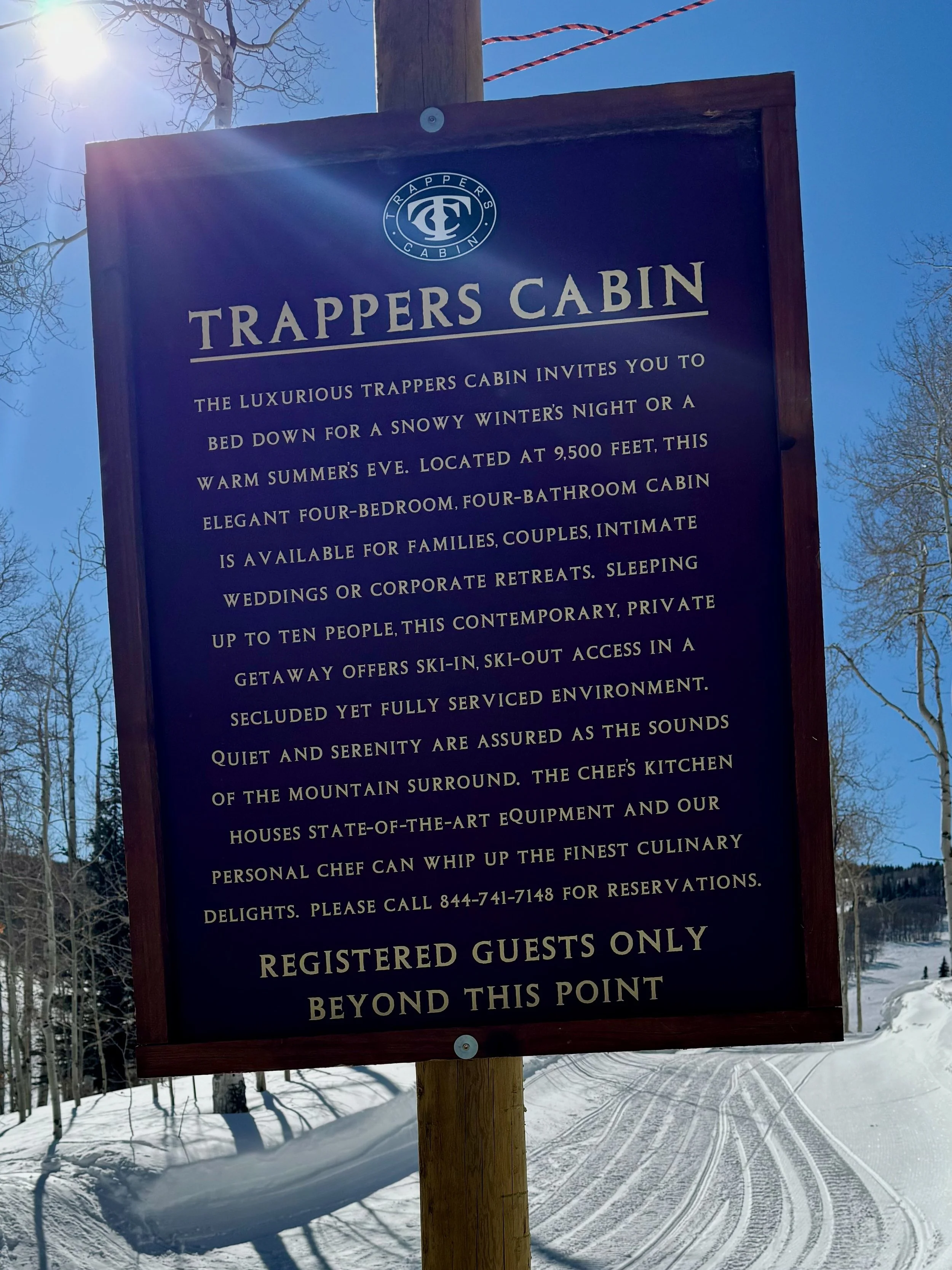
In addition to the condo complexes and base-level hotels, there are slope side chalets available offering true ski-in/ski-out. This one is high on the mountain, ultra-luxurious — and quite expensive.
Beaver Creek has more ski-in/ski-out lodging than you’ll find at most resorts, spread across all three main base villages (Beaver Creek Village, Bachelor Gulch, and Arrowhead) — but the term deserves a closer look here than it does at most resorts. If you browse in-resort lodging listings, you'll notice a surprising number labeled "ski-in" despite sitting what looks like a considerable distance from the base. That's another benefit of Beaver Creek's master-planned approach: the architects built ski access into the layout from the very beginning, and the trail map is riddled with skiways — narrow, gently sloped access trails that let many properties legitimately claim "ski-in" status even when they're not also "ski-out."
Staying in one of these locations may mean a Village Connect ride to reach a lift base each morning, but at the end of your ski day, gliding straight down to your own condo's ski locker room is a great feeling — provided the skiways have enough natural snow to be open and maintained. They tend to be among the last trails to open each season, since they rely on natural snowfall, so it's worth checking conditions before assuming a "ski-in" listing will actually deliver that experience on your specific trip.
There are several condominiums around the edge of the main village that fit the definition of “ski-in/lift-out” through the presence of the Elkhorn lift. The base of this lift is right outside the door of the Elkhorn Lodge condo complex and a short ski down the skiway from a couple of other condo options. The lift crosses a road and there is a second loading area which is accessible from numerous residences on that side as well. We know this one well because we have stayed here multiple times and found it to be very convenient, although in the snow-starved season of 2025–26 the lift did not open until the end of January (right after we checked out). The Village Connect shuttle we used to get to the slopes each day was still a pleasant substitute.
True, unqualified ski-in/ski-out — where you're clicking into your skis and skiing straight back to your door, no shuttle required in either direction — remains the gold standard and the most expensive tier of lodging, here as almost everywhere.
Village-Adjacent, Not Ski-In/Ski-Out
A step down in price (and convenience) is lodging that's walkable to the village and lifts but doesn't put you directly on snow. You'll be using Village Connect, the escalator, or a short walk in street shoes with your gear on your back instead of clicking in outside your door — a manageable inconvenience for most guests.
Bachelor Gulch and Arrowhead vs. Beaver Creek Village
As covered in our cluster breakdowns, Bachelor Gulch and Arrowhead each function as their own self-contained bases, with their own lodging, dining, and lift access. Staying in either means less walkable variety (fewer restaurant and shopping options right outside your door compared to the main village) in exchange for a quieter, less crowded home base — Arrowhead especially, given how consistently we've found it to be the least trafficked part of the resort.
Staying in Avon
As we covered in Getting to the Mountain, Avon — particularly the Riverfront area near the Westin — offers a useful middle ground: not ski-in/ski-out, but a direct gondola connection to Beaver Creek Landing that gets you on-mountain in about three minutes. Lodging here tends to be more affordable than comparable properties inside the resort boundary, which makes it a smart option for budget-conscious travelers or larger groups who don't want to pay the premium for ski-in/ski-out access. The Westin Riverfront Resort & Spa is the standout property here, with its own spa, hot tubs along the Eagle River, and the Riverfront Express Gondola just steps away — a free, publicly accessible gondola (not a hotel-exclusive perk) that makes it feel more connected to the mountain than a typical off-site hotel.
Beyond the Westin, Avon also has more standard hotel options (Comfort Inn, TownePlace Suites, SpringHill Suites among them) that trade the gondola convenience for lower prices still — a reasonable option if you're comfortable relying on Beaver Creek's free shuttle network, taking the Riverfront Express Gondola, or driving in each day.
Dining and Après-Ski
Beaver Creek’s target market trends towards affluent travelers and families, and a sizable number of homeowners and full-time residents also live within the resort. To attract and retain those guests and residents, Beaver Creek's dining scene is decidedly upscale and weighted more toward inventive, upscale dining than casual fare. But that doesn’t mean your only choice is to have breakfast on fine china every morning. Beaver Creek is designed so guests can arrive and stay on-site for their entire trip, if they wish — so there is enough variety to keep guests satisfied. And by and large, the in-resort dining is good. However, none of it is cheap.
Between the village, Bachelor Gulch, and Arrowhead, there are dozens of restaurants and food vendors covering everything from a grab-and-go breakfast sandwich to some of the most memorable fine dining in the Vail Valley. Restaurants come and go, though, and menus change hands more often than trail names do — so rather than attempt a directory that may be outdated within a season, we're highlighting a few dining experiences that feel particularly Beaver Creek. For up-to-the-minute reviews and hours, sites like Google and Yelp will always be more current than we can be.
Après-Ski
Après at Beaver Creek has a different energy than at some of its neighbors. Beaver Creek doesn't have the kind of nightlife found in Vail — the bars close early, and anyone chasing a late night generally heads down to Avon or over to Vail instead. That's not a knock; it's consistent with everything else this guide has said about Beaver Creek's whole approach — polished and relaxed as opposed to loud and late.
The classic, no-frills local bar. Every ski town has one spot that's been there since the beginning, where the crowd is more locals-and-regulars than tourists. Coyote Cafe, right in the main village, has held that role since the early 1980s — margaritas, Southwest-inspired food, and a patio that fills up fast the moment the lifts close.
Upscale après with a view. For something with a bit more polish, the village has options built around a great patio and a well-curated drink list. Beaver Creek Chophouse and C-Bar share a large slopeside patio near the base and lean into the resort's more refined side.
Après with live music. Over in Bachelor Gulch, the Ritz-Carlton's mountainside terrace functions as that cluster's main après hub, often with live music through the season.
Dinner Beyond Après
The Sleigh-Ride Cabins
This is the one category worth covering in a bit more detail, since it's something you may not find at many other resorts. Beaver Creek offers three different cabin dining experiences, each reachable only by horse-drawn or snowcat-pulled sleigh in the evening:
Beano's Cabin is the biggest commitment of the three, with the longest sleigh ride, a prix-fixe menu, and a reputation as the most upscale option.
Allie's Cabin is shorter and more casual, with an intimate setting built around a floor-to-ceiling stone fireplace. Its Northern Italian menu and shorter sleigh ride make it a more workable choice with kids along, without sacrificing much of the magic.
Zach's Cabin sits high above Bachelor Gulch, with some of the best views of the three, and focuses on Alsatian cuisine paired with a serious wine list — a good pick if you want the special-occasion feel without quite the same formality as Beano's.
We haven't tried any of the three ourselves yet, but we have been told that reservations can be difficult to get — particularly during peak weeks. Book well in advance if one of these is part of your plan.
Village Dining
Beyond the cabins, the village covers the usual range you'd expect from a resort this size:
Beaver Creek Chophouse, for steaks, Colorado beef, and fresh seafood — the kind of place you'd book for a proper night out.
Blue Moose Pizzeria, right on the main village plaza, is a local favorite for New York-style pizza — a good option if you want a break from the resort's fine-dining price points for a night.
Grouse Mountain Grill at the Pines Lodge is a fine-dining standout — AAA Four Diamond-rated, known for farm-to-table cooking, and good enough that you should consider booking even if you're not staying there.
Avon and Beyond
In our opinion, some of the best food in the valley isn't actually inside the resort at all. Avon and Edwards (just down the road) trade a bit of the alpine-lodge atmosphere for more affordable prices, easier parking, and a much wider range of cuisines than you'll find within Beaver Creek's own boundaries. Vail and Beaver Creek tend to overemphasize alpine flair like fondue, while Avon and Edwards are just as likely to serve you a bowl of pho or a proper taco.
Casual and local. This is where Vail Valley locals actually eat, and it shows: taco shops, burger counters, and casual Mexican spots that don't come with a resort markup.
A proper wine bar or bistro. For a step up without needing a reservation weeks in advance, Avon and Edwards have a handful of well-regarded spots for a good bottle and a relaxed atmosphere, popular for both post-work drinks and après.
Something different from another night of mountain lodge food. After a few nights of elk and bison, Avon's more varied food scene — sushi, ramen, Italian, Hawaiian poke — can be a welcome change of pace, especially for families or groups getting a little burned out on the resort's own (excellent, but repetitive) dining options.
Off the Mountain
Beaver Creek's whole design assumes you're spending most of your time on snow, but there's more to do here than skiing alone — both right in the village and a short trip away in Avon and Vail.
Right in the heart of Beaver Creek Village, the ice rink we mentioned earlier does double duty as both a non-mountain activity and a social gathering spot, surrounded by fire pits and couches where you and your group can settle in. That makes it just as appealing to sit nearby with a hot drink as it is to actually lace up skates.
For something a bit more organized, the Vilar Performing Arts Center sits right in the village and attracts surprisingly accomplished acts for a mountain town. An intimate, roughly 530-seat venue, it has a full year-round calendar of concerts, comedy, and Broadway touring shows. It's an easy, no-car-needed evening plan if you want a break from dinner-and-après as your only nightly options, and parking is included with any ticket purchase at the Villa Montane and Ford Hall garages.
Down in Avon, Nottingham Park and its lake form the town's central gathering spot — in winter that mostly means it's a nice place for a walk or to let kids burn off energy, though it offers much more in warmer months. Avon and Edwards also have the area's more practical off-mountain services if you need them: grocery stores, medical care, and rental shops at a fraction of resort pricing, all covered in more detail in our Base Village and Town section.
If you're willing to make the short trip over to Vail, the Colorado Snowsports Museum & Hall of Fame is well worth an hour, especially on a bad-weather day. It's free, located right in the Vail Village parking structure, and covers the fascinating history of skiing in Colorado — including the 10th Mountain Division, the World War II mountain infantry unit whose veterans went on to help found Vail and several other Colorado resorts after the war. It's a good way to add some context to a trip that's otherwise all about the luxury skiing — we found that it left a strong impression on us and sparked a continuing interest in the history of Colorado skiing. If you don’t want to waste any precious on-slope time, consider building in a stop-off at the museum on one of your travel days. Even an hour can be quite enjoyable.
Pairs Well With
At the risk of stating the obvious, the most natural pairing for a trip to Beaver Creek is a day (or more) at Vail. Vail is a super-sized, world-class resort with an enormous variety of terrain worth experiencing if you're already in the area. Better yet, the two resorts are incredibly close geographically and closely linked through the free bus system outlined earlier in this guide. Unless you are planning to walk up and purchase a lift ticket, your Epic Pass or Epic Day Pass will work just the same at Vail as it does at Beaver Creek. Just walk up to the lift or gondola and scan yourself in. It’s so easy that it is practically a no-brainer. Just check for any blackout dates or restrictions associated with your particular pass product before heading over.
And even if you’re paying walk-up rates at the window, the prices at Vail are essentially comparable to those at Beaver Creek, so it’s not like you’re wasting any additional money by trying out Vail.
The only notable drawback to this is the same thing that makes it so obvious: Vail is big. It’s much larger than Beaver Creek, and just one day at Vail may not be enough. You may want to make it two or even more — which begs the question of why you didn’t just make your plan to ski at Vail in the first place and add in a side of Beaver Creek for one or two days.
But our opinion is that this is a minor downside. You can still get a taste of Vail in just one day and you can decide for yourself if you want to plan a return trip someday. You may decide that it’s just too big and too crowded (it is typically significantly more crowded than Beaver Creek) for your taste and opt to stick with the more laid-back and empty Beaver Creek.
Beyond Vail, there aren’t many resorts we would recommend as “day” trips while you’re staying in Beaver Creek. Breckenridge, another Vail-owned resort on the Epic Pass, is about an hour away, so it is reasonably feasible. Other resorts are best handled as extensions or add-on destinations, and would generally require new lodging and additional travel.
Bottom Line
We really like Beaver Creek, and consider it rather underrated compared to many of its I-70 neighbors — but we're honest with ourselves about who it's for. This isn't a mountain that's trying to be everything to everyone, and the traveler who loves it most tends to be pretty specific: families, mixed-ability groups, and anyone who wants an uncrowded, low-hassle ski vacation without sacrificing quality terrain or service. And — importantly — someone who is willing and able to spend what it takes on skiing, lodging and dining at Beaver Creek for several days.
If that sounds like you, Beaver Creek delivers about as well as any resort in Colorado. If you're chasing steep expert terrain, a lively nightlife scene, or bargain pricing, you already know from this guide that you'll be happier elsewhere — and that's fine. Beaver Creek isn't for everyone, and it doesn't pretend to be.
For the right group, though, it's an easy recommendation. We keep going back.