

Winning the Offseason
"Champions are made in the off-season" - Bear Bryant
Well, so are great ski trips.
At River Run Ski, we start planning our trips for next winter while the lifts are still spinning and the deals are running hot.
It is not lost on us that this is the exact opposite advice you'll hear from many ski travel consultants, ski influencers and content creators, and perhaps many of your friends and family.
But they approach things a little differently than we do. The reasoning behind their advice makes sense on the surface: you need snow to ski. And you don't know where the snow is going to be in the winter when it's still pool and palm tree season.
And that's perfectly fine if your lifestyle and financial means allow you to drop everything and fly to Jackson Hole, or Tignes, or Hokkaido chasing a big dump. And many of those "influencers" and content creators are in the industry and can do just that. Their job is to ski, and they may even get paid to travel and make content. And your friends and family? Well they may be living in a world that disappeared over a decade ago, when you could still plausibly afford walk-up lift tickets.
But River Run Ski is for real people. People who circle a week in February on their calendar, and request the time off months in advance. We can't afford to chase powder, and we're not going to pretend otherwise.
Our Planning Framework accounts for how much the ski industry has changed over the last 15 years by prioritizing early planning — particularly for season passes or multi-day lift tickets. Our framework urges you to Choose your Mountain as early as possible, then move straight to Securing your Access — passes and multi-day tickets only get more expensive or harder to find the longer you wait. Once that's locked in, turn your attention to lodging and air.
But there is more to it than that -- the "off season" is the time to watch for heavily discounted gear, lodging and even the occasional deal on air and ground travel.
Season Passes and Multi-Day Passes
Although well-covered in Guide 5 (Secure Access) of our Planning Framework, it bears repeating here: the earlier you purchase your lift tickets or season passes, the less money you'll spend. It's as simple as that.
They don't go "on sale" later and there won't be any Hot Deals or surprise price cuts. Ikon, Epic, and The Mountain Collective all follow a similar model of escalating prices throughout the offseason until eventually they become unavailable. This is true for their general season pass products and their multi-day pass products alike, although specialty products (such as the Epic Military Pass) consistently remain heavily discounted throughout the offseason.
Early planning and decision making can save you significant money, especially if you're purchasing for multiple people, such as a family.
Most smaller resort groups and independent resorts have adopted similar models. Pacific Group Resorts (PGR) — owners of six different resorts including Jay Peak in Vermont and SilverStar Resort in BC, Canada — offers a "Mission Affordable" pass that goes on sale around the time the season is wrapping up in the spring, then increases from there.
The Mountain Collective is worth a close look if your list includes bigger names — the pass includes two days apiece at 27 resorts as of 2026, among them Alta, Snowbird, and Aspen Snowmass, alongside international destinations like Niseko and Chamonix. It follows the same pricing logic as Epic and Ikon: a lower spring price, followed by scheduled increases as the offseason progresses, with no risk of the pass selling out entirely. If your target mountain happens to sit on this roster, it's a strong value play precisely because the only cost of waiting is a higher price tag, not lost access.
Indy Pass is a different animal altogether, and time matters even more here — not because of price increases, but because Indy throttles the number of passes it sells, period. A finite batch goes on sale and once it's gone, it's gone; there's no guarantee it comes back before the season starts. And that window keeps getting tighter. The last few seasons tell the story: the 2024–25 pass sale ran about two and a half weeks before closing. The 2025–26 sale closed in just nine days. By 2026–27, the public sale window lasted 37 minutes before the pass sold out completely. If you're serious about Indy, "as soon as it opens" isn't a suggestion — it's the only strategy that reliably works anymore.
Perks
In an effort to get consumers to lock in as early as possible, resort companies also front-load their most generous perks, extras, and benefits into the first purchase window, with reductions following as the season progresses.
Vail Resorts recently overhauled this system for the Epic Pass. Buddy Tickets and Ski With a Friend Tickets — the old, resort-by-resort discount system — have been replaced by Epic Friend Tickets, a flat 50% off lift tickets usable at any of Vail's 37 North American resorts. It's a better perk than what it replaced, but the early-bird structure survived the rebrand: passholders who purchase during the earliest window receive the full 10 Friend Tickets, while those who wait past the deadline receive fewer.
Ikon runs a similar companion-ticket system of its own, sized to match its two-tier pass structure. Full Ikon Pass holders get 15 Friends & Family tickets at 25% off window rates; Ikon Base Pass holders get 10. Ikon also layers in its own version of the early-bird incentive through its Renewal Rewards program — credits, gear rentals, and other perks — which is only available to passholders who buy before the first deadline. And rather than shrinking a discount, Ikon staggers access itself: early purchasers get immediate spring skiing privileges at select resorts, while additional destinations don't open up to later buyers until weeks after the pass goes on sale.
The PGR Mission Affordable pass follows the more familiar version of this pattern with its own Buddy Tickets, which decline from six at the earliest tier down to four at later ones.
Different pass, different mechanism — smaller discount, delayed access, fewer companion tickets — but the underlying incentive is identical across all of them: buy first, get more.
Lodging Deals
For most ski trips, lodging costs will consume the highest portion of your budget. Consequently, you have the most to save by strategically planning your reservations to take advantage of offseason discounts.
Resort Lodging

Most of the major ski companies begin offering off-season deals as soon as ski season ends.
Although rarely the cheapest option, sometimes the most convenient option is to book directly through the resort. And savvy offseason shoppers can still be rewarded with savings if you approach it the right way.
First off: make sure you're aware of any discounts you may be entitled to as a passholder or even multiday pass holder. Epic Pass members automatically receive a flat 20% discount on resort lodging (along with smaller discounts on food, lessons, and rentals), and it often stacks on top of other ongoing specials that may be running. PGR's Mission Affordable pass holders enjoy a similar discount.
Ikon Pass works differently. There's no single flat-rate lodging discount across the board — instead, individual Ikon destinations run their own lodging offers (plus their own modest food and retail discounts), and those offers vary significantly by resort, both in size and in how long they last. Some past examples have ranged from 20% off to 40% off depending on the property, and nearly all of them carry a specific booking deadline rather than standing open all season. That actually strengthens the early-planning case rather than weakening it — miss a particular resort's window and that deal is simply gone, no second chance.
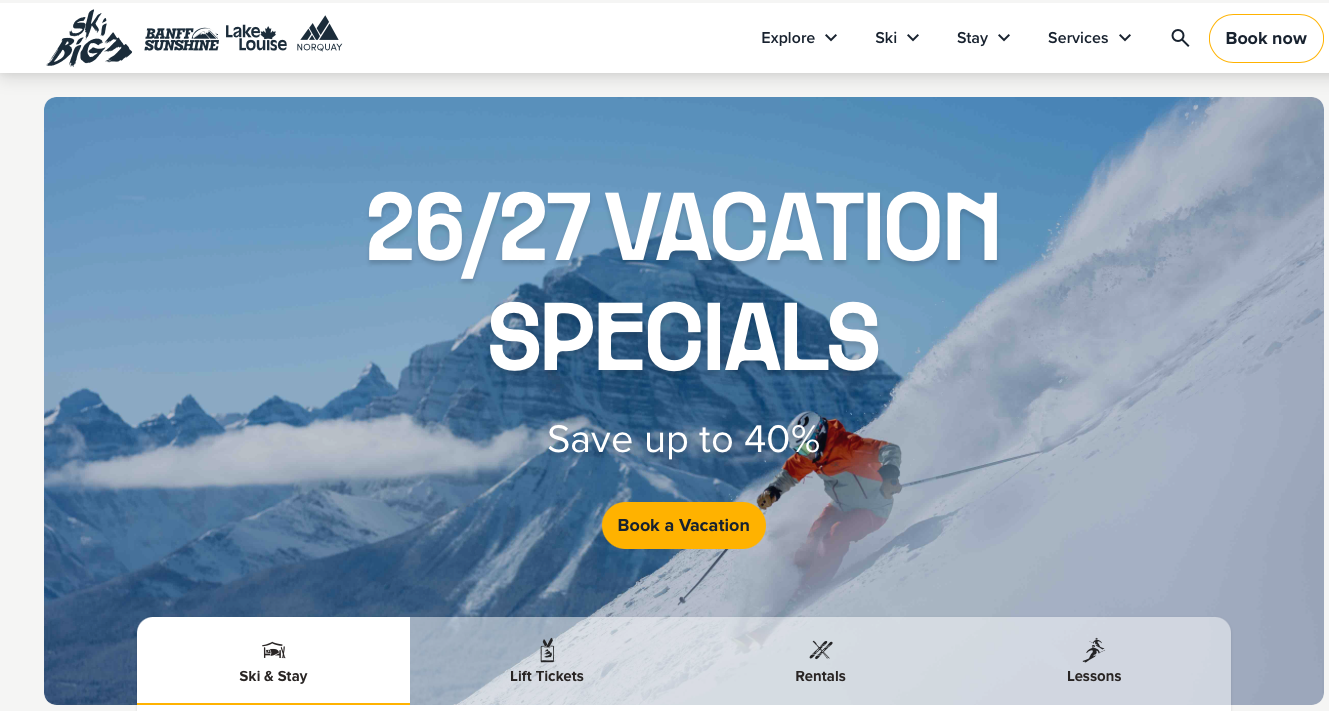
Example of an Off-Season Vacation Package special. The time to book is when the lifts aren’t spinning and the grass is green.
Secondly, pay attention to prices throughout the year. Like the passes, resorts often offer low pricing in the spring for those willing and able to lock in far in advance. But keep looking around holidays too, even if you've already reserved lodging. American resorts will often run Memorial Day, Independence Day (4th of July), and Labor Day sales. For Canadian resorts, watch for deals around Canada Day (July 1) and Civic Holiday — the first Monday in August, known regionally as BC Day, Alberta Heritage Day, and by other provincial names.
Finally, if possible, book refundable, pay-later lodging. Unlike season passes, the price of lodging does go down (and up). If you're able to maintain some flexibility, you can take advantage of that elasticity.
Short-Term Rentals (STRs)
Some resorts are dominated by resort-owned lodging, but many are the opposite. On mountain or in town lodging is a mix of short term rentals and some private hotels.
What do we mean by short term rentals? These are the privately owned lodging options made available for rent only on a short-term basis. Typically a week or less.
These could be condos, townhouses, homes, chalets or (at the high end) mammoth on-mountain mansions. Every resort is different so spend some time doing your research on what your chosen mountain has for inventory and begin looking at your options.
In recent years, the STR market has been dominated by international brokers such as Airbnb and VRBO. However, nearly every resort and the surrounding area still has a few good locally-based rental companies so it pays to shop around. It can be common for these smaller rental companies to list on their own sites as well as Airbnb or VRBO (or both) and often if you book directly on their site the price is considerably cheaper.
Unlike resort-owned lodging, there is almost no structure or pattern to any sort of "discounts" that may be found in short term rentals. But what you find is that the prime rentals get booked early. Every resort has sought-after lodging options, buildings or neighborhoods and if you want to grab a spot in one, you need to book early.
STR bookings do typically require a deposit up front, but once again we recommend booking something with a generous refund period. While prices do not typically go down frequently, you may find that an option in a more desirable location opens up unexpectedly. You'll appreciate the flexibility of being able to cancel and book elsewhere.
Hotels
Hotels are often the last option that people look at when booking a ski vacation, with good reason. Many resorts don't even have private (non-resort owned) hotel options. At least not within the resort. And the ones that do still tend to be dominated by resort lodging or STR options, with hotel rooms being the exception rather than the rule.
But for those that do have hotel rooms available, it can be a good option, particularly for small groups, couples or solo travelers.
Like ski resorts, hotels generally fall into two broad categories: chain hotels and independents.
Chain Hotels
Chain hotels offer a known quantity. Book the Four Seasons and you know exactly what you're getting — and what you'll pay for it. A more budget-oriented brand carries the same predictability at the other end of the price scale. That consistency matters if you're planning one trip a year and can't afford a gamble on lodging quality.
Chains also let you put existing loyalty status or points to work, whether that's a free night, a room upgrade, or simply avoiding a new deposit. And because chain pricing runs on national promotional calendars rather than resort seasonality, a brand-wide deal — stay four nights, get the fifth free, for example — will often apply to a ski-town property even though it has nothing to do with that resort's own pricing pattern. Worth checking your preferred chain's current promotions independently of anything resort-specific.
Independent Hotels
Independently owned hotels are a dying breed across most of the US — in cities and suburbs, nearly everything now flies a corporate flag. But ski towns are one of the last places they've held on, since base villages and small mountain towns are exactly the kind of market a national chain has less interest in.
Staying independent means supporting a small business directly, and it usually comes with a more personal experience — the kind of trail-map advice or restaurant tip you won't get from a front desk following a corporate script. Independent hotels are competing against chain marketing budgets and STR platforms like Airbnb and VRBO without either one's reach, so pricing isn't always lower. Sometimes it is — but you'll need to do the same research and price-tracking here that you'd do anywhere else.
Air and Ground Transportation

Airfare doesn't follow the seasonal discount pattern that passes and lodging do — prices swing for reasons that have little to do with ski season. That makes early research valuable less as a way to find a "sale" and more as a way to establish a baseline. Once you know what a route typically costs, you'll actually recognize a good price when one shows up.
A few practical habits:
Book refundable fares when the price difference is reasonable — it's become more expensive to do this across the board, but it's still worth pricing out.
Standard economy fares usually aren't refundable outright, but most airlines will let you cancel for a credit. If prices drop after you've booked, it's worth checking whether rebooking at the lower fare (even with a change fee) still nets you savings.
Track fares on Google Flights or a similar tool rather than checking once and booking.
The same logic applies to rental cars: book early, then keep checking for price drops. Costco Travel is a strong option here — no deposit required, and reservations are fully refundable, so there's no downside to locking in a rate early and rebooking if a better one appears.
Gear Sales

Gear pricing runs roughly opposite to season passes. Instead of prices climbing the longer you wait, they fall — starting around midseason and continuing to drop until the last of current-season inventory clears out, right before next season's models arrive.
The catch is inventory, not price. As discounts deepen, the most popular sizes disappear first, so waiting for the lowest price often means settling for whatever's left.
Online retailers offer the deepest discounts, but do not be tempted to purchase boots sight unseen. Boot are the one item that are essential to purchase in person — proper fit matters too much to leave to a return policy. For everything else, it's worth supporting your local shop where you can: watch for sidewalk sales, warehouse clearances, and holiday promotions. Buying local also sometimes comes with extras that online retailers can't offer, like discounted tunes and waxing or free binding mounts.
Summary
None of this requires obsessive tracking or a spreadsheet full of price alerts. It just requires making a few decisions while everyone else is still waiting for it to snow. Book your access while it's still available, watch lodging through the summer instead of the panic of a holiday week, and let the gear sale come to you instead of chasing it in October. Champions are made in the off-season. So are the trips you'll actually be glad you took.