

Destination Guide: Lake Louise Ski Resort
Our Destination Guides are written for first-timers, not locals or returning visitors — this is what we wish we'd known before our own first trip to each resort.
At a Glance
Location
Lake Louise, AB
Year Opened
1954
Size
4,200 acres
Altitude
5,400–8,650 ft
Trails · 170 Total
Lift Fleet
13 lifts
Longest Run
5 mi
Pass

Jump to a Section
On the Mountain
Village and Stay
Beyond Skiing
Many years ago — far more than I care to admit, or even think about — I had a friend whose parents had set up the absolute quintessential basement rec room. It had a pool table, naturally. And a wet bar. Twelve-year-old me got to spend a lot of time with that pool table, but I had to wait a few years to try out the bar.
All around the walls were framed posters, photographs and artwork. Mostly travel scenes, some from exotic locations that I’m quite certain this family never got close to. But I loved walking around that room, looking at all those places and wondering what it would be like to see them someday.
My favorite was a wide-framed, expansive view of an enormous mountain range in winter. Rocky, snow-covered peaks encircled and towered over a small, frozen lake. There was no civilization, no sign of humans anywhere — except for a tiny castle rising beside the lake, right in the center of the frame.
I’ve looked for that photograph online many times over the years and have never found it. It looked something like this:
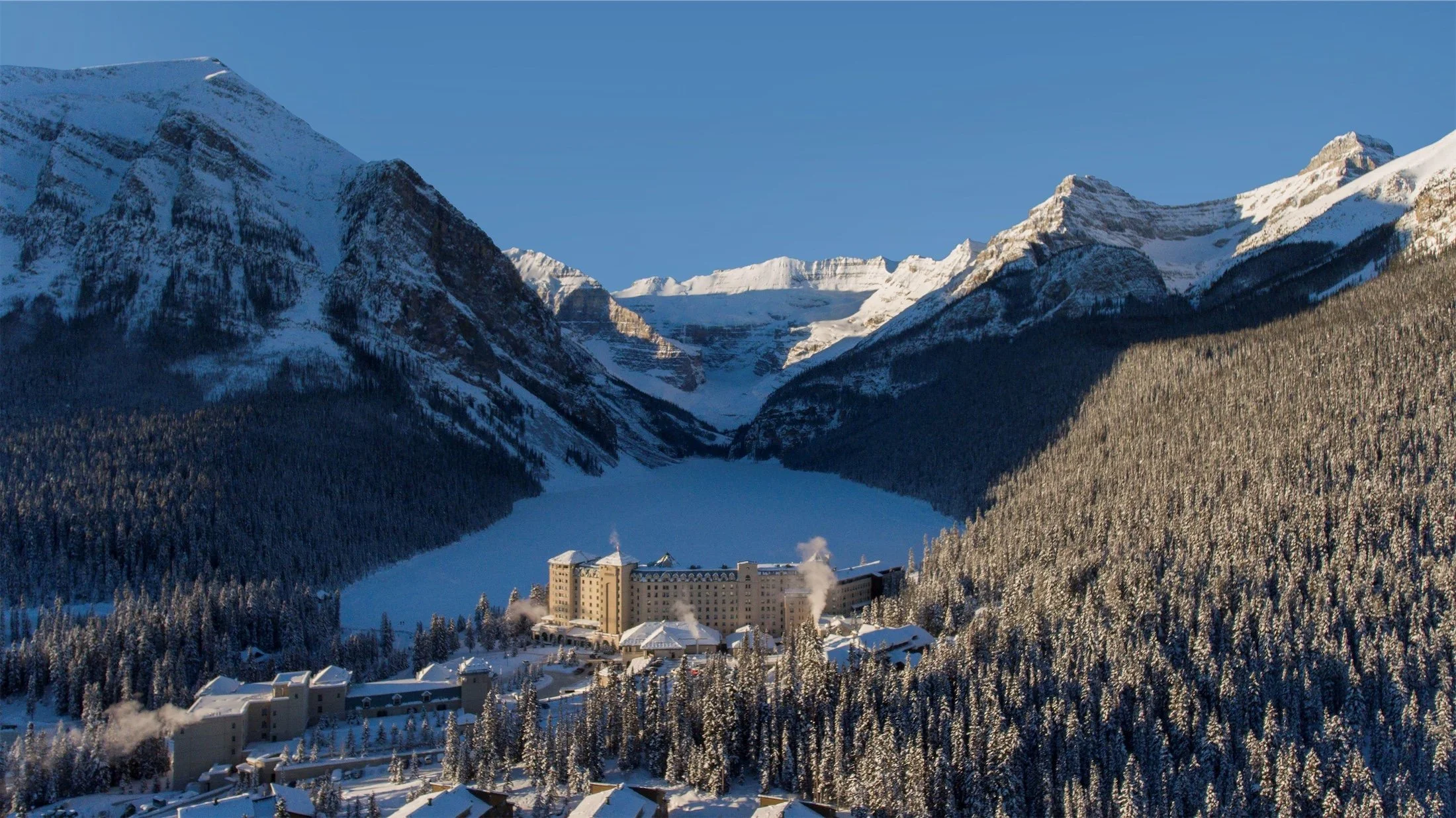
Lake Louise in Winter (Aerial) - Photograph Courtesy of Fairmont Château Lake Louise
At the time, neither my friend nor I had any idea where it was. But when I got older — and a little more worldly — I figured it out. It was Banff National Park in Alberta, Canada. And that frozen lake was Lake Louise. And that tiny castle wasn't a castle at all, it was a hotel. Now known as the Fairmont Château Lake Louise.
And what's even more, there is a ski resort right across the valley: Lake Louise Ski Resort. And from the trails cascading from the frontside summit, you can get that view of the snow-covered peaks, the frozen lake, and the "castle" hotel as you carve your way down the mountain.
Once I discovered this, Lake Louise was an immediate add to my ski bucket list. And unlike many of the other items on that list, I've actually checked this one off, making multiple trips at different times of the ski season and under different conditions.
Continue reading for our River Run Ski — Lake Louise Ski Resort Destination Guide.
Is This Mountain Right for You
Lake Louise (the actual lake) and the ski resort that rises up nearby are not exactly off the beaten path, but they rarely seem to be top of mind for the destination skiers we talk to. For American skiers, traveling internationally may seem like more of a bother than it's worth (you'll need a passport, and there could be fewer flight options than some popular U.S. destinations).
For those who do love to travel internationally — count us in that group — people seem more likely to try to hit Whistler or even one of the popular (and accessible) eastern Canadian resorts than the Canadian Rockies.
But Lake Louise Ski Resort can be a fantastic choice for the right group, and in our opinion it deserves far more consideration than it appears to get.
One readability note for this guide: the fact that you have the similarly named Lake Louise, the Village of Lake Louise, and the Lake Louise Ski Resort all within close proximity of each other can be confusing. Since this is a ski destination guide, the guide will use "Lake Louise Ski Resort" and "Lake Louise" interchangeably to refer to the ski resort. When we mention the lake or the nearby village by name, we will make it clear that this is what we are referring to.
Who This Mountain Is Good For
Canadians — As you'll see when we begin to break down the areas of this resort and the terrain that is available, Lake Louise is an impressive mountain with a wide variety of trails. There really is something for everyone and the location and climate make for a long ski season. It's a fantastic domestic option — not only for "locals" from Calgary or Edmonton or nearby Alberta and British Columbia, but also for destination skiers from the east or west coasts. No passport required!
Skiers tackling Canada’s “Big3” — There are three major ski resorts within the Bow River Valley region of Banff National Park: Lake Louise Ski Resort, Banff Sunshine Village, and Mt. Norquay. In 1978 they established “SkiBig3” — a joint venture and marketing partnership collectively owned by the three resorts. While each resort retains completely independent ownership and operations, SkiBig3 allows them to pool their marketing resources, provide a centralized booking hub, and offer a shared multi-resort pass. They also offer the Trifecta Challenge — a bit of gamification to encourage skiers to hit up all three resorts within one trip. Validation of this achievement results in a free beer and a prize. SkiBig3 offers a variety of lodging and other discounts as well.
Ikon or Mountain Collective Passholders — In addition to the shared SkiBig3 pass, Lake Louise is also a partner of Alterra Mountain Company’s Ikon Pass and the Mountain Collective ski pass. Skiers who already have decided to purchase one of those passes (or already hold one) will have access to Lake Louise, although the passes differ in how they can be utilized. The full Ikon Pass grants the passholder 7 total days combined across the three Banff-area resorts with no blackout dates. The Ikon Base Pass gives 5 days combined and may have blackout dates so make sure you check the terms of your pass before planning a trip. The Mountain Collective treats Lake Louise and Sunshine Village as completely separate resorts (but notably Mt. Norquay is not a partner with Mountain Collective). The pass grants you 2 full days at Lake Louise (and 2 at Sunshine Village) each season, with no blackout dates. You also get 50% off an unlimited number of additional days at either resort. For holders of either of these passes, a trip to Banff and Lake Louise would be a great addition to your skiing resumé and the economics could make sense.
People who want the experience of skiing “almost” in the wild — Lake Louise is a major ski resort with a fantastic lift infrastructure. With the recent additions of the West Bowl and Richardson’s Ridge acreage, the resort is now the second largest ski area in Canada by some measures. Some of that terrain used to be true backcountry that has now been made in-bounds, and is now marketed as “emulated” wilderness. But what you will not find is massive over-development. Or even any development at all, as there is no lodging within the resort, either at the base or on mountain. In fact there is no base village at all — just a lodge complex with dining, retail, rentals and resort-specific services. The drive up to the resort is bereft of the commercialization that you find at most other resorts of this size. From the summit, looking around at the surrounding peaks, you can feel like you’re on the edge of civilization, which is a fantastic and rewarding experience.
People who love a good view as much as the terrain — Much like the bullet above, this is really getting to the type of experience you’ll have at Lake Louise. The size and diversity of the resort should be enough to ensure that just about anyone will find the type of terrain you may be looking for at this resort — but if you’re the type that likes to stop off at the side of the trail just to marvel at the view unfolding below you, Lake Louise may earn a special place in your heart. Trails like Sunset Terrace (an intermediate run that descends from the frontside summit) practically have parkway-style scenic viewpoints built-in to the trail where you will see skiers and groups with their phones out, documenting the stunning vista.
Well-rounded groups — It shouldn’t be surprising given the amount of skiable acreage at Lake Louise, but this resort has plenty of terrain for all ability levels. And it’s reasonably well-distributed throughout the resort. Groups with different experience levels and abilities are all able to stick together for the most part, even on the backside and the new Richardson’s Ridge area that opened in late 2025. Lake Louise claims 13 total lifts, but three of those are short surface lifts. This limited lift fleet often means that groups can congregate around one lift, riding up together but taking their own preferred route down before meeting up again. Of course, there are exceptions to this. Two large areas on the backside are overwhelmingly advanced or expert-rated, and beginners or intermediates should probably avoid them. In our experience, however, the lifts that access that terrain are well-marked and the resort provides a route to bail out if needed.
Early season skiers — Due to the latitude, altitude and general weather/climate in Banff National Park, Lake Louise tends to be one of the more reliable resorts for good early season skiing. We broke down the numbers for the past three seasons in our Where to Ski at Thanksgiving article. We rarely recommend planning an expensive ski trip for the early season — our typical advice is to plan for a January trip at the earliest. But if your schedule demands that you plan to ski earlier than that, Lake Louise is one of the resorts we would recommend considering.
Who Should Avoid This Mountain
People who hate the cold — As we outlined in our Where to Ski at Thanksgiving article, Lake Louise benefits immensely from its high latitude when it comes to early season snow, not to mention temperatures that begin to dip into all-day snowmaking territory (around 28 degrees) as early as late October at mid-mountain. The flip side of that is that it can get incredibly cold at the resort, at any point in the season (but particularly in late December, January and February). The 20-year average low at mid-mountain in the first week of February is 11 degrees Fahrenheit, for example. But look at the outliers — even in December it can dip as low as -25 degrees Fahrenheit at times, and that doesn’t even account for wind chill. The cold temperatures are serious enough that the resort has a published set of Cold Weather Guidelines that warn to expect operational impacts (such as lift delays) and offer tips on how to avoid frostbite. The bottom line is, if you do not (or cannot) enjoy skiing in frigid temperatures, this may not be the resort for you.
Extreme skiers — This one is more anecdotal than many of our other recommendations. The resort has a significant amount of extreme terrain, including two entire clusters almost entirely dedicated to Black or Double-Black trails. There is advanced and expert bowl skiing, glades, cliff jumps, “emulated wilderness” — just about anything you would want. However, we have been told by locals on more than one occasion that true extreme skiers may want to try out relatively nearby Kicking Horse resort instead. We have not skied Kicking Horse (yet) so cannot attest to this one way or another, but other reviewers online seem to agree completely. PeakRankings refers to Kicking Horse as “the most notorious ski resort in Canada” and reports that it is home to “some of the most intense expert terrain in the world.” Less than 90 minutes away from Lake Louise, Kicking Horse may indeed be the better option for the thrill-seekers.
Impolite skiers — Let’s face it, Canadians have a reputation for being polite. And that reputation is well-earned. In our experience, having traveled extensively around the world, you won’t find a more polite and welcoming culture than you’ll find in Canada. This spills over into the skiing culture, with orderly lift lines, genuinely pleasant conversation and an omnipresent air of helpfulness. If you stop and stare at the trail map at the top of a lift for too long, don’t be surprised if you’re asked if you need some help. Rude or aggressive behavior, line-jumping, or just general unfriendliness is frowned upon.
Those who need ski in/out — This one isn’t too hard to explain. There is no ski-in/ski-out lodging at Lake Louise. In fact, there is no on-resort lodging at all. Even considering the enormous Fairmont Château Lake Louise right next to the lake itself, and the few hotels and other lodging possibilities in the Village of Lake Louise (a few minutes down the mountain), we would still consider the lodging options “limited” around Lake Louise Ski Resort. There are plenty of options a bit farther afield (which we will get to later in this guide) but certainly no ski-in/ski-out.
Luxury-seekers — This isn’t Aspen. It doesn’t pretend to be and we doubt that it wants to be. Instead of ski valets keeping your boots warm on the patio of your luxury hotel, you’ll see skiers scarfing down breakfast sandwiches outside their camper vans in the parking lot. While the base lodge has some great dining choices, and a retail shop with anything you may need, you aren’t going to find a Rolex dealer or a Michelin-starred restaurant. Lake Louise is all about the skiing.
Getting There
Although not exactly “off the beaten path,” Lake Louise is located within a Canadian national park and does require some travel time to get there. Of the three ski resorts in the park, Lake Louise is the farthest from the closest major airport. But there is a major highway (the Trans-Canada Highway) that can get you from the airport area directly to the Village of Lake Louise without getting off a highway. It’s hard to get lost on this drive, despite the mountainous terrain. Keep in mind that winter storms can shut down the Trans-Canada highway from time to time, and there are limited roadside services available — particularly in wintertime.
Nearest Airports and Drive Times
Calgary Airport (YYC) — Drive time is about 120 minutes
YYC is a large, international airport with direct flights from about 30 U.S. destinations and at least a half-dozen European airports. There is even a scheduled route from Abu Dhabi at the moment. A few of the more notable routes:
Seattle, Denver, Salt Lake City, Houston, Washington DC (Dulles), San Francisco, Chicago, Los Angeles, Atlanta and Minneapolis/St. Paul
London, Paris, Amsterdam, Frankfurt, Zurich and Munich
Please note that some of those routes are seasonal or only run on certain days of the week — and of course airlines’ flight maps change all the time. And this is certainly not an exhaustive list — a good site to do your research on is Google Flights. Mainly what you need to know is that it’s a substantial airport that shouldn’t be a challenge to get to. Based on our experience, the airport appears well-versed in managing inbound and outbound ski vacationers. There is always a healthy crowd at the oversized luggage window at baggage claim, awaiting their ski bags.
Edmonton Airport (YEG) — Drive time is between 5 and 8 hours (heavily route dependent)
YEG is the next closest airport geographically, but would likely require a circuitous driving route to get from there to the resort. While it is possible to reach Lake Louise from the north (via Jasper and the Icefields Parkway), that road can be slow, desolate and subject to frequent closures due to winter weather. Most information available online suggests that skiers instead drive all the way to Calgary and then enter the park the same way someone arriving at YYC would. Therefore, we do not consider it a practical alternative.
Do You Need a Rental Car
No, you do not need a rental car. It is possible to get from the airport to any of the various lodging options and on to the ski resort via shuttle services and (in some cases) public transportation.
However, we have always rented one — mostly so we could explore the park on our own schedule, drive to and from dining options if we wanted, and come and go from the ski resort according to our own schedule. That being said, it is an extra expense and definitely not required if you prefer to go a different route.
YYC to the Village of Lake Louise
You can technically make it from Calgary to Lake Louise on public transportation, though it takes some patience. Roam Transit — the regional bus system serving Banff, Canmore, and Lake Louise — runs a year-round route (8X) between Banff and Lake Louise for a few dollars each way, but it doesn't go anywhere near the airport. To skip a car entirely, you'd need to combine an airport shuttle or the Banff Airporter into Banff with a transfer onto the 8X, or book one of a handful of private operators (Airport Shuttle Express, the Banff Jasper Collection's Lake Louise Airport Express, and Mountain Park Transportation, among others) that drive straight from YYC to Lake Louise with no transfer required. None of it is complicated, but it does take some planning ahead, and reservations are a good idea for most of these during busy weeks.
Lodging to the Ski Resort
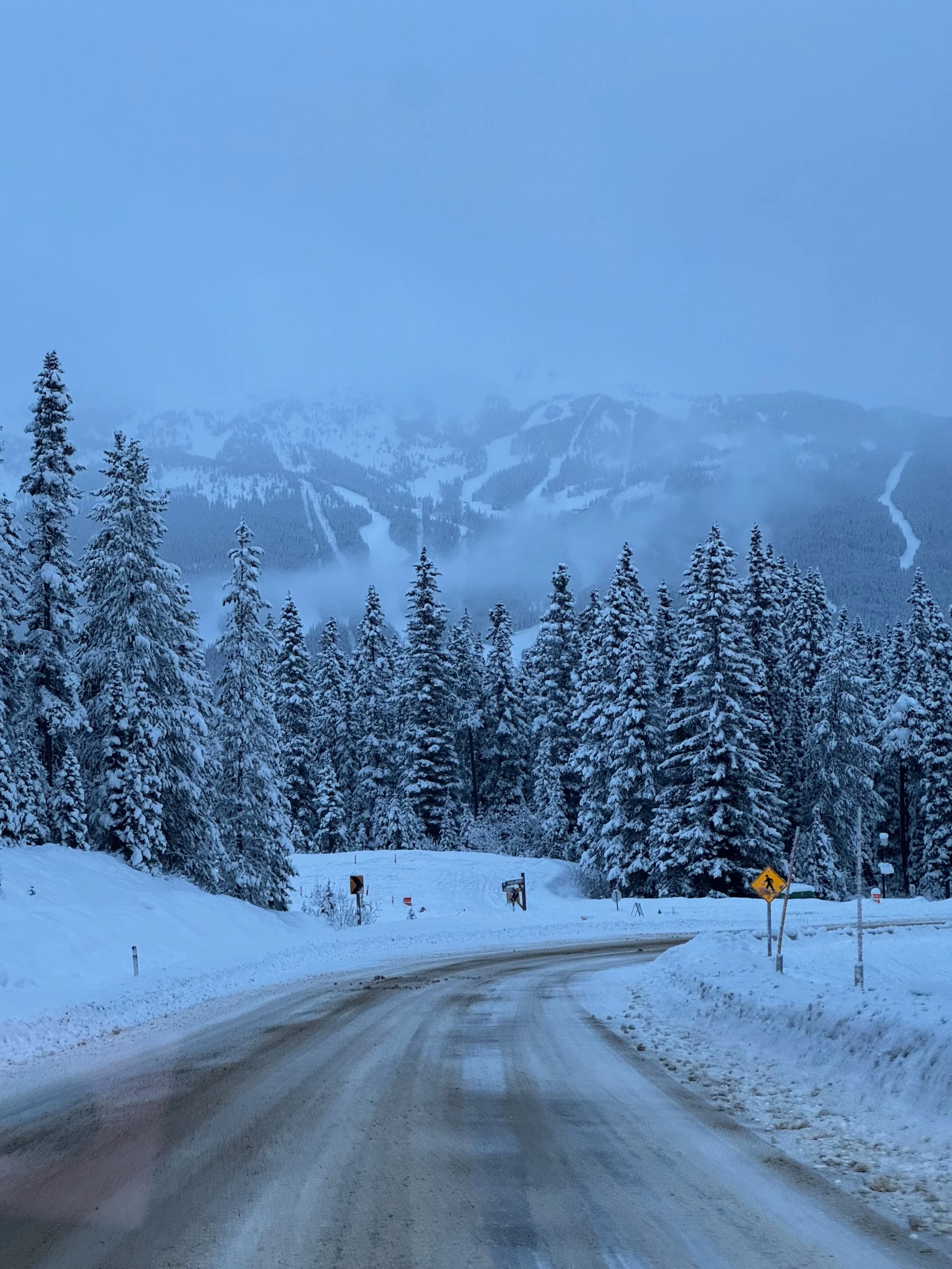
The drive from the lake to Lake Louise Ski Resort
As you’ll see in the Lodging section, there are three primary areas where you will likely be staying on a Lake Louise ski trip: Banff, Canmore, and the Village of Lake Louise.
SkiBig3 runs a free ski shuttle from Banff hotels to all three resorts, included with any SkiBig3 lift ticket, season pass, Mountain Collective pass, or Ikon Pass. Stay in Banff itself, and you can take this direct shuttle to Lake Louise Ski Resort.
Canmore is a little trickier. There's no direct public transit or standing ski shuttle from Canmore to Lake Louise — you'd take Roam's Route 3 into Banff first, then transfer to the 8X, which eats up a chunk of your morning. A private seasonal shuttle between Canmore and Lake Louise has run in past years but we cannot confirm if it’s still operating — so it's worth checking what's currently available before ruling it out.
Staying in the Village of Lake Louise solves this problem outright, and it's where we'd point most readers hoping to go car-free. The Fairmont Château Lake Louise runs its own complimentary shuttle to the resort every half hour, guests only, about a 10-minute ride. The Post Hotel does the same and their drivers will reportedly work around the published schedule if you ask nicely. Between hotel shuttles like these and Roam's 8X connecting the village to the resort, staying in Lake Louise itself removes most of the case for renting a car. The flip side is that lodging in the village is very limited (beyond those two hotels) and in our experience tends to be quite expensive relative to Canmore and many options in Banff.
Vehicle Rental
Although it’s certainly possible to utilize the above options to go car-free for your entire trip, we still recommend pricing out a rental car anyway. On our visits, it has ended up being surprisingly affordable to rent an AWD/4WD vehicle. This was largely due to a very favorable exchange rate with our USD, so it’s subject to change. But it doesn’t hurt to consider the costs of renting vs. public/private transportation just to see.
Alberta has no mandatory winter tire law, so don't assume your rental will come with true winter tires — most standard rentals are equipped with all-season tires instead. If you want winter tires specifically, ask at the counter, though expect to pay extra for them. Worth knowing: Parks Canada requires vehicles traveling within Banff National Park to carry winter tires or chains from November through April, so it's worth sorting out before you're on the highway. In our case, we reserved 4WD Jeeps or mid-sized AWD SUVs which came pre-equipped with appropriate tires. Although it did snow frequently during our trips, we never had any issues with traction.
Keep in mind that you may also be paying for parking at your place of lodging (although Lake Louise Ski Resort itself does not charge for parking) and certainly will need to pay for fuel before you return your vehicle at the end of your trip.
Best Time to Visit
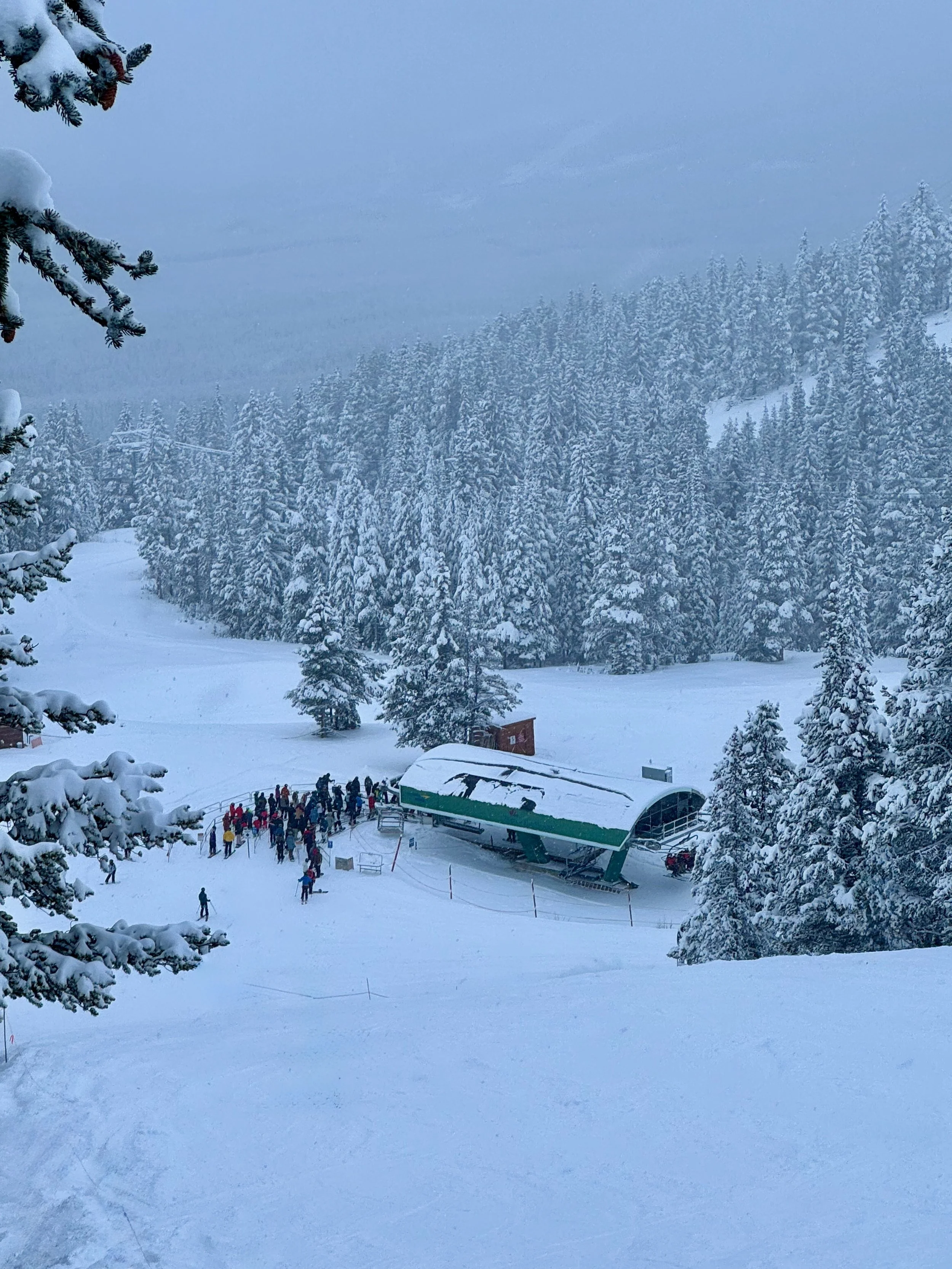
Fresh Snow at Mid-Mountain in November 2025
Lake Louise's season typically runs about six months, from early November to early May — one of the longer seasons you'll find in North America. That length, combined with the resort's latitude and altitude, is a big part of why we consider it one of the few resorts we'd call a consistently viable option for early season skiing. We broke down the data behind that claim in our Where to Ski at Thanksgiving article, and Lake Louise held up well across the seasons we looked at.
Midwinter is when you'll find the entire resort open and skiable, frontside to back bowls, with generally reliable conditions throughout January and February. The tradeoff is the cold. This is Banff National Park in the dead of winter, and temperatures can swing hard — the twenty-year average low at mid-mountain in the first week of February sits around 11°F, and it's not unheard of to see readings dip into the -20s during a true cold snap. Layer accordingly, and don't be surprised if the resort's cold weather guidelines come into play on the coldest days.
Snow and Weather Patterns
When we talk about mountain weather, we usually start with elevation. Higher terrain generally means lower air pressure and colder temperatures, and mountain topography can help wring moisture out of passing storms. But for Lake Louise, we are going to talk about latitude instead of altitude. Lake Louise sits at 51.4°N — a northern enough latitude that it affects the weather and climate more than the resort's elevation. The base is 5,401 feet — modest in comparison to many resorts in the U.S. Rockies — but the cold arriving from that far north compensates.
Lake Louise averages around 180-215 inches of snowfall each year. To put that in context, here's roughly where it lands next to some other resorts you might be considering — either as part of the same trip or as a mental yardstick if you're used to skiing elsewhere:
Lake Louise: ~180–215 in/year
Banff Sunshine Village: ~257 in/year
Kicking Horse: ~190–290 in/year (sources vary widely here)
Fernie: ~373 in/year
Revelstoke: ~410 in/year
Vail: ~350 in/year, for a U.S. comparison point
Take the exact numbers with a grain of salt — snowfall totals get measured and reported differently from resort to resort and site to site, and you'll find plenty of disagreement if you go looking. But the shape of it is consistent: Lake Louise sits at the drier end of this particular neighborhood, not the wet end.
It's a common observation among skiers who've spent time in the region: the Banff-area resorts get noticeably less total snowfall than their BC neighbors just a few hours west — Revelstoke and Fernie both average well over 350 inches a year, compared to somewhere in the 180–215 inch range at Lake Louise. That's a rain shadow effect. Storms moving in off the Pacific dump much of their moisture on BC's interior ranges before they ever reach the Continental Divide — where Lake Louise sits. What's left by the time a storm crosses into Alberta is a smaller quantity of snow, but colder, drier air means what does fall tends to be lighter and fluffier, with fewer rain events mixed in than you'd find closer to the coast. And the cold temps and lower sun angles this far north mean it sticks around longer. This may be why Lake Louise achieves a 5-Star rating for Snow Reliability from European resort tracking site skiresort.com.
Peak vs. Shoulder Season
The long season and the comparatively steady snow accumulation mean peak and shoulder don't map quite the same way here as at most resorts. Shoulder season could mean early January or late March at some resorts — those are arguably bordering on “peak” for Lake Louise. In fact, Lake Louise is one of the few resorts we would suggest you not only look at shoulder season, but even consider for early season skiing in November.
In our Where to Ski at Thanksgiving research, we found Lake Louise's base crosses the 28°F threshold for all-day snowmaking by the first week of November on average, while the summit and mid-mountain get there by the end of October. (Note: We use 28°F air temperature as a simplified proxy — real snowmaking efficiency also depends on humidity via wet-bulb temperature, which is usually a few degrees colder than the plain air reading. See OpenSnow's explainer for the full picture. Once the cold sets in, the snow tends to arrive steadily rather than in a few big dumps — averaging around 6 inches a week at mid-mountain through most of November, which is a more dependable pattern than resorts waiting on a single storm to open.
Steady isn't the same as guaranteed, though. Across the three seasons we studied, Lake Louise ran 4 of 8 lifts on (American) Thanksgiving Day in 2023, 8 of 9 in 2024, and 6 of 9 in 2025 — significat swings from year to year, even with the structural advantages working in its favor. The upside: once the mountain does get going, it goes quickly. In 2025 Lake Louise grew from 24 open runs on Thanksgiving Day to 104 by the following Sunday, once West Bowl came online.
Early season is a definite option at Lake Louise — not a sure thing, as the gap between 2023's slow start and 2024's near-full-fleet Thanksgiving shows — but a viable one, which puts it in a small club of resorts worth considering for an early trip. Midwinter, January into February and even March, is peak in the conventional sense: full mountain access and the most reliable snowpack, traded off against the coldest stretch of the season. And because the season runs into early May, spring holds on longer here than at most North American resorts, stretching what would normally be "shoulder season" into something closer to a second peak for skiers who don't mind variable spring conditions.
Ideal Trip Length
We wouldn't plan more than three days at Lake Louise itself. It's a big mountain, but three days is enough to get through the frontside, Larch, and the Back Bowls without repeating too much terrain, and it leaves room to add a side trip to Sunshine Village or Norquay while you're already in the park. If you're traveling on a Mountain Collective pass specifically, two days is the right call — that's all the pass covers here before you're paying full freight, and it lines up naturally with a shorter Lake Louise stint before moving on to your second Mountain Collective resort.
Major Mountain Clusters
Lake Louise has been built up slowly, organically and incrementally — across seven decades, generally just one lift or one new cluster at a time. Being inside a national park, the expansion timeline has been dictated as much by Parks Canada approvals as by skier demand.
Lake Louise's roots go back further than you might expect, and those roots didn’t even start at what is now the “front door” of the resort (the Front Side). A rope tow went up in 1952 on what's now the Larch side of the mountain, followed by a Poma platter to Larch Hill in 1954. The Front Side didn't get its own lift until 1958–59, when the resort installed Canada's first gondola, partway up Mount Whitehorn. Those dates still put Lake Louise ahead of the wave that built most of the big-name resorts people now think of as classic western skiing: Vail didn't open until 1962, Steamboat and Breckenridge in 1961, Jackson Hole in 1963. Lake Louise certainly wasn't first — Sun Valley, Alta, and Winter Park all beat it by fifteen to twenty years — but it was already an established, growing resort while places like Vail were still sheep pasture.
Despite that early split start, the Front Side has long since become the heart of the resort. Unlike many resorts of this size, Lake Louise has only one base area today. Access to all backside terrain (as well as the frontside summit) goes through one of the lifts that rise up from the frontside base.
The next expansion came on the back side: the Back Bowls followed in 1976 with a single platter lift, and Paradise arrived in 1982, purpose-built to improve access into those bowls once new ownership took over the resort.
For decades after that, growth mostly meant upgrading what already existed rather than opening new terrain — until 2021, when West Bowl became the resort's first new in-bounds terrain in a quarter century, followed by Richardson's Ridge in December 2025.
That history shows up on the map today as six major clusters, which we'll break down one at a time: Front Side, West Bowl, Back Bowls, Paradise, Larch, and Richardson's Ridge. Geographically, Front Side sits at the center of the resort and functions as the hub everything else branches from — West Bowl sits off its far western edge, Larch and Richardson’s off the east, with Paradise and the Back Bowls making up nearly the entire backside of the mountain.
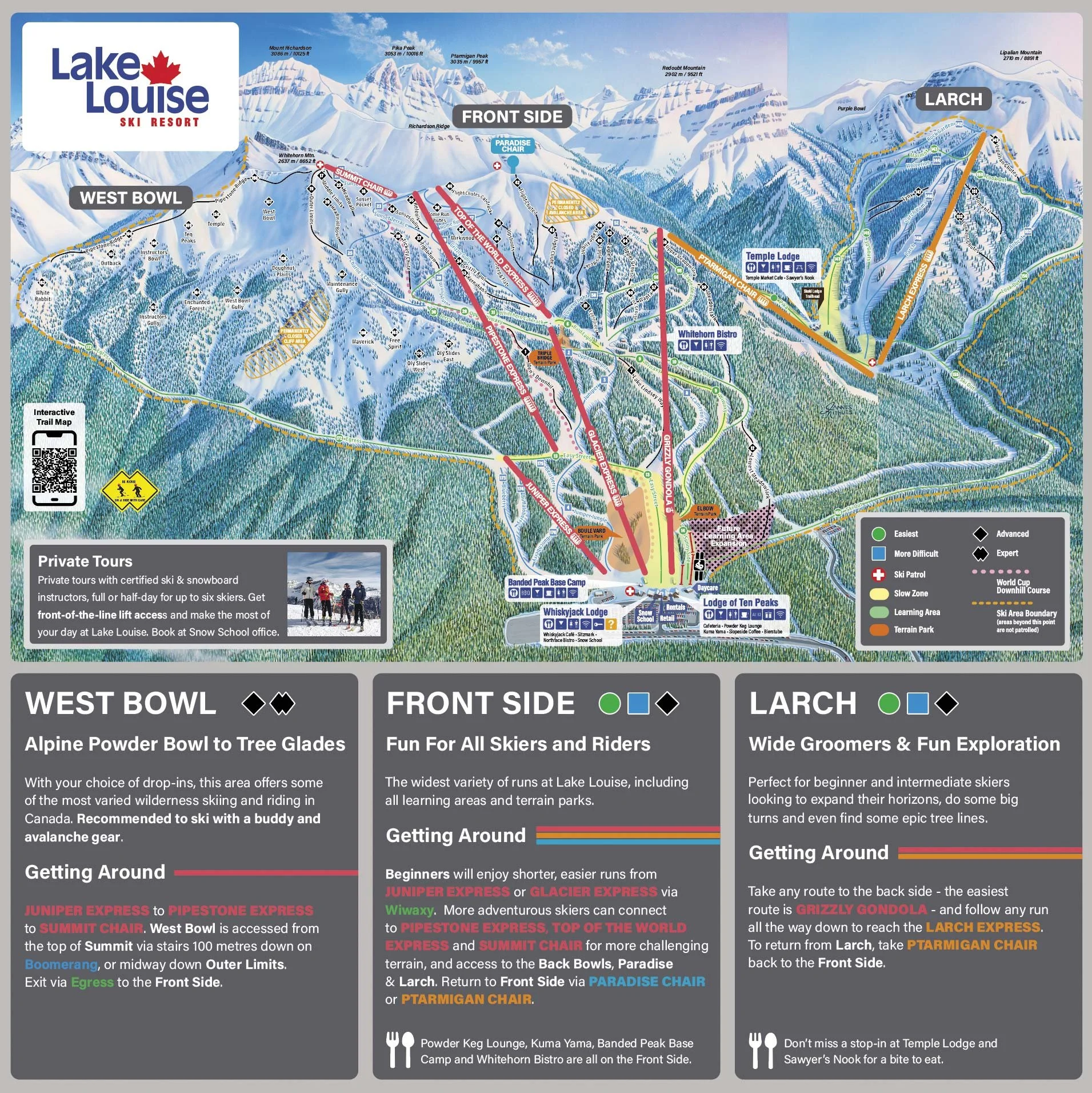
As always, representing a complex real, three-dimensional network of mountainous ski trails and terrain on a two-dimensional map is a challenge for map designers. It can be hard to tell how some of these clusters relate to each other or how to find connecting routes. Lake Louise actually offers a 3-D view on their website if you want to cross-reference our written descriptions.
Front Side
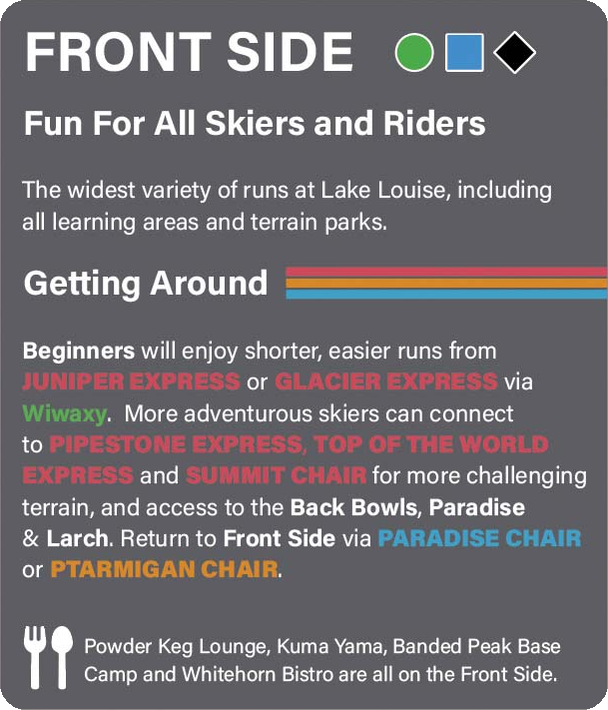
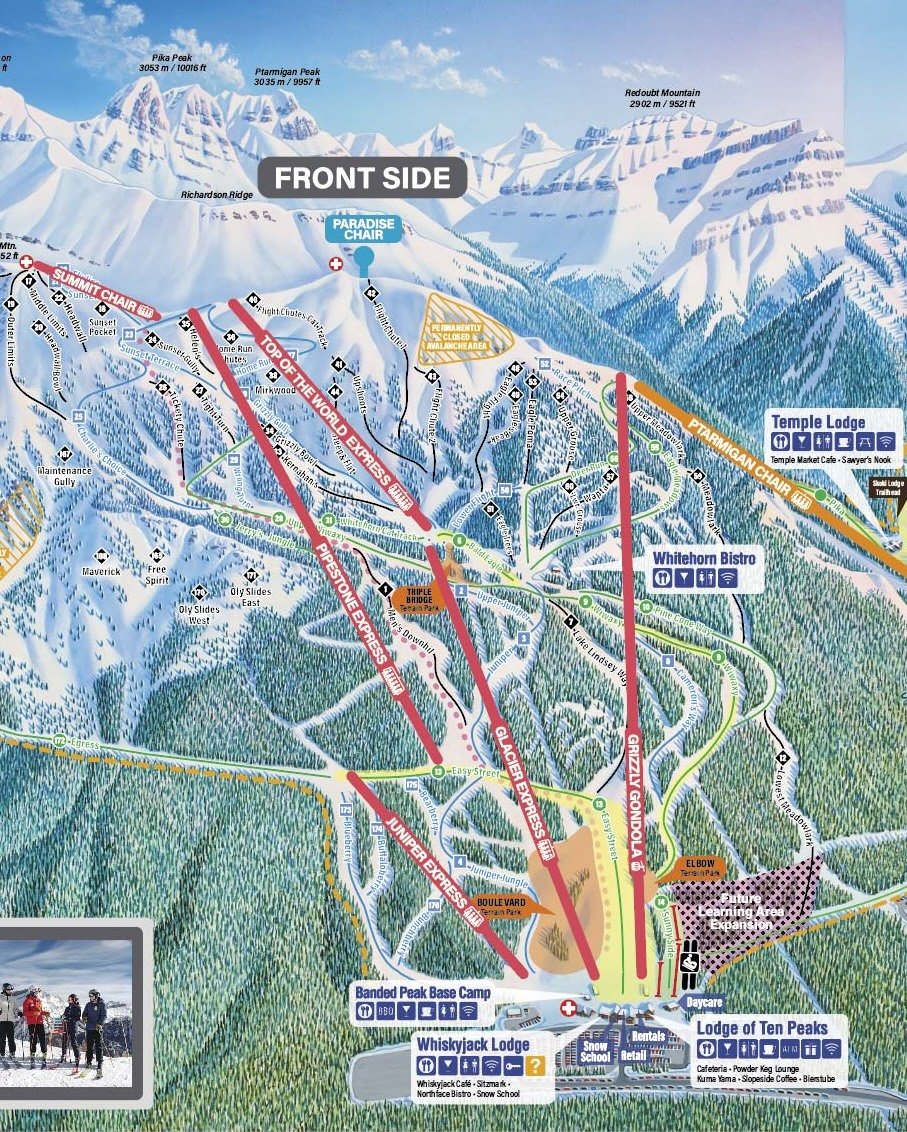
The heart of the resort, the Front Side is the starting point of everyone’s day. Whether you are a beginner learning to ski for the first time or an experienced backcountry skier who carries a beacon and an airbag — you’re still starting (and ending) your day at the Front Side base. There are multiple lifts to choose from, each giving you access to different sets of terrain or different lifts from which to continue your day. We will go through these, roughly in the order of how far they will get you up the mountain (and on to other terrain).
Sunnyside Carpets (3)
Sunnyside, marked as a single trail on the trail map, is a marked learning area for beginning skiers. There are three carpets here (Lower Sunnyside, Upper Sunnyside, and a short one simply named “Magic Carpet”) to get novices and learners around the gentle terrain in this area.
Juniper Express
Juniper is a four-person express lift off to the west side of the base (to the left as you exit the lodge/parking area). Installed in 2021, it services six runs, five of which are rated as intermediates (and all five have berry-themed names such as Blueberry or Buffaloberry). The outlier is a green run named Easy Street. All six trails lead back to the base, but if you take Easy Street off the top of the lift, you will soon encounter the loading station for the Pipestone Express Chair (see below) that will take you high up the mountain, close to the summit.
Glacier Express
One of the two lifts that occupy the central territory of the lower Front Side, the Glacier Express is a four-person chair that whisks skiers up to mid-mountain. Installed in 2000, it replaced a 1976 triple chair and provided much higher capacity and speed. The trail map lists 11 runs serviced by this lift: four Greens, five Blues and two Black Diamonds. All of these trails take you back down to the base, although the Intermediate trail Juniper will let you jump on the Pipestone Express instead. At 6,081 feet in length, this lift is substantially longer than the Juniper Express lift (3,576 feet) and naturally the trails accessed by Glacier Express are also lengthier. The green-rated Wiwaxy is a particularly long, meandering groomer that winds its way across the Front Side from mid-mountain to the base. It's perfect for less experienced skiers who are ready to start to stretch their legs and test their skills.
Grizzly Gondola
This six-person gondola takes skiers the highest on the Front Side of the three aerial lifts, and provides access to the most terrain, additional lift options, and even a few trails on the back side of the mountain. The gondola itself was installed in 2004 and repurposed from what is now Palisades Tahoe. We’ve never experienced anything other than a smooth ride but this lift is very popular and can attract crowds (and lines) on busy days. The trail map shows 20 trails serviced by the gondola with a mix of ability levels. The gondola offers the most access by far to the most expert options of the frontside lifts. Meadowlark is a standout for us, a long, meandering black diamond through the forest that is occasionally groomed. It’s a great trail to return to the base at the end of the day, but not for everyone (especially if ungroomed). Surprisingly there are no intermediate-rated options from the top of the gondola to get to the base, but Deer Run and Eagle Meadows are healthy greens with wonderful views — once you get closer to mid-mountain you can opt to take several different blues down further. For skiers who wish to go higher or deeper into the resort, the most direct route is to ski down Lower Flight to the Top of the World Lift loading station, or hop off the backside at the top station of the gondola and explore the Ptarmigan area (which we will cover in more detail in the Paradise cluster).
Aside from the learning area's magic carpets, taking any of the base area lifts will put you in the position to lap some of the base runs if you wish. But each can also give you access to more advanced terrain such as the Front Side summit area or various areas of the backside. Once you decide where you want to explore next, here are the remaining Front Side lift options, the terrain they give you access to, and the additional terrain you can access without taking any more lifts:
Pipestone Express
Opened in 2024, this six-person heated bubble chair is an alternate route up to Summit Chair — alongside the Glacier Express to Top of the World route. The heated seats and protective bubble can be a welcome warm-up on a cold morning, or really any time the arctic winds pick up and the wind chill drops below zero. Once you're at the top you have options: hop straight onto Summit Chair, or ski down either side of the ridge where Pipestone unloads.
Here we will focus on the Front Side terrain served by this lift: Home Run, Charlie's Choice, Sunset Terrace, and Grizzly Gully are all intermediates that bring you back down to the base of Top of the World or Pipestone itself (or all the way to the resort base, if you're calling it a day). Our favorite is Sunset Terrace — there's a switchback partway down with one of the best views of the surrounding Rockies you'll find anywhere on the mountain. One side note: Sunset Terrace is listed as an intermediate on the printed trail map, but the “interactive map” on the Lake Louise website lists it as a green.
A few short expert pitches are mixed in if you want to test your legs, but if you want to really open things up you’ll want to continue on to West Bowl or the Back Bowls.
Pipestone’s bottom station can be reached three ways: ski Easy Street from the top of Juniper Express, ski the trail Juniper down from Glacier Express, or — from the Grizzly Gondola — make your way to the mid-mountain area where the Whitehorn Bistro is located, and jump on the trail Juniper from there.
Top of the World Express
Top of the World Express is a high-speed, six-person lift installed in 2002. As the name implies, this lift brings skiers very close to the summit of the resort, unloading along the same ridge that the Pipestone Express does — just a bit higher elevation. This lift provides the alternate path to get to the loading station of the Summit Chair lift. It also serves substantial terrain in and of itself: the trail map lists 28 named trails served by this lift. But the majority of that terrain belongs to Paradise so we'll cover it there.
The Front Side terrain accessible from Top of the World is essentially the same terrain we covered in Pipestone, above. These two lifts' top stations are adjacent to each other along the ridge.
There are a handful of trails near the top station of Top of the World that would appear to be reachable with an uphill walk, but the best way to access them is actually to wind around the backside to Paradise lift (more on this one in the Paradise cluster section). These trails include Flight Chutes Cat Track, Upshoots, Flight Chutes 1 and 2, Steep & Flat, Eagle Flight, Eagle's Beak, and Eagle Poma.
The Top of the World loading station can be reached from the top of the Glacier Express lift, or from Grizzly Gondola (take Deer Run to Lower Flight).
Summit Chair
Both Top of the World and Pipestone are strategically located to get skiers to one particular place: the bottom station of the lift that takes you to the summit. Installed in 2020, the four-person Summit Chair replaced an older platter lift (installed in 1976) that ran along a slightly different line to the summit. A notably short, fixed-grip lift with a ride time of less than three and a half minutes, Summit Chair has one job: get you to the highest lift-served point of the resort. The entire trip is above treeline, and once unloaded you are rewarded with an unspoiled, 360-degree view of the surrounding Rockies. On a clear day — it is beyond compare.
There are two intermediate trails accessible from the top of Summit Chair: Skyline and Sunset. If you want to take some quick laps on the Summit Chair and soak in the monumental views, take Skyline straight back down to the lift loading station. The trail runs directly under the lift and you can hop right back in line (or, in our experience, straight back on to the lift with no wait at all). Alternately, Sunset also roughly follows the same path, just a bit lower down. It does not return you to the base of the lift. Following this trail will lead you to an intersection with Sunset Terrace (described above under Pipestone).
For those looking for more of a challenge, the remaining Front Side accessible trails from the top of Summit form a high alpine bowl where you can pretty much pick your line. The named trails along this bowl are Sunset Pocket (which you drop into from Sunset), Headwall, Middle Limits, Outer Limits, and Headwall Bowl. As with all bowl-style terrain, those “trails” are really just suggestions — skiers have free rein to choose their own path down and through. These are all rated as black diamond difficulty, and all will guide you towards either Sunset Terrace or Charlie’s Choice and take you back down the Front Side.
That covers all of the Front Side terrain accessible from Summit Chair. The backside terrain will be covered in detail in the Back Bowls cluster. Skiers can also choose to continue west from the top of Summit Chair to reach the next cluster we will review: West Bowl.
West Bowl
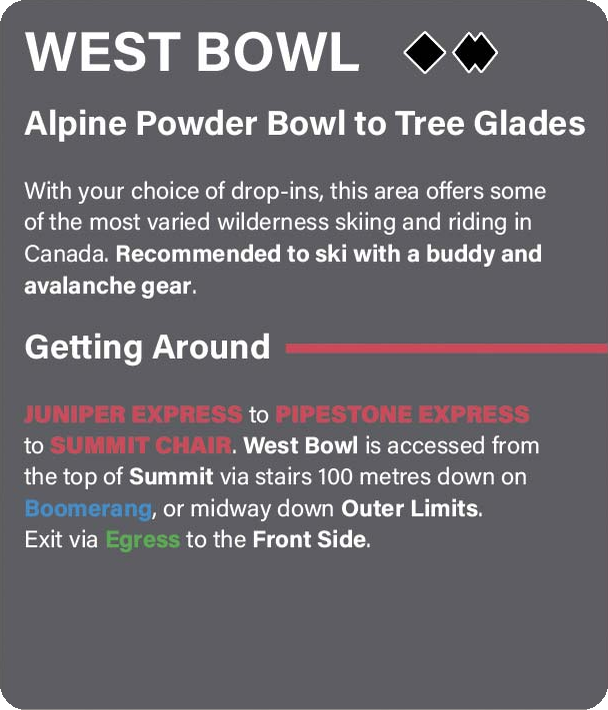
West Bowl is one of the resort’s newer clusters, opening for the 2020–21 season in conjunction with the retirement of the old Summit Platter in favor of the current Summit Chair. Take a step back and look at the frontside trail map (mechanical note: insert link to full trail map here) — although probably not to exact scale, you can still see how enormous this 480-acre territory really is — and the vast majority of this is skiable (there is one small “permanently closed” cliff area). The next thing you may notice is: there are few marked trails at all — really just the top ridge (Pipestone Ridge) and the exit Egress are marked as actual trails. Everything else is general area. Lake Louise intentionally declined to cut runs, grade slopes, or post trail signs across this new terrain. Even though it's technically in-bounds, the resort wanted it to still feel like the backcountry it was before 2020.
Instead of marked lines, West Bowl features loosely bounded zones at the top with names like West Bowl, Temple, and Ten Peaks — which are steep bowls above the treeline with few visible differentiating features. This is classic bowl skiing — pick a name, point yourself downhill, and the rest is up to you. Once you descend to tree-level, you’ll enter what Lake Louise has deemed a series of “gullies” — another set of general areas with names like West Bowl Gully, Enchanted Forest, Instructors Gully and the oddly named (to us, at least) Maintenance Gully. These are steep, heavily gladed areas that all funnel you towards the run-out trail, Egress. The gullies in the middle of West Bowl tend to be thicker with trees, while the areas around the edges (such as White Rabbit to the west and Maverick and others to the east) are more sparse and continue the more bowl-like terrain from the top.
There's an interesting story behind this expansion that helps put things in context. The new terrain sits outside Lake Louise's original leasehold, so the resort gave back roughly 1,000 acres elsewhere to Parks Canada — much of it grizzly habitat — as part of the deal. This actually trimmed the resort's overall footprint by about 30 percent even as it opened new terrain to skiers.
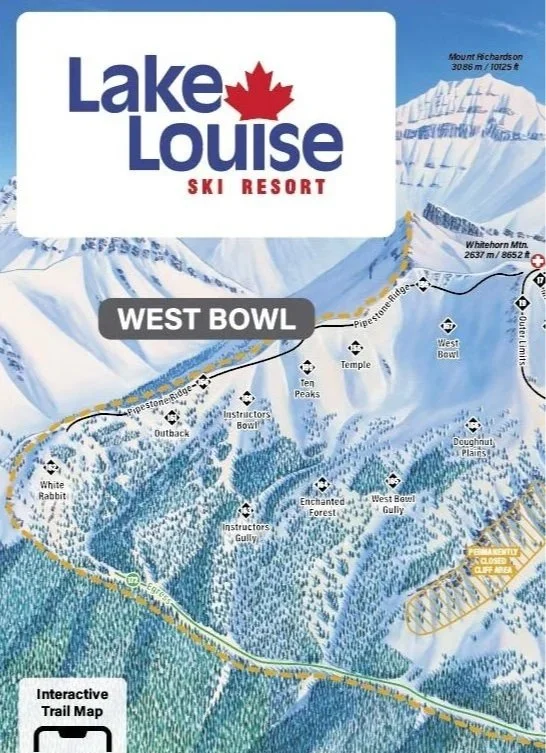
Getting out to this “wilderness” takes a little work. The only access to West Bowl is from the top of Summit Chair. To get there, you’ll need to ride Juniper Express to Pipestone Express, or Glacier Express to Top of the World Express — either route lands you at the Summit Chair loading station. From the top of Summit, West Bowl still isn't directly underfoot. You’ll need to drop about 100 meters down Boomerang (officially a Back Bowls trail, which we will cover in that cluster) to a staircase that cuts across into the zone, or ski partway down Outer Limits, which has its own cut-in.
Note: There's no lift inside West Bowl itself. Once you drop in, you're committed to skiing all the way down and out.
And "out" means one specific path. Every line in West Bowl funnels into a single long, groomed egress trail (imaginatively named Egress) that spits you back out at the top of the Juniper Express lift onto Easy Street — the same connector from the Front Side section — for an easy run down to the base or a quick hop over to Pipestone Express for another lap. You can't get truly lost in here; if you start at the top of West Bowl and keep heading downhill — you’ll hit Egress eventually. One interesting discrepancy that we’ve found: On the printed, 2D trail map Egress is clearly marked as a green, beginner-rated trail, which makes sense as it is gently sloped and completely straight. More of a catwalk than a trail. But on the interactive, three-dimensional map it is shown as a black diamond. Our speculation is that they did not want novice skiers seeing a beginner-rated trail in this cluster and mistakenly assuming they can get to it without going through true expert terrain. Hopefully they resolve this discrepancy in the future.
The current trail map rates the rest of this entire cluster as Advanced, and it means it: there's no beginner or low-intermediate line down, and once you've committed to a route there's no bailing to something easier partway through. It is worth noting that while the individual zones in West Bowl are all Advanced, the trail map designates the West Bowl cluster as a whole with a double-black “expert” rating.
Ski Magazine's coverage of the opening described some corners as skiing more like advanced-intermediate terrain for strong skiers with the right skills, but don't plan a West Bowl lap for anyone who isn't fully comfortable in ungroomed, ungraded terrain. Traveling with a partner and carrying avalanche safety gear is strongly recommended — not a formality, given this was backcountry-only terrain until Parks Canada agreed to bring it in-bounds. If you don't already hold AST 1 certification, Lake Louise runs its own two-day courses with Avalanche Canada, and gear can be rented in the village, Banff, or Canmore.
The next cluster we'll cover, the Back Bowls, is the other area accessed primarily off Summit Chair.
Back Bowls
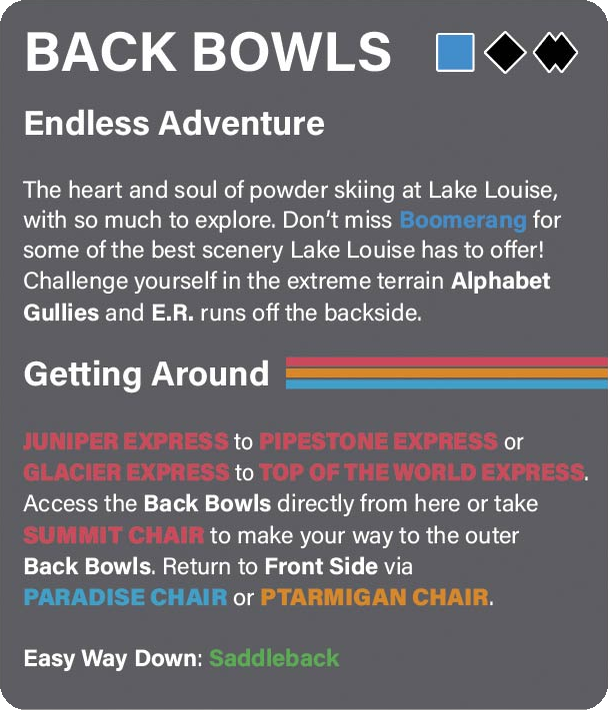
The Back Bowls cluster is probably what put Lake Louise on the map for advanced skiers. It opened in 1976 with a single platter lift, decades before West Bowl or Richardson's Ridge existed, and for most of the resort's history it was the only place to find this kind of terrain in-bounds. Summit Chair has handled access since 2020, replacing the old platter on a shorter, more direct line — but the terrain itself hasn't been softened one bit. This is the most consistently expert-rated cluster at the resort, with some advanced terrain mixed in and a single blue connector trail that mainly exists to get you back out of the Back Bowls (or back out of trouble, if you bite off more than you can chew and need to bail). The majority of the named runs in the Back Bowls are indeed rated as double-black diamond, which is a stark contrast to West Bowl, which surprisingly has no double-black terrain at all despite the trail map rating the West Bowl cluster overall as double-black.
Getting here means committing to the same climb as West Bowl, however: Juniper Express to Pipestone Express, or Glacier Express to Top of the World Express, either of which gets you to the ridge — then continue on to Summit Chair itself. Top of the World's own terrain, despite unloading nearby, belongs to Paradise, Front Side, and West Bowl, not Back Bowls. Summit Chair is the one lift that actually opens this cluster up.
Off the top of Summit, heading back in the direction of the Summit Chair loading station, Whitehorn 1 is the first thing you'll hit: the Ridge Run trail, then four numbered gates (1st, 2nd, 3rd, 4th) dropping into short, steep pitches that funnel down into Rodney's Ridge and finally Hour Glass, which spills out right at the Saddleback line — Back Bowls' "boundary line" trail before Paradise takes over. These aren’t quite interchangeable — they run a difficulty gradient, with 1st Gate the longest and hardest and 4th Gate the shortest and easiest.
Back at the top, continue along the ridge away from the Summit Lift instead and you'll reach Whitehorn 2, better known as the Alphabet Gullies — nine parallel chutes, A Gully through I Gully, fanning down the bowl with a permanently closed avalanche-control zone sitting in the middle. We have read that this closed zone may be referred to as “Whitehorn 3” by locals, with I Gully actually part of this zone (as opposed to Whitehorn 2) and the only chute that is ever open and skiable. Pick a letter and go; they're steep and narrow enough that there's not much practical difference between them beyond which one happens to be catching light or wind that day. All are double-black diamonds.
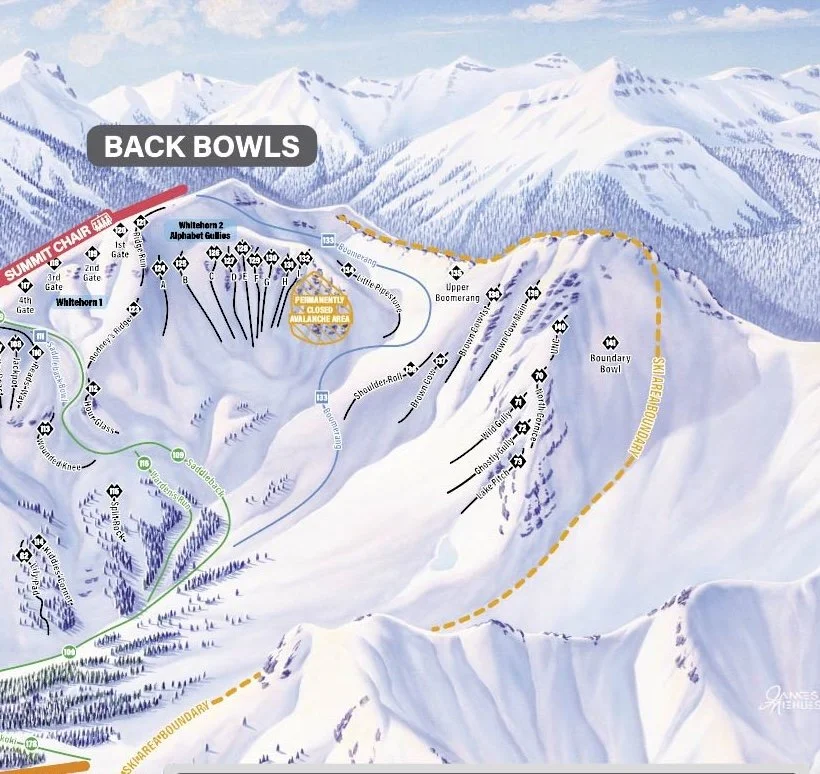
Little Pipestone (single black) and Boomerang (Intermediate) thread around the edges of the gullies and give you a way to bail to something at least slightly more moderate without leaving the cluster. Boomerang can be accessed directly from the summit ridge and stays blue the entire way down, ending right at Saddleback — meaning you can ski the Back Bowls cluster without ever setting foot on Expert/Advanced terrain if you wish. The trail map also singles out Boomerang as offering one of the best views that Lake Louise has to offer — and we won’t argue with that since on a clear day it offers unobstructed views of the surrounding, completely undeveloped, Banff National Park.
Beyond the gullies, the terrain gets more remote rather than less. Upper Boomerang, Shoulder Roll, Brown Cow, and Brown Cow Main sit further out along the ridge, with Boundary Bowl, Wild Gully, Ghostly Gully, Lake Pitch, and the enigmatically named (to us, at least) UNC hugging the actual ski area boundary line beyond that. We have read one report that UNC stands for Upper North Cornice — which would make sense since this feeds to the “North Cornice” area. That’s the type of information a local may know but doesn’t show up on a trail map. None of this outer ring shows up on any lift's serviceable-runs list — you get there by continuing to traverse out past Boomerang or Little Pipestone, not by riding a lift to it.
Although generally rated more challenging than West Bowl, the Back Bowls cluster doesn't quite have West Bowl's fully wild, uncut character — these are still named, patrolled lines, and much more of it is above treeline compared to West Bowl so you can see plenty of adjacent activity. But this outermost area is the most remote pocket of terrain in Back Bowls, and the extra effort to reach it keeps things quieter than anywhere else in the cluster.
There's no lift back to the Front Side from anywhere in Back Bowls — in fact there is no lift at all within this cluster. Whatever line you pick, you'll come out into Paradise or Ptarmigan territory and need to ride Paradise Chair or Ptarmigan Chair to get home — both covered next. If you wish to return for more Back Bowls terrain, take Paradise up and ski down the ridge on Saddleback past Top of the World and Pipestone to reach the Summit Chair loading station.
Paradise (and Ptarmigan)
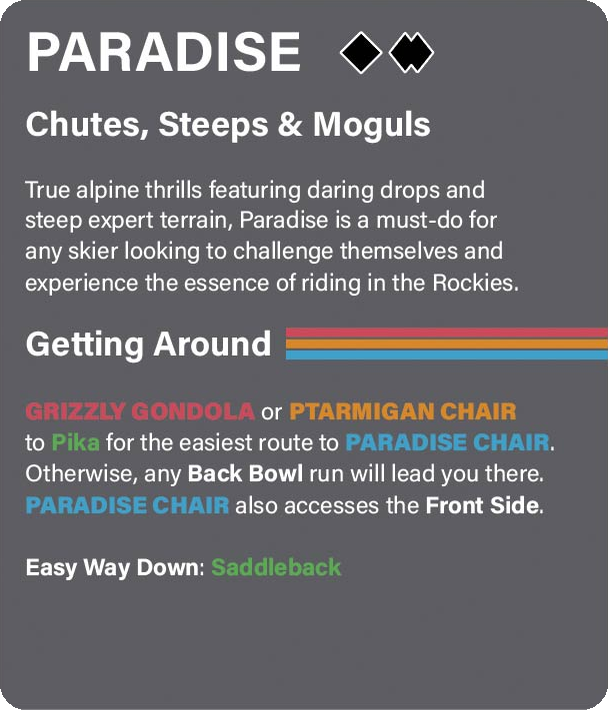
If Back Bowls is where Lake Louise built its reputation, the resort doubled down when they opened up Paradise. Paradise Chair — a fixed-grip triple built by Yan — arrived in 1982, purpose-built to open this bowl once new ownership took over the resort, and it's still the only lift that reaches this terrain directly. We're grouping Ptarmigan into this cluster too. It's a separate lift rising from the Front Side base, installed in its current form in 2008, but dating all the way back to 1966 when a double chair was installed to link up the Larch section of the resort to what we now call the Front Side. But when Paradise opened, Ptarmigan naturally began doing double-duty — a path to get back to the Front Side from all the backside terrain, as well as a great route to access Paradise terrain.
Paradise Chair
Let’s start with Paradise Chair. Nearly everything this chair reaches falls under a ridge locals call Eagle Ridge — E.R. for short — broken into seven numbered sections running roughly looker's-left to looker's-right as you traverse out along Corridor from the top of the lift:
E.R. 1 is East Bowl on its own, at the far end of the traverse.
E.R. 2 covers Crow Bowl and the 2/3 Shoulder, along with East Bowl Trees — tighter and steeper than the approach suggests.
E.R. 3 holds some of the steepest terrain on the ridge, funneling down through the reliably rocky Swede's into Powder Pockets.
E.R. 4 is the most-skied section and home to the marquee run of the whole cluster: Paradise Bowl itself, one of the widest open bowls you'll find at any resort in North America, plus Fenceline Gully, Paradise Cornice, and its lower extension, 4/5 Shoulder.
E.R. 5 is the most extreme terrain on the mountain, and the upper pitches need a rare amount of snow to ever open — Lower 5 and Kiddie's Corner, the more forgiving lower portions, see far more traffic than anything above them.
E.R. 6 is the namesake run, dropping into either Kiddie's Corner or Split Rock depending which way you cut at the bottom.
E.R. 7 is the same fan of chutes we flagged back in Back Bowls as Paradise's despite unloading right next to Back Bowls' own terrain — Big 7, Drop Out, Vertical Cornice, Couloir, Peyto's Pitch, The Beast, and Jackpot — also reachable from Top of the World if you're coming from that side of the ridge instead.
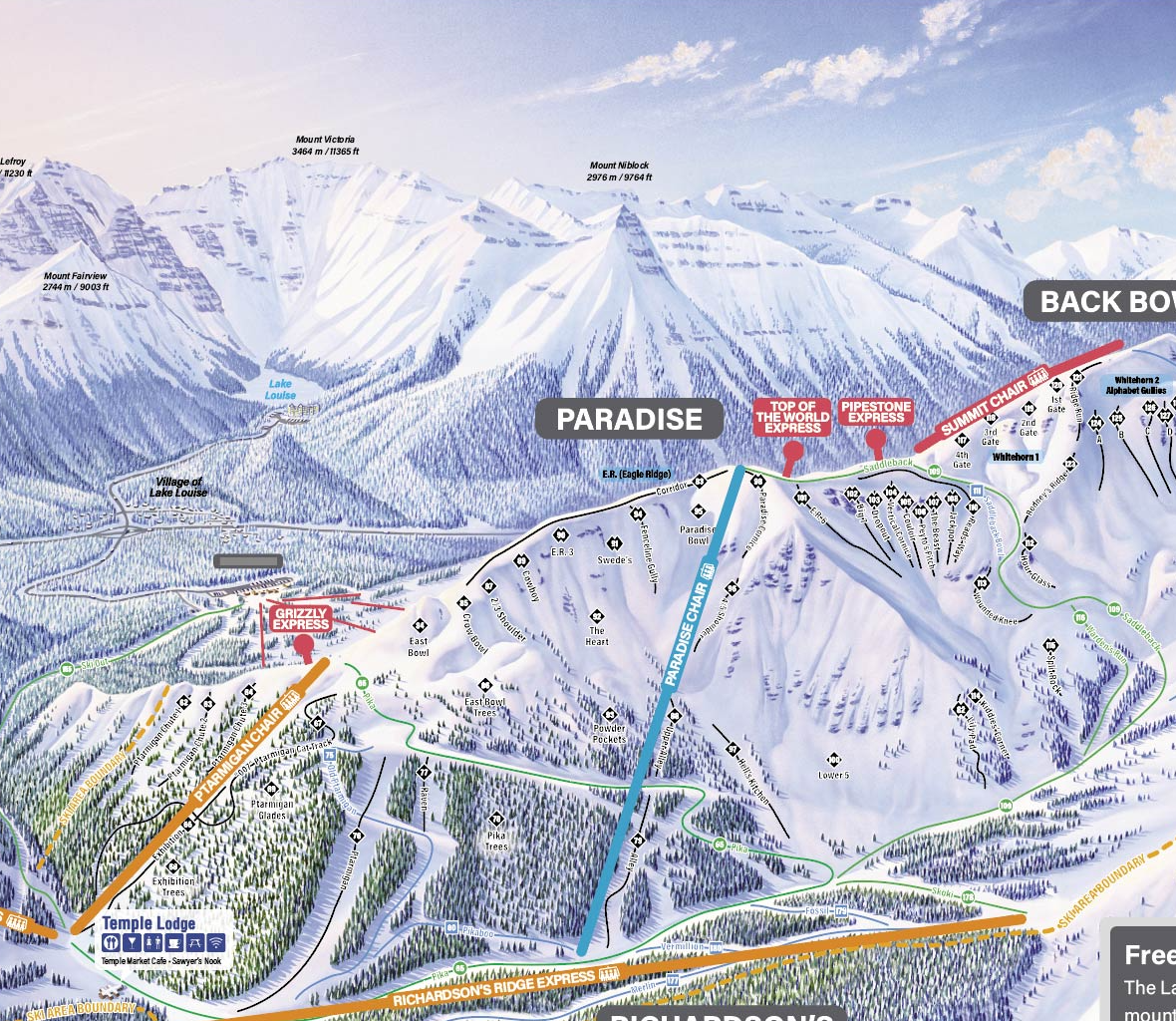
Coming down, Saddleback is the one trail here rated for everyone: a long, green, above-treeline traverse that doubles as the easy way down for both Paradise and Back Bowls. Saddleback Bowl sits right alongside it, a blue alternative for skiers who want a bit more pitch than the traverse without committing to anything harder. Wounded Knee, Split Rock, and Warden's Run round out the way down, though they're not interchangeable: Wounded Knee is a double black, but short. Split Rock carries the same rating but only really earns it if you take one specific, avoidable rock drop near the top; and Warden's Run, also rated green, is the gentlest of the three, just a shade steeper than Saddleback's own lower half, worth taking over it for the speed retention on an otherwise flat exit.
The placement of this lift means you unload along the same ridge that two Front Side lifts (Top of the World and Pipestone) also unload at, just slightly above them. In practice, this means that Paradise Chair riders can opt to ski over the ridge to the Front Side and take a number of different trail options that are otherwise unreachable from those Front Side lifts: Flight Chutes Cat Track, Upshoots, Flight Chutes 1 and 2, Steep & Flat, Eagle Flight, Eagle's Beak, Eagle Poma. Paradise riders can also take Saddleback down past Top of the World and Pipestone and access any of the terrain we’ve already covered under those lifts — or they can continue on to load Summit Chair. In some ways, Paradise is the linchpin of the resort’s lift network.
Ptarmigan Chair
Ptarmigan is a four-person, fixed-grip chair rising from roughly the same base area as Larch Express (discussed next, in the Larch cluster). You can also reach it three ways:
If you are arriving from the Front Side, unload from the Grizzly Gondola and look for Pika — a long, meandering green trail that crosses under Paradise Chair before turning back and routing skiers down to the loading station of Ptarmigan. As skiers take Pika down, there are numerous opportunities to jump off onto other trails, most of which are rated as advanced. There is a large block of closely gladed trees named Pika Trees right off Pika for those who want to get some nice tree skiing in but don’t want to journey over to West Bowl. Pika also takes skiers right past the loading station for Paradise Chair.
Skiers coming in from Back Bowls or other Paradise trails are naturally routed to the bottom of Pika, which will eventually place them at Ptarmigan’s loading station (unless they load onto Paradise Chair first).
For Richardson’s Ridge or Larch Express skiers, Ptarmigan can be easily accessed from the bottom of either of those clusters. Something to keep in mind: Ptarmigan is the only route back to the Front Side from Larch. Richardson's Ridge has a second option — Paradise Chair also gets you home from there.
Ptarmigan is the access point to its own set of terrain, as well: primarily a dense pocket of advanced-rated glades and chutes. This includes Ptarmigan Glades and Exhibition Trees for tree skiing, plus Lower Grouse, Wapta, Lake Lindsey Way, Ptarmigan, and Raven rounding out the black-diamond list. Old Ptarmigan starts out as a road before turning into a winding groomer partway down, and a connector nicknamed the "007" catwalk threads from it into the glades. The three numbered Ptarmigan Chutes get progressively narrower — Chute 3 is the widest entry, Chute 1 sits in the middle, and Chute 2 is the tightest of the three. Old Ptarmigan and Cameron's Way are the closest things to a breather here, both rated blue.
None of this is beginner terrain. So, if you're not ready for it — or just need a break — hop on Pika at the top and enjoy the long cruise. There simply isn't a bad view at Lake Louise and even the most seasoned skiers could stand to pause and soak in the landscape.
At the bottom of the Paradise cluster, you can access either the oldest skiable terrain in the resort (Larch) or the newest (Richardson's Ridge). We will cover both in the next two sections.
Larch
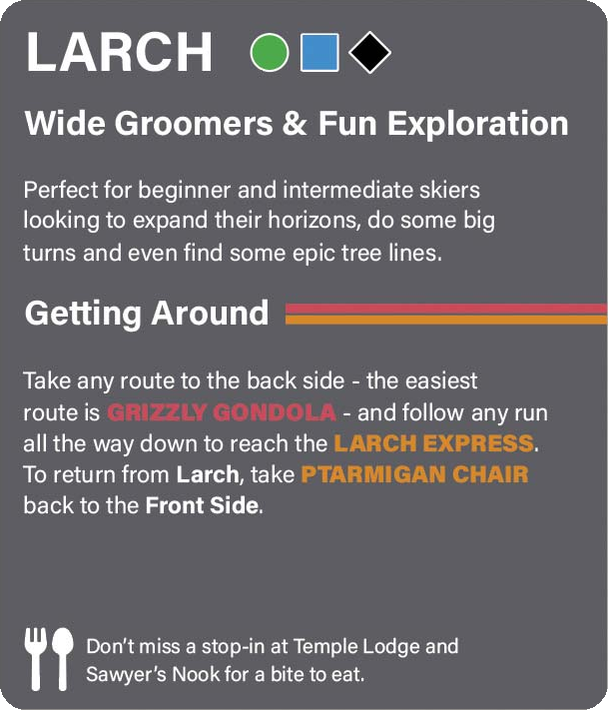
Larch has a legitimate claim to being the oldest developed terrain at the resort. A rope tow went up here in 1952, followed by a $25,000 Poma platter to Larch Hill in 1954 — both ahead of the Front Side's first lift by several years. That original Poma gave way to a double chair in 1972, and the double was replaced with the current high-speed quad in 1998. It's a smaller, gentler cluster than Back Bowls or Paradise, and very diverse — offering a full range from beginner trails to double-black expert terrain. There is something here for everyone, and it’s a great cluster for mixed groups to ski together — splitting up after unloading but meeting up again at the bottom.
Larch (and its neighbor Richardson’s Ridge) presents another interesting challenge to the trail map artists. Geographically, it’s somewhat behind the main mountain that makes up the Front Side, West Bowl, Back Bowls and Paradise. It sits across a narrow valley, roughly facing the Ptarmigan area of Paradise. You cannot access it directly from any Front Side lift — you must descend along the backside first to eventually reach the Larch Express lift. But the aspect of this territory makes it more logical to place it on the frontside trail map, which is where you will find it.
The location is somewhat remote from the Front Side base area, but you have several options to reach Larch depending on how much of a challenge you want to take on. The most direct route would be to ride Grizzly Gondola and take any Paradise/Ptarmigan run down to the Larch Express base — with Pika being the easiest trail. For more of a challenge, choose one of the more advanced options within Paradise/Ptarmigan. And if you really want to take the long way (and ski some expert terrain in the process) you can take Pipestone or Top of the World, transfer to Summit Chair, and choose your route down the Back Bowls. That will inevitably put you on Saddleback, which eventually transitions to Pika.
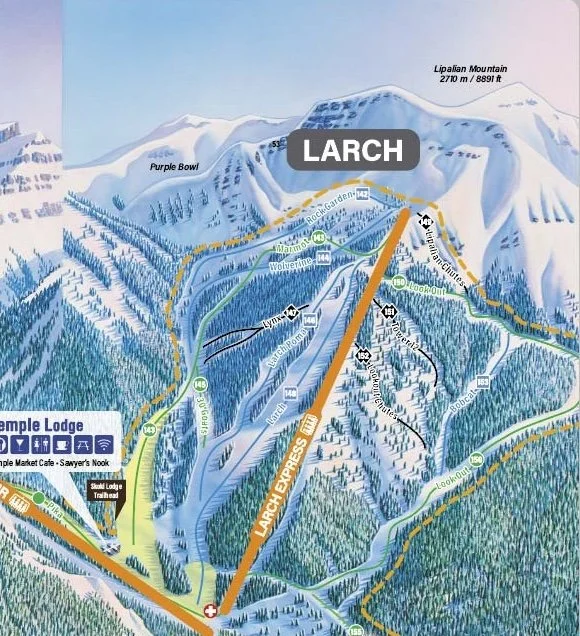
The terrain on Larch is significantly different than the backside terrain it faces — weighted toward wide, groomed cruising, with a few pockets of tree skiing for those on the hunt for it. Rock Garden is the standout intermediate run and one that we highly recommend for the novelty — a boulder-strewn slope that demands precise turns but is rewarding once you’ve made it through. Pay attention to the trail report — this one can sometimes get bumped up to black-diamond status if the coverage is too thin.
Marmot is a narrow green, fine for a confident beginner but not a first-timer's run. Wolverine offers solid intermediate bump skiing, and Lynx is similar (but more advanced). Bobcat is worth an asterisk here — it shows as a blue on the printed map, but a black diamond on the interactive one. This is one more example of the rating inconsistencies we mentioned earlier in this guide.
The Larch run itself, the cluster's namesake, is a long, easy-going intermediate cruiser and probably where most visitors spend the bulk of their time here. Larch Poma and 30 Goats follow the line of the original 1954 lift lower down the hill. For something with more bite, Lookout Chutes, Tower 12, and Lipalian Chutes offer great tree skiing toward the edges of the cluster.
Whatever you do, avoid the Ski Out trail unless you have no other option — it's a roughly three-mile flat catwalk back to the Front Side, really only meant as a backup if Ptarmigan Chair goes down mechanically. It’s not even a named trail on the trail map (but it is depicted) so we don’t consider it a viable return option.
Richardson's Ridge
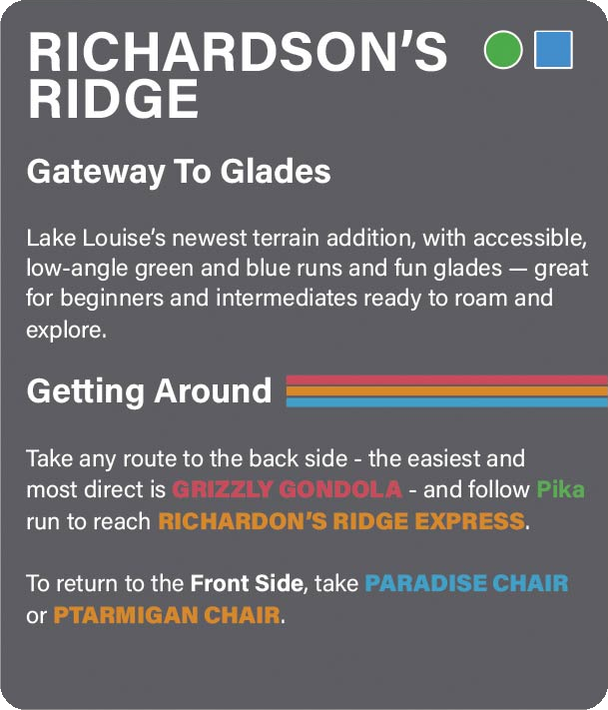
Richardson's Ridge has the longest and strangest development history of any terrain at Lake Louise, even though it's the newest thing on the map. The resort first won approval to build here back in 1991 — and had even begun clearing trees — before new federal park guidelines revoked it a few years later. The idea sat dormant for over a decade before resurfacing in the resort's long-range planning, and it took years more after that before the first chair finally loaded. Richardson's Ridge Express, a high-speed quad, finally opened in December 2025.
Full disclosure: we have not skied Richardson's Ridge yet. So this section will be based on our own research, the trail map, and our analysis of media posts since the 2025 launch.
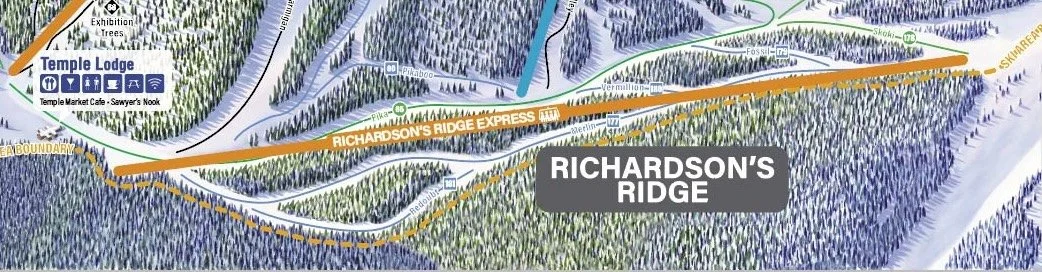
What opened is five named runs — Skoki, a long green — plus four intermediates: Fossil, Vermillion, Redoubt, and Merlin. These are spread across roughly 200 acres, about the same footprint as Larch but far fewer trails. It's low-angle, approachable terrain with some natural glades mixed in, and genuinely good views down Pika Valley toward Mt. Temple. One nice bit of trivia: the ridge the resort named this cluster after is technically called Merlin Ridge on the map, home to Mount Richardson, Ptarmigan Peak, and Pika Peak — which is likely where the trail Merlin gets its name.
This is also just the first phase. The resort's long-range plans reportedly call for glading some advanced and expert terrain here down the line, along with a future surface lift connecting up from Temple Lodge — worth watching for on future visits.
Getting there is straightforward but not quick. It essentially follows the same path as getting to the Larch cluster. Grizzly Gondola is the most direct route, a single lift ride to the Pika trail, which leads over to the Richardson's Ridge Express base. Getting back means riding either Paradise Chair or Ptarmigan Chair to return to the Front Side.
Terrain by Ability Level
We've now covered each of Lake Louise's six clusters in detail, noting where certain types of terrain are concentrated. This section steps back and looks at the bigger picture: how much terrain exists at each ability level, what it's actually like to ski, and where to point yourself first.
Of Lake Louise's 170 named runs, roughly 25% are rated beginner, 45% intermediate, and 30% advanced. On paper, that's not a wildly unusual spread for a big western resort. What makes Lake Louise different is less about the raw numbers and more about where that beginner and intermediate terrain actually sits. At Lake Louise, it's concentrated almost entirely on the Front Side. The Back Bowls and Paradise carry essentially no beginner terrain at all, and West Bowl offers nothing easier than Advanced. Considering the vastness of some of these clusters, the overall percentage of skiable acreage (as opposed to trail count) is considerably tilted towards Advanced/Expert. Note: in this guide we try to adhere to the Lake Louise convention of referring to Single Black Diamond trails and terrain as “Advanced” and Double Black Diamond as “Expert.”
One thing to note: trail difficulty ratings are non-standardized and notoriously subjective. At every resort there always seems to be at least some disagreement among skiers about a few trails — whether a specific trail is rated too hard or too easy, for example. But Lake Louise seems to generate a bit more than the usual amount of disagreement. Several independent reviews of the mountain single out specific black-rated runs — Whitehorn 1 and the Ptarmigan Chutes among them — as skiing closer to double-black at most other resorts. We tend to agree, and would point to a few inconsistencies on the trail map that hint to us that the resort itself isn't always sure of its own ratings. For example, the map shows the West Bowl cluster overall as a double-black diamond despite having no individual runs rated that way. And we've found a few trails that are rated differently on the printed map than they are on the interactive map. And finally, we've been skiing there when the resort has "upgraded" (at least temporarily) trails from blue to black due to conditions.
Green Circle
Plenty of people learn to ski at Lake Louise. We know this is true because we saw them there, in large group lessons in the beginner zone near the base, or riding up with us in the gondola. We spoke with parents who started their kids in local school-based programs when they were practically toddlers, and they are now competitive skiers or even experienced instructors themselves.
Nevertheless, it’s hard to spend a few days at Lake Louise and come away with the impression that this resort is in any way “for beginners.” There are whole clusters (West Bowl, Back Bowls) that have no beginner terrain at all, a stark contrast to the "beginner terrain everywhere" approach some resorts have been taking.
What real learning terrain exists is concentrated on the Front Side: the Sunnyside carpets handle true first-timers at the base, and once you're ready for a chairlift, Wiwaxy off Glacier Express is the standout — a long, easy, confidence-building cruiser that lets newer skiers stretch their legs without getting in over their heads.
Venture off the Front Side and the picture changes. The green trails on the backside — Pika, Saddleback, Warden’s Run, and Skoki over on Richardson's Ridge — function more as connectors between clusters than as terrain built for practicing turns. They are fine for a confident beginner working their way from one part of the mountain to another, but not where you'd want to send someone on day one.
Richardson's Ridge, which opened in 2025, is the resort's attempt to close that gap — a dedicated pocket of low-angle green and blue terrain with actual glades for those who want to start learning to tree ski. The size of Richardson's Ridge is quite modest, though, in comparison to other recently added terrain (West Bowl) at the resort. But still, it's a step in the right direction for Lake Louise — even if it's a bit of a journey to reach for a true first-timer.
Lake Louise's long-range plans reportedly include a dedicated learning lift (perhaps to be named Sunnyside chair) at the base as well, which should make the very first day on snow here easier than it is today.
Blue Square
45% of the trails at Lake Louise are rated as Intermediate difficulty, according to the Lake Louise website — the highest percentage of all the ratings. Our perception from skiing the resort is that while there are certainly more blue runs than there are greens, the sheer size of the advanced and expert terrain zones makes it feel like the more advanced terrain dominates. Despite this, if you are an intermediate skier there are still plenty of terrain options for you to explore and they’re distributed a bit more around the resort than the green trails.
It's not wall-to-wall intermediate terrain, but if Lake Louise has a cruiser's cluster, it's Larch. The Larch run itself is a long, relaxed intermediate groomer, and Wolverine adds some intermediate-friendly bump skiing nearby — more variety in one place than you'll find anywhere else at the resort for this ability level.
The Front Side holds the next-best selection: Juniper Express's five berry-named runs, Home Run and Sunset Terrace off Pipestone and Top of the World (the latter especially, for the view), and Skyline and Sunset up at Summit Chair for something with a real alpine feel. All are fantastic options that are relatively accessible in comparison to making it all the way back to Larch.
Past that, intermediate terrain gets thin fast. Back Bowls has exactly one blue trail, Paradise has Saddleback Bowl and not much else in that range, and West Bowl has none at all. Richardson's Ridge is the newest bright spot — four of its five named runs are blue — but the terrain footprint is still fairly narrow. If lapping intermediate cruisers all day is the priority for your trip, we recommend planning around Larch and the Front Side, and treating the backside as a place to visit for the experience — or to get away from any crowds that form on the Front Side.
Black Diamond
It’s hard to believe that Lake Louise reports only 30% of its terrain as “advanced” on its website. Presumably this figure includes Advanced and Expert (Double Black Diamond) terrain, which makes it even harder to fathom. Reviewing the trail map, you will notice that single-black terrain shows up in every cluster we've covered except for the new Richardson’s Ridge — Meadowlark and the Summit Chair bowl trails on the Front Side, Whitehorn 1's gates in Back Bowls, most of Eagle Ridge in Paradise, the black-diamond core of Ptarmigan's glades and chutes, and every individual zone in West Bowl.
This is a mountain built for someone who's fully comfortable on black terrain and wants variety within it, not someone testing the waters for the first time. There are glades, steeps, moguls, cliffs and boulders. And as we noted earlier, plenty of it skis harder than the single-black label implies — Whitehorn 1 and the Ptarmigan Chutes both have a reputation for running closer to double-black. If you're a confident intermediate looking to step up, start somewhere groomed and below treeline — the black terrain off Grizzly Gondola is the gentlest introduction — before committing to anything on the backside.
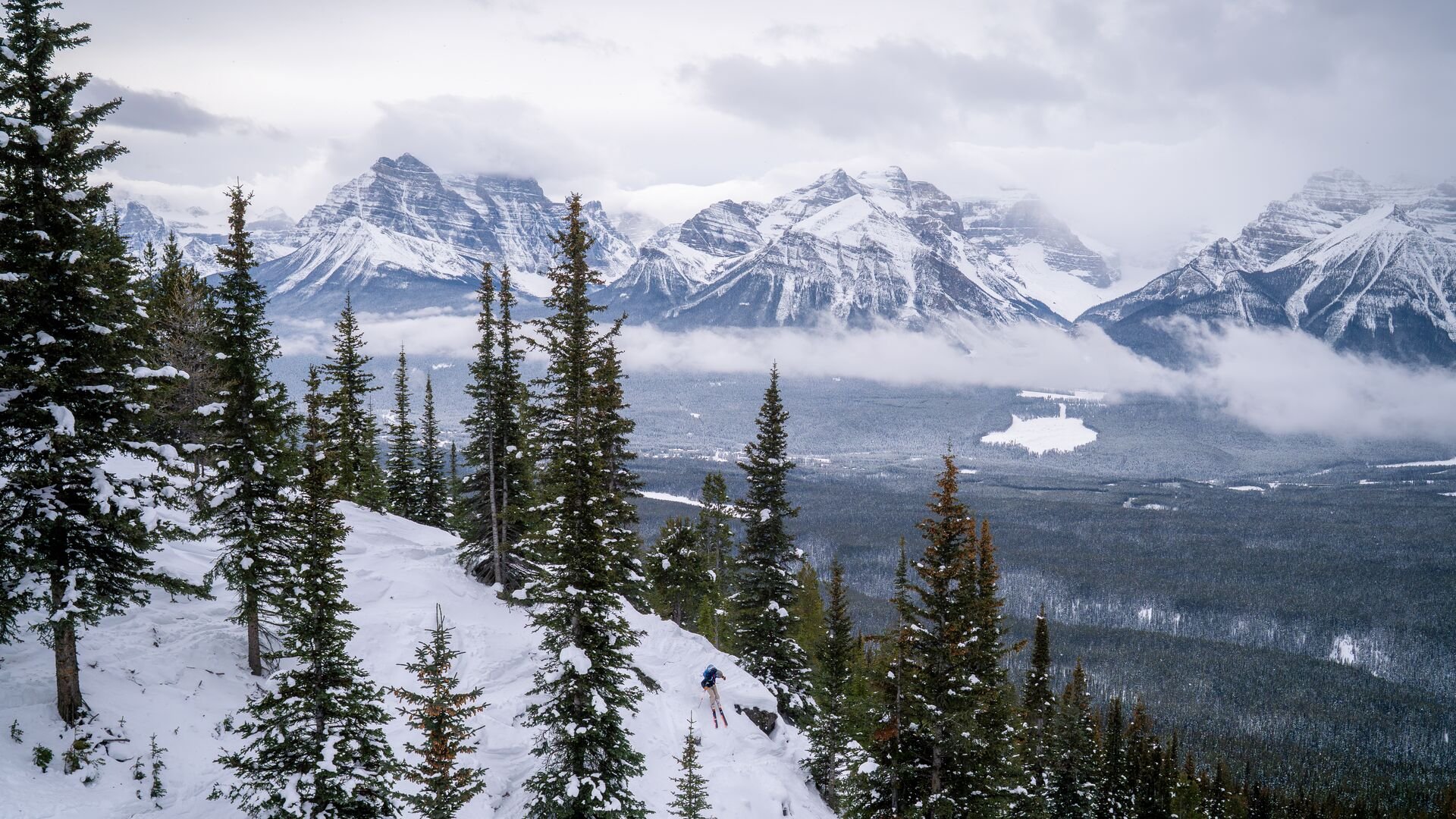
Photograph courtesy of Jill Scarpato / SkiBig3
Double Black Diamond
The headline zone for double-black terrain is Back Bowls' Alphabet Gullies. All nine chutes (A through I) are rated as Expert, with nothing softer mixed in between them. The entire outer bowl of Back Bowls is also double-black diamond at the rim — all the way from Brown Cow to Boundary Bowl. There just aren't that many marked trails in the Back Bowls that are not double-black diamond rated.
But they aren't all in the Back Bowls. Paradise holds its share too, concentrated mostly in Eagle Ridge's upper reaches — Wounded Knee and Split Rock both carry the rating, though Split Rock only really justifies it if you take one specific, avoidable line near the top. E.R. 5 has a reputation for being the most extreme terrain on the mountain, and much of it simply doesn't open most seasons. If your trip coincides with one of those brief windows, count yourself lucky.
Even Larch, one of the resort's more gentle clusters, keeps a couple of double-black pockets tucked into its far edges.
Two clusters have no marked double-black trails at all. The Front Side simply doesn't carry any — its hardest terrain tops out at single-black. West Bowl is the more surprising case: despite the printed trail map's blanket Expert badge on the whole cluster, not one individual zone is labeled as double-black on the interactive map. If you're chasing true double-black terrain, Back Bowls and Paradise are where you'll find it. West Bowl's reputation for difficulty comes more from its ungraded, uncut character than any particular zone. It requires skill and vigilance to navigate the natural obstacles, but the terrain is simply not quite as extreme as it gets on the backside.
Getting to the Mountain
Considering the size of Lake Louise (one of the 10 largest resorts in North America by skiable acreage and one of the two or three largest in Canada), first-time visitors may be a bit surprised at how little development there is at the ski resort itself. There aren't multiple base areas to choose from (or navigate to); there is just one road into the resort, and really just one (very large) parking area. And since there is no overnight lodging or housing at Lake Louise, pretty much everyone is a day visitor.
Arriving by Car
Accessing the resort is not typically difficult. It's just a short drive up from the Lake Louise exit on the Trans-Canada Highway (Highway 1). There are no switchbacks and the grade is moderate. We've driven up in a snowstorm and had no issues, but be careful on the drive back down — even with the moderate grade, packed down snow can turn the road into an ice rink.
Due to the impact on wildlife in the park, they do not use chemicals or salt to de-ice the roadways. They rely completely on plows and sand. It generally works, but take road conditions seriously and obey any chain or winter tire laws in effect. Although the road maintenance staff who maintain the roads in Banff National Park are experts in how to handle winter conditions, there is always a risk that a storm could shut down the highway or even the access road. Always monitor road conditions.
There is just one parking lot at Lake Louise, and it is massive. Their website promises “Guaranteed free parking for your car or RV” and you can see where they get the confidence to make such a promise: it holds over 2,000 vehicles.
On busier days, you may notice cars parking along the access road as you get near to the resort. This does not mean parking is full — the parking lot is quite wide, and many people have surmised that it may be a shorter walk to the lifts if you park on the access road just outside the first parking lot entrance than if you have to park somewhere in the far reaches of the lot.
If you arrive early enough, you can pull into the first parking lot entrance, where the closest spots are. The most prime parking spots will be roped off — Lake Louise sells preferred parking passes on a seasonal basis. But those are for locals, and this guide is for destination travelers. Near the preferred parking sections are several rows of general parking spaces — available to anyone on a first-come, first-served basis — that are nearly as close to the lodge as the preferred spots. If you arrive early, and it's a weekday, and there hasn't been fresh snow — well, you may get lucky and snag one.
If the spots in front are full, the parking attendants will wave you onward to further entrances and send you down an aisle. From there, you can just park and follow the crowd to the closest lift or the base lodge complex. You may find that on busier days where you may have to park a bit farther away, the closest lift is actually Juniper Express. Unless you need to drop off belongings or use a locker, you could head straight there if you already have your lift ticket or pass. One thing to mention: even if you do not have a season pass (or any other type of pre-purchased physical pass) you do not need to go to the ticket window. Lake Louise has self-service kiosks in the parking lot to purchase day tickets or print out pre-purchased lift tickets. Just print it out, zip-tie it to your pants or jacket, and head to the lifts.
Arriving by Shuttle
Private shuttles run from a few local hotels (such as the Fairmont Château Lake Louise) as well as the free SkiBig3 shuttle from Banff. There are also a few stops at other hotels in Lake Louise Village. All of these shuttles will drop you off right at the Lake Louise base, making it one of the most convenient options out there, especially if you do not have access to a rental car or don’t want to spend time parking and walking.
Where to Gear Up
Unless something has gone terribly wrong, no one is staying overnight at Lake Louise Ski Resort. Everyone is a day visitor, so everyone arrives with their gear each and every ski day. Where you actually get that gear depends on how you got there.
If you drove, the simplest option is often your own car. The lot sits close enough to the base that most people just boot up at the trunk or tailgate and walk in.
If you're coming by shuttle, do your gearing up before you leave the hotel. Board the shuttle in your boots and layers, skis or board in hand. The shuttles aren't set up for a mid-ride wardrobe change, and you'll want to step off ready to walk straight to a lift.
For those don't want to get your gear on beforehand or in the car, the base area has some day lockers, along with a section of open-air, unattended racks near the main entrance where you can stash your gear between runs without carrying it around all day. Just don't expect a heated, full-service setup — it's functional rather than fancy, which definitely fits the Lake Louise vibe.
On-Mountain Amenities
We hope it’s clear at this point that Lake Louise’s focus is on the mountain experience itself — the skiing or snowboarding and the lift infrastructure — and many of the investments they’ve made in recent years have been in service of expanding terrain or adding new lifts. Lake Louise spends most of its dollars on the actual ski experience, without a lot of unnecessary extravagance. But even first-to-last chair skiers need to stop and eat or drink once in a while, and Lake Louise offers two on-mountain facilities that rank high on our list of picturesque ski resort dining locations. Each of these also has at least a component that is decidedly upscale — a nice option to have if you’re looking for something a little more elevated than the standard chicken tenders or burgers.
The first is the Temple Lodge, which is tucked away off the side of the Pika trail coming down from Ptarmigan — and remember, Pika is also the run-out from the entire backside so Temple Lodge can also be accessed via Pika from the Back Bowls, Paradise and even Richardson’s Ridge. Temple Lodge is also right at the base of the Larch cluster, so it’s very centrally located. Slightly nestled in the trees off the side of the Pika trail, you just come upon it as you glide down a gently sloped section of the trail. It’s much more prominent if you approach it from the Larch side.
It contains three separate dining/bar options:
Temple Market Cafeteria — This is what you may think of when you think “ski resort lodge lunch” — a grill, soup or chili, some sandwich options, hot and cold drinks. This is (as the name gives away) a cafeteria, with plenty of seating both inside and outside.
Temple Cantina — This is an outdoor, patio area that serves a limited selection of Mexican-style food and drinks (tacos, nachos, Mexican beer, etc.).
Sawyer’s Nook — Located inside Temple Lodge, this is a sit-down restaurant that boasts “a unique mountain menu featuring traditional alpine items as well as our own house made favourites.” While the menu for the upcoming ski season has not been posted yet as of this writing, some of the examples they give are: Charcuterie for Two, a Confit Duck Baguette, our Signature Sawyer's Burger, or a hearty Vegetable Lentil Ragu. They also have wine, beer and cocktails.
The second is the Whitehorn Bistro — which is located at mid-mountain on the Front Side and accessed by taking any of the trails down the Front Side after exiting the Grizzly Gondola (such as Eagle Meadows or Deer Run). Whitehorn Bistro is another table service restaurant, closer to Sawyer's Nook than anything else. The resort advertises it as "the perfect spot for you to stop and enjoy sweeping panoramic views & fantastic scenery while experiencing an upscale menu in a casual environment." Although they accept walk-ins, they do recommend making reservations, especially on busy days. The reservations calendar is available on the Lake Louise website.
Base Village and Town
Our guides often feature a detailed breakdown of the on-property hotels, shops, bars and restaurants in this section. But those resorts usually have an enormous constellation of private development that has sprung up around the ski resorts, or the resorts have been developed right on top of an existing town or village — neither of which applies to Lake Louise. What you get here is the ski resort, and that's it. So let's talk about what's at the base lodge area of the resort.
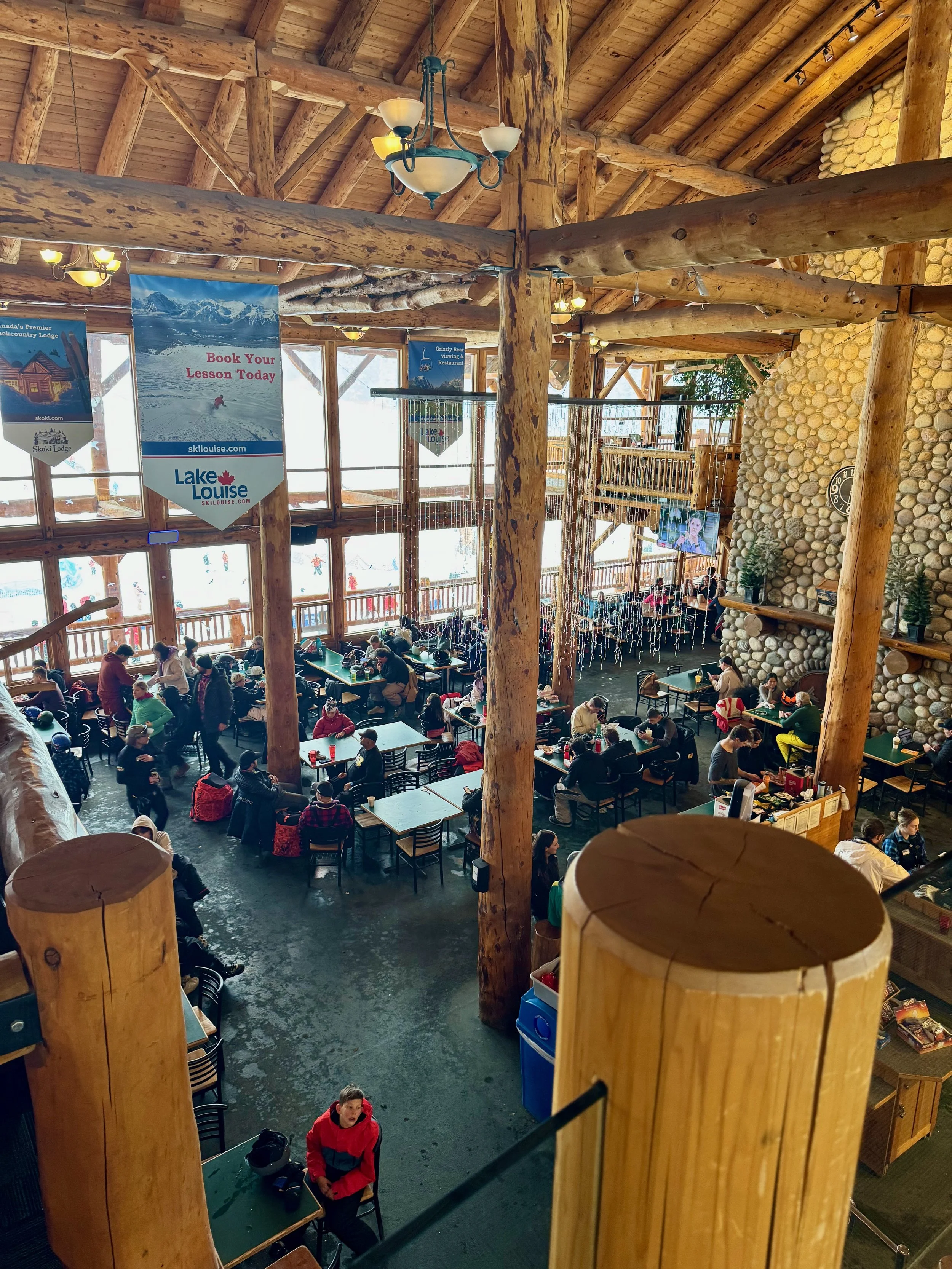
Lodge of Ten Peaks Interior
First off, understand that while the main base “lodge” appears as a single, wide building as you walk up to it from the parking lot (or even as you ski down to it from the slopes), it is actually two distinct buildings connected by a covered passageway. There is also a smaller, detached building close to the main lodge complex.
All three of these lodges have dining options.
Dining at the Base
In our opinion, between the two connected base lodges, the Lodge of Ten Peaks is the standout, has the most variety, and is the one most skiers seem to gravitate towards. The lodge itself is impressive to behold — an open, multi-story log structure worth a visit even if you're not hungry. Inside is a standard cafeteria for the quick grab-and-go, Slopeside Coffee for caffeine, and two bars — the Powder Keg Lounge, which you could consider a typical ski-lodge bar, and the Bierstube, a German beer hall. The real novelty is Kuma Yama, a sushi and ramen counter — a nice find this deep into the Rockies.
Whiskyjack Lodge is right next door and has its own lineup: the Whiskyjack Café for something casual, Northface Bistro for overflow seating, the Polar Ice Palace (outside Whiskyjack), and Sitzmark — a lounge/seating area named for the divot you leave in the snow after a fall.
Banded Peak Base Camp is the third building, and it leans more casual and grill-focused than the other two — BBQ-style food, its own bar, and a coffee counter. Seating at Banded Peak is outdoor.
Ski School, Rentals, and the Rest
Beyond food, the base compound covers the practical side of a ski day too. Snow School operates out of the same area, if you're booking lessons or dropping off a beginner for the day. There's a combined rental and retail shop if you need to rent gear, replace a forgotten glove, or get a repair or tune. There is also on-site daycare and a first aid station right in the heart of the compound.
One more thing worth knowing if you're planning to travel with any beginners: the current trail map already marks a "Future Learning Area Expansion" zone right next to the Sunnyside carpets — which lines up with the long-range plans mentioned earlier in this guide for a dedicated learning lift at the base. Nothing's built yet, but it's in their master plan.
General Vibe
Lake Louise has an unpretentious, distinctly Rocky Mountain feel — the kind of atmosphere local Colorado skiers may seem nostalgic for. A throwback to a time before their own mountain towns got quite so built up. There's no attempt to dress the place up as anything other than what it is: a serious ski destination inside a national park, run by people who'd rather put money into lifts and terrain than polish.
That welcoming instinct extends to how the resort treats newcomers, too. Lake Louise runs a fantastic, free program called Ski Friends — volunteers in yellow jackets who lead guided mountain tours twice a day (10am and 1:15pm). These are tailored to whatever ability level shows up, so no need to worry that you'll be bored or that they'll send you down the backside if you aren't ready. It's a small touch, but it's the kind of thing a lot of big mountains don't bother with anymore.
The architecture reinforces the "Rockies" aesthetic: wood post-and-beam and log-timbered buildings throughout the base area — the Lodge of Ten Peaks, covered earlier, is the best example — nothing glassy or modern.
All that said, this is still fundamentally a resort built around serious skiing, and the backside terrain leans hard into expert and extreme. It doesn't go quite as far as Kicking Horse, which we've already flagged elsewhere in this guide as the more extreme option nearby — but the intent is clearly there, and casual intermediates shouldn't assume they'll have the run of the place without reading the terrain sections closely first.
One more thing we noticed repeatedly on our trips: a lot of accents. Lift operators, staff, gondola riders — more often than not British, with Australian close behind. That's not a coincidence. Lake Louise takes part in Canada's International Experience Canada working holiday visa program, which lets young people from the UK, Australia, and several other countries work in Canada for up to a year or two, and the resort partners directly with agencies that help place UK and Australian applicants. If the accent on the chairlift next to you doesn't sound Albertan, there's a decent chance that's why.
Lodging Overview
It bears repeating once more in this guide: there is no lodging at Lake Louise Ski Resort itself. Not a slopeside condo, not a ski-in/ski-out cabin, not a base-area hotel — nothing. Every option is outside of the resort, which means the real decision isn't “which resort hotel” but “which nearby area.” And it comes down to four broad options: the Fairmont Château Lake Louise hotel, the handful of other hotels and lodges around the Village of Lake Louise or nearby, lodging in the town of Banff, and Canmore.
Lodging Areas / Proximity Tradeoffs
Each option for lodging has pros and cons, and one of the biggest decisions you’ll have to make is how far away you are willing to stay. We discuss this and some of the other factors in this section.
The Fairmont Château Lake Louise
This iconic grand hotel is the single most recognizable building in the area, sitting right on the lakeshore with the classic glacier-and-peaks backdrop that made this place famous well before the ski resort existed. Staying here means the lake is on your doorstep and the ski resort is a short, complimentary shuttle ride away or a quick drive up the mountain. The Fairmont is also, unsurprisingly, the most expensive option in the area by a wide margin, and its size — well over 500 rooms — means it can feel more like a large convention hotel than an intimate mountain lodge. There are not many convention hotels with views like the Fairmont has, though. If budget isn't the deciding factor and you want the full "so this is why we came all this way" experience, this is it.
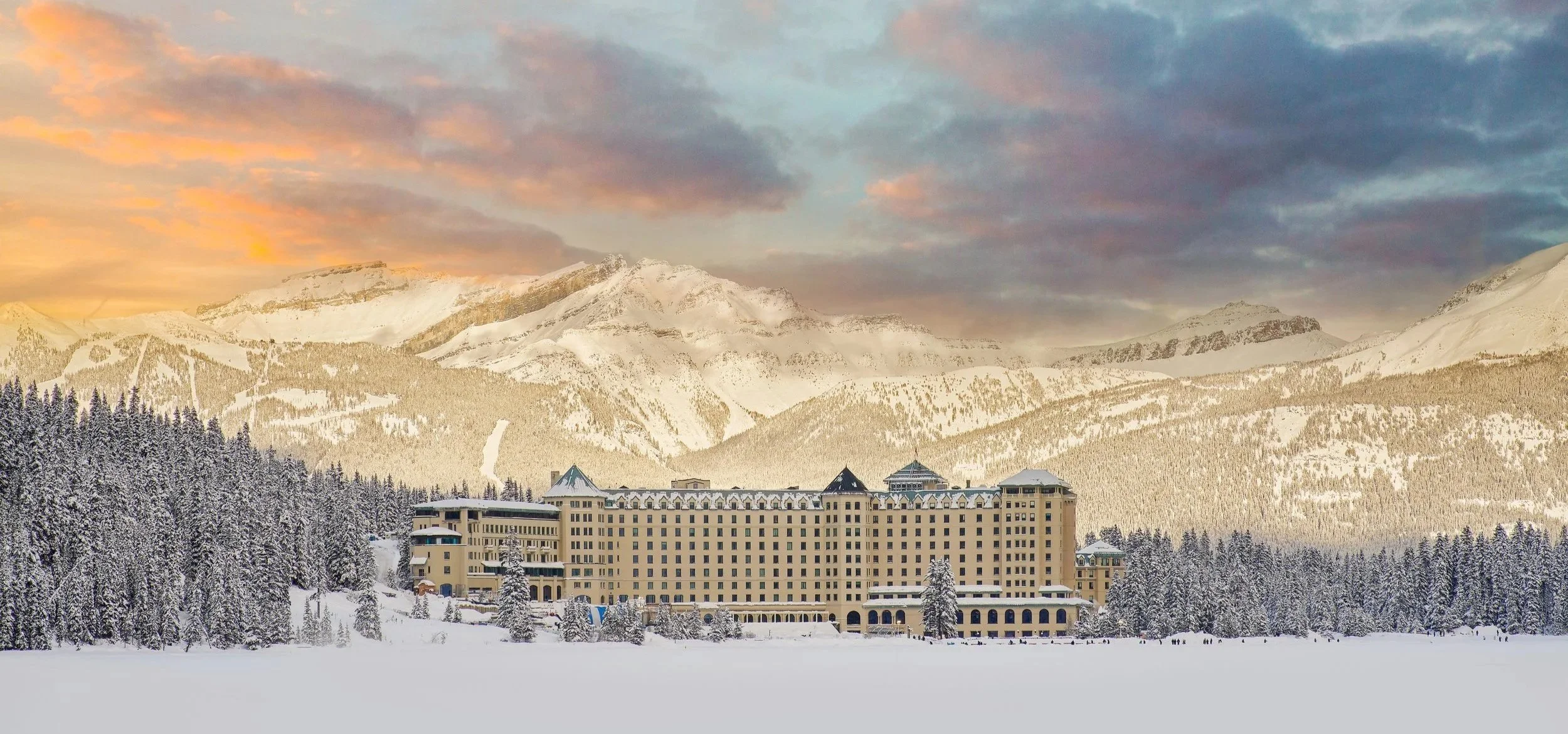
Fairmont Château Lake Louise in Winter (Photograph Courtesy of Fairmont)
The Village Hotels (and a Few Points Down the Road)
Beyond the Château, the Village of Lake Louise has a handful of other lodging options, most within a short walk of the village center. It may be helpful to clarify what we mean by the “Village of Lake Louise” — this is a very small unincorporated area right off the Trans-Canada Highway. It’s about a 10-minute drive to the lake itself, and even less than that up to the ski resort. But don’t expect the picturesque “mountain town” look that you will find in the Town of Banff. The “village” is just a few meandering streets of retail/restaurants, hotels, some residences and a few government buildings.
The Post Hotel, on the Bow River, has been welcoming guests since the 1940s and has built its reputation on the dining room and wine cellar. It's the closest thing to a second luxury option you’ll find in the village, at a somewhat gentler price than the Fairmont. Paradise Lodge & Bungalows and the Mountaineer Lodge are both simpler, more affordable options within walking distance of the village center that get great reviews from what we can see. And the Lake Louise Inn is the most budget-friendly hotel in the immediate area, a few kilometers further out.
If you're willing to trade some proximity for a quieter, more remote setting, Baker Creek — about 20 to 25 minutes down the Bow Valley Parkway toward Banff — is worth knowing about: log cabins and chalet rooms tucked into the forest, some with full kitchens. And just like everything in Banff National Park — the scenery can’t be beat. Just factor the extra drive time into your lift-line math.
Many ski travelers gravitate towards short-term rentals (STRs), but there are relatively few in Banff National Park — at least as compared to other large resort towns. Nevertheless, if a STR is your preference, take a look on VRBO or Airbnb. There are some available, you just may have to book well in advance as inventory gets slim once the snow starts falling.
The Town of Banff
Banff is the biggest, most obvious base for a Lake Louise trip within the confines of the National Park. It has, by far, the widest range of lodging, dining, and things to do once the lifts close, and it's covered by the free SkiBig3 shuttle already mentioned earlier in this guide, so you're not adding a second transportation puzzle on top of your hotel decision. The tradeoff is distance: Banff sits roughly 45 minutes to an hour from Lake Louise depending on conditions, so even with a free ride, you're committing to a longer commute each way than staying in the village. For destination travelers splitting a trip across all three SkiBig3 resorts, Banff is the natural home base.
The Town of Banff has its own Fairmont hotel, by the way. Considerably larger than the Fairmont Château Lake Louise, the Fairmont Banff Springs hotel is perhaps even more iconic. While it does not have that incredible lake view, it makes up for that (for some) with a much closer proximity to a real town with shopping, nightlife and restaurants.
Canmore
We’ve noticed that many Banff-focused travel guides will point you in the direction of Canmore — particularly if you are looking to be as budget-conscious as possible while still staying relatively close to the resorts. Canmore is just outside the entrance to the National Park, so there are far fewer limits on development. It’s also closer to Calgary, farther from Lake Louise at roughly an hour's drive, and generally feels less touristy and more affordable. The tradeoff is convenience: there's no direct shuttle from Canmore to Lake Louise, so you're either renting a car or stringing together the Roam Transit connections we covered in Getting There. Canmore makes the most sense for travelers prioritizing value and a more residential feel over ski-day convenience, or anyone splitting their trip between Lake Louise and other things to do in the area.
Dining and Après-Ski
With no overnight guests, there isn’t much of a need for dining or après-ski spots beyond what we’ve already covered in previous sections. The bars in the base lodges do stay open until 6:00 pm, a full two hours after the lifts stop spinning. That gives you a nice opportunity to slow down and relax with friends and recount the day’s accomplishments. But keep an eye on the shuttle schedule — if you arrived via shuttle you’ll need to depart the same way, and once you miss the last one you’ll be in a bind.
Where you find further libations — or dinner — is largely dependent on where your lodging is. You’ll most likely want to head in that direction to avoid a late-night drive home.
But there is one casual spot that we can highly recommend if you need a quick bite for your drive back to your lodging: the Trailhead Cafe in the village has excellent sandwiches, wraps and soups. We usually try to drop by and pick up something after our day on the slopes, and judging from the number of fellow customers in ski attire we aren’t the only ones. It’s only open until 6:00, so don’t linger too long in the lodge if you plan on making a stop here.
Off the Mountain
Lake Louise (the actual lake) is one of the most photographed places in Canada, but the busy season is the summertime. On a peak day in midsummer the lake sees over 10,000 visitors. In fact, they use the parking lot at the ski resort to handle all those guests, with a shuttle running back and forth all day.
In winter, though, it's far less visited. Depending on the time of day and the day of the week, you may even find the path that runs alongside the lake to be almost completely empty. It can be a magical experience, walking the snow-covered path next to a frozen lake, with the glacier looming in the distance. If you make the trip up to Lake Louise Ski Resort, you should definitely stop off at its namesake.
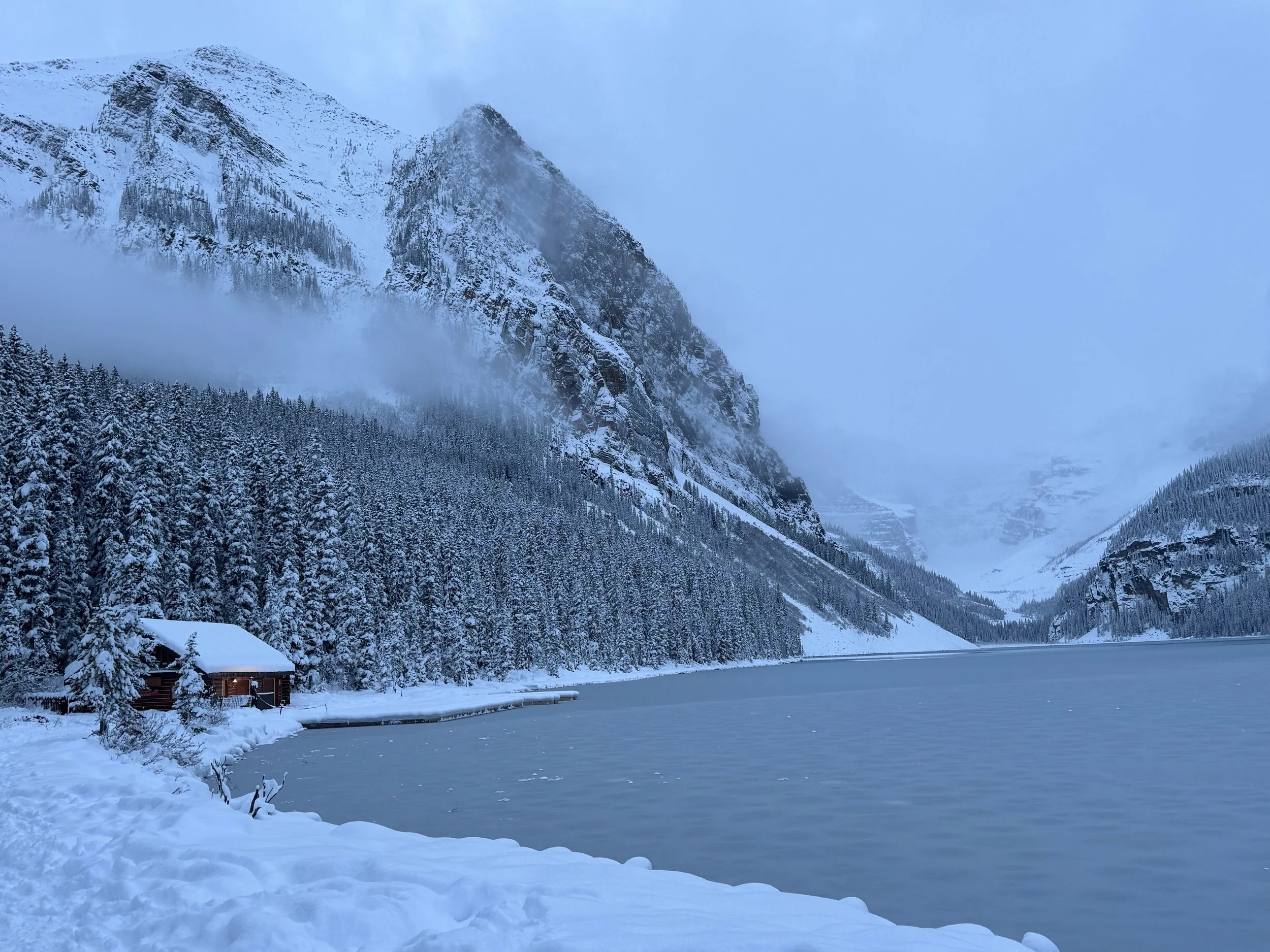
The lake provides a recreation opportunity as well. In addition to the footpath, you could snowshoe or cross-country ski over the network of trails around the lake. Hiking is more limited once the snow really sets in, but a few of the area's famous summer trails stay accessible in snowshoes for those willing to work for the view.
And then there is ice skating. The lake freezes solid enough to skate on, and the section in front of the Fairmont is groomed and maintained all season, centered most years around a very impressive hand-built ice castle. It's consistently ranked among the most beautiful places in the world to skate, and skate rentals are available right there if you didn't pack your own.
If you're visiting in early February, look into the Ice Magic Festival — a multi-day ice-carving competition held right on the lakeshore — though note that general admission has tightened up in recent years and typically requires a ticket through a participating hotel rather than just showing up.
Halfway between Lake Louise and Banff along the Bow Valley Parkway sits Johnston Canyon, and in winter it's also worth a stop: the waterfalls freeze into towering columns of blue ice, and a network of catwalks lets you walk right up next to them. Ice cleats are recommended (and easy to rent), and there are guided evening versions of the walk if you want to see it by headlamp.
And then there's Banff itself, which we'll cover in far more detail in a future guide, but a few things are worth a mention now: the shopping and restaurants along Banff Avenue, the Banff Gondola up Sulphur Mountain (Sky Bistro, at the summit, is a high-end restaurant with the view over town everyone talks about), and the Banff Upper Hot Springs, a natural hot spring just down the road from the Gondola base and a rejuvenating way to end a ski day. In winter, the Gondola also runs an after-dark experience called Nightrise — more light-and-sound show than stargazing, but a reason to go up after the sun sets rather than during the day. The tradeoff is that the view it’s famous for is essentially nonexistent after sundown.
On a recent trip we planned a nice dinner at Sky Bistro and while the experience was enjoyable (we can't help it — we love any gondola ride) the food was merely passable.
Pairs Well With
As much as we have loved skiing at Lake Louise, if you're traveling all the way to the Canadian Rockies for a destination ski trip you're going to want to see what else is there. The obvious "pairing" is Banff Sunshine Village, just 45 minutes down the highway from Lake Louise. It's comparable in size but has a vastly different personality. Banff Sunshine sits on the Continental Divide and is known for reliable natural snowfall and one of the longest seasons in the Rockies, with terrain that runs from mellow to genuinely challenging. We will cover it more comprehensively in a future guide, but we can state here that you should absolutely ski both resorts while you're visiting the area.
Lake Louise and Sunshine Village make up two of the three legs of SkiBig3. The third is Mt. Norquay, which (like Sunshine Village) is close to the Town of Banff. Mt. Norquay is the smaller, local-favorite option. If you are pressed for time it can be a good half-day or rest-day pick, especially with families, and it's the one SkiBig3 hill that offers night skiing on weekends.
Between the three, you've got enough variety that the Trifecta Challenge mentioned earlier in this guide is a fun goal for a longer trip.
Worth going further for: Kicking Horse, in Golden, BC, about an hour and fifteen to twenty minutes west through Yoho National Park. It's not on the SkiBig3 ticket and it's a bit of a hike, but it's a feasible day trip (several shuttle operators run the route specifically from Lake Louise and Banff). Kicking Horse delivers exactly the kind of extreme, big-mountain terrain we've referenced a few times already in this guide as a notch beyond what Lake Louise's backside offers — plus you'll get to eat lunch at Eagle's Eye, the highest restaurant in Canada.
Bottom Line
Lake Louise is one of the largest, most dramatic ski areas in North America. Unlike most resorts comparable in size — or even many smaller resorts — the focus here is entirely on the skiing, not the full travel experience.
That tradeoff won't suit everyone. If you want ski-in/ski-out convenience, a lively base village, or groomed beginner terrain right off every lift, look elsewhere. But if you want a serious mountain in a spectacular setting, and you don't mind driving to get to your hotel at the end of the day, Lake Louise more than earns its spot on a Canadian Rockies ski trip — and, for a lot of skiers, on the short list of the best in North America, period.