

Does Altitude Matter? How Elevation Shapes Your Ski Trip
Yes. When it comes to skiing, altitude definitely matters.
Elevation is a factor that helps determine whether there's good snow when you arrive. Higher mountains are colder, which means more precipitation falls as snow instead of rain, and the snow that falls lasts longer.
But higher altitudes have a downside, too. The thin air can bring fatigue, slower recovery and (a big one for us) sleepless nights — and it doesn't matter how long you’ve looked forward to the trip or how much you spent on it.
And it can be worse. In Step Four of our Planning Guide, we told the story of a colleague — a lifelong skier and semi-pro cyclist — whose planned weeklong trip to Breckenridge turned into less than three hours on snow. His case was unusual. For those of us who live closer to sea level, the more common cost is a bad first night and a sluggish first day. Lose even that first day on a four-day trip, and that's a quarter of your skiing.
Let's get into it.
Where the High-Altitude Resorts Are
Many travelers aren't fully aware of how widely elevations can vary across ski regions. In North America, we find that many East Coasters in particular believe that the big western resorts are all relatively high altitude, and assume that a resort in the Colorado Rockies will be roughly the same elevation as a resort in the Canadian Rockies, for example. But there are vast differences in base elevation from region to region, and if you're going to factor altitude into your decision-making and planning, it's helpful to understand these differences.
North American Resorts
In North America, Colorado is the epicenter for high-altitude skiing. The state's Summit County has some of the highest base areas on the continent: Breckenridge, Keystone, Copper, Arapahoe Basin and Loveland, all sitting close to the Continental Divide. Farther out, Vail and Beaver Creek, Telluride, and Aspen Snowmass are only a bit lower. Taos in New Mexico belongs in the same conversation. (Our High Altitude Resort page lists base and summit elevations for the highest of these resorts in both North America and Europe.)
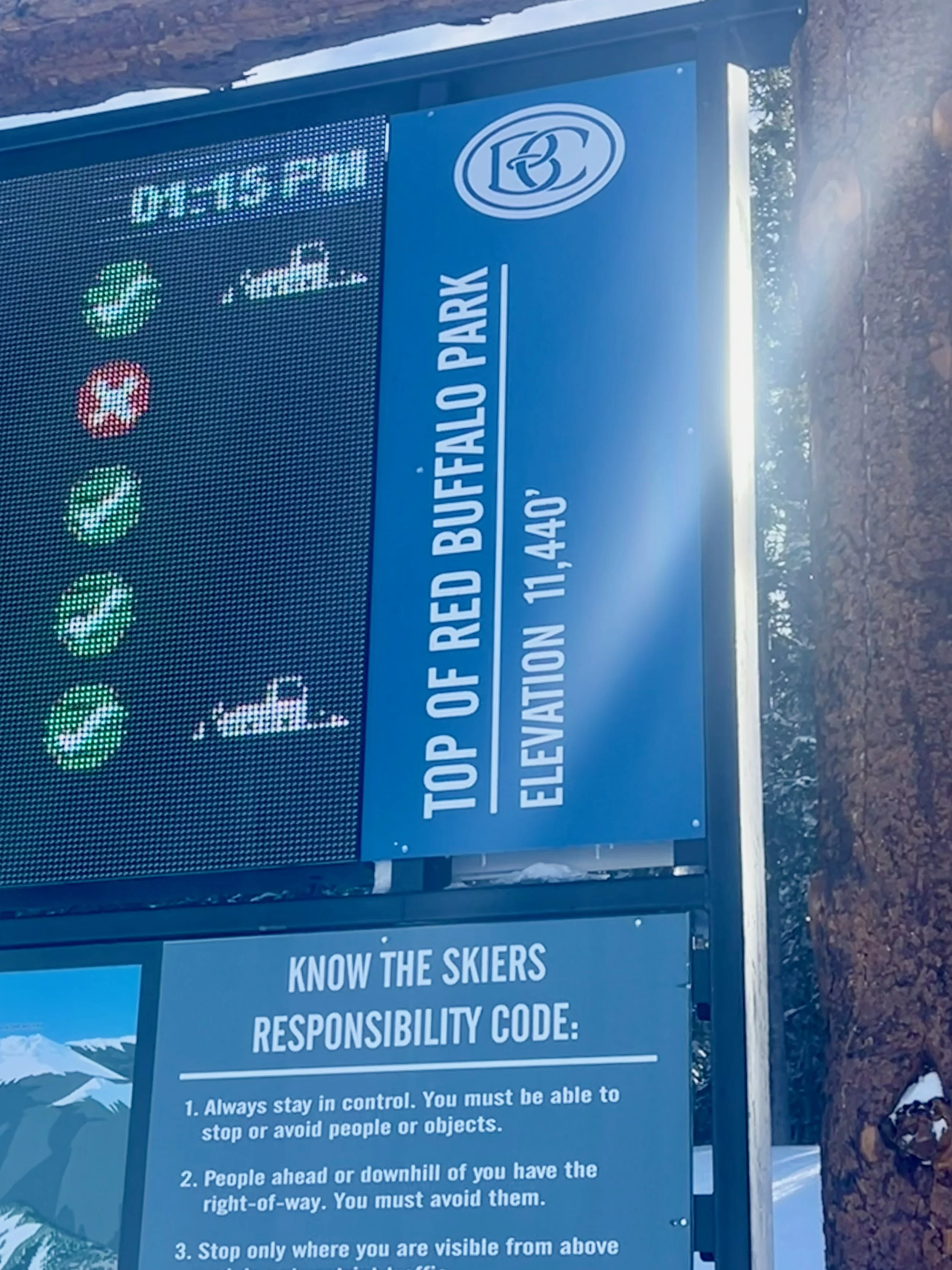
Red Buffalo Park at Beaver Creek resort in Colorado features mostly beginner terrain, yet is at nearly summit level (11,440 feet / 3,487 meters).
But just as important as how high the lifts go is where you sleep. In Colorado, many of the towns themselves sit at high elevation, so you never really get a break from the thin air. That's different from the Alps, where most traditional villages sit far below the lifts, more on that in a moment.
Since you'll spend most of your trip near the base, that's the number we use here. A rough way to think about it:
Very high (base above 9,000 feet): Breckenridge, Keystone, Copper, Arapahoe Basin, Loveland and Taos. Most sea-level visitors will keenly feel the altitude here, often from the first night.
High (about 7,500 to 9,000 feet): Vail, Beaver Creek, Aspen Snowmass, Alta, Snowbird, Mammoth and Big Sky. Many visitors will notice the altitude, especially when exerting themselves. Telluride straddles the line: the town sits at 8,750 feet, while Mountain Village is at 9,545. And if you think of Utah as the "lower" alternative to Colorado, note that Alta's base actually sits higher than Vail's.
Moderate (about 5,000 to 7,500 feet): Park City, Deer Valley, Jackson Hole, Steamboat and Lake Louise. If you've spent a night in Denver, you've slept at the low end of this range. Lake Louise's base sits at 5,400 feet, almost exactly the elevation of the Mile High City. Even here, as we noted in the Planning Guide, some flatlanders may notice a difference.
Low (under 5,000 feet): Whitefish, Whistler, the Pacific Northwest and the resorts of the East. Whitefish's base, at 4,464 feet, actually sits lower than Denver.
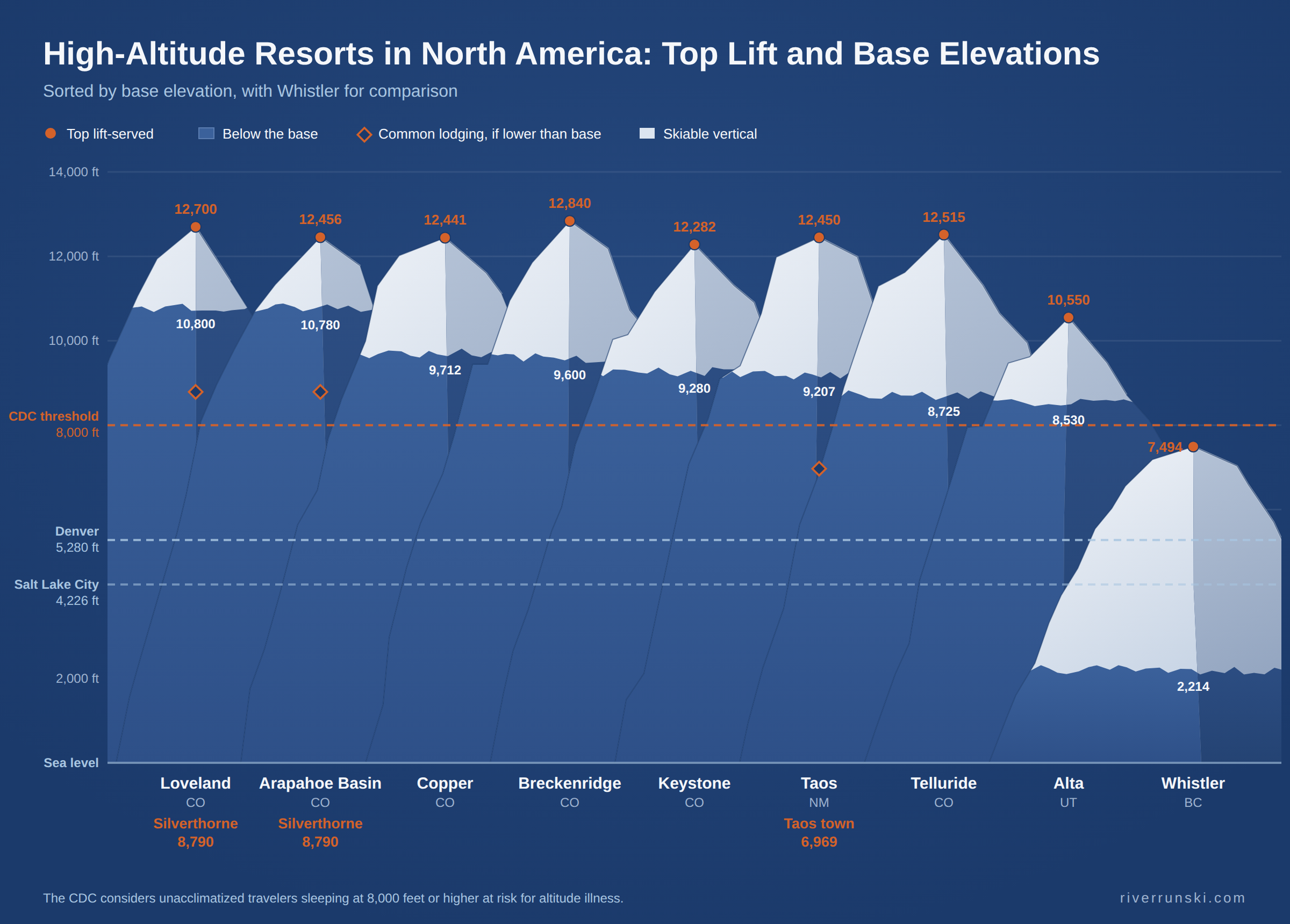
A selection of some of the highest resorts in North America. Click the image (or here) for the full elevation data for these resorts.
What About Europe?
The Alps flip the Colorado pattern: you ski high, but you usually sleep much lower. Zermatt is a classic example. The village sits at about 1,620 meters (roughly 5,300 feet, about the same as Denver), yet its lifts climb to the Matterhorn Glacier Paradise at 3,883 meters, or about 12,740 feet. We can personally attest that the altitude at the Matterhorn glacier is very noticeable.
Even Europe's highest resort villages are lower than you might expect. Val Thorens, at about 2,300 meters, is the highest in Europe. That works out to roughly 7,550 feet, which is below the CDC's 8,000-foot threshold and lower than every Colorado base in our elevation chart. Tignes sits at about 2,100 meters, or around 6,900 feet.
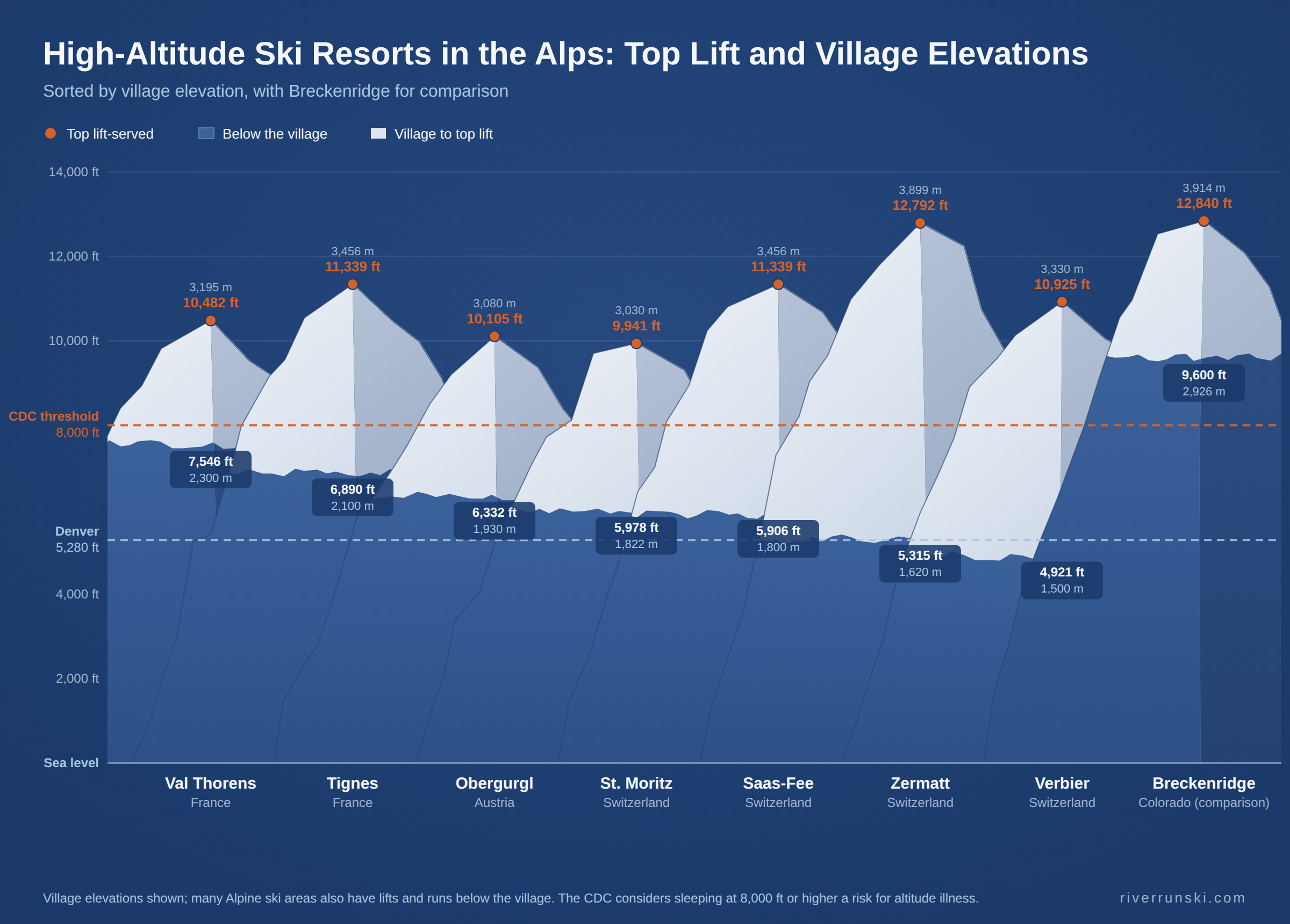
A selection of some of the highest resorts in Europe, with Breckenridge shown as a comparison. Click the image (or here) for the full elevation data for these resorts.
For skiers who struggle with altitude, that's a real advantage: in the Alps, you can ski at Colorado heights and still sleep at Denver heights.
And remember: altitude is one variable, not the whole story. More on that in the next section.
How Altitude Affects Snow, Terrain and Climate
It may be natural to assume that a higher-elevation resort is going to receive more snow. And while there is an element of truth to that, the real story is much more complex. Elevation certainly helps, but it's just one ingredient in a complicated recipe.
Colder air, longer seasons
The basic physics is simple: air gets colder as you go up. A resort with a base at 9,600 feet will typically run more than 10 degrees colder than one at 6,500 feet on the same day.
When watching a mountain weather report this winter, pay attention to when the meteorologist mentions the "snow level" or the "rain/snow line." When temperatures are hovering around the freezing mark (which happens often, especially early and late in the season), elevation plays a big role in whether precipitation falls as snow or rain. The colder air up at the higher altitudes means more storms fall as snow rather than rain, and the snow that lands sticks around longer.
That's why the highest resorts tend to open earliest and close latest. Arapahoe Basin, with a base at 10,780 feet, is the classic example. Its 2018–2019 season was a 259-day stretch between opening day on October 19 and closing day on July 4, and the latest it has ever closed was August 10 in 1995. (For more on which resorts reliably have terrain open early, see our Thanksgiving terrain article.) But while the temperatures associated with higher elevations can help preserve snow and make for a longer season, it takes a lot more than that to reliably produce more snow.
Higher doesn't necessarily mean more snow
Colorado's high resorts are known for light, dry snow, but they don't always get the most of it. Copper Mountain, with a base above 9,700 feet, averages 306 inches of snow a year. Jackson Hole's base sits more than 3,000 feet lower, yet the resort averages 458 inches of snow each year.
So when it comes to racking up big snow totals, storm track and geography often matter as much as elevation, if not more. Consider Jay Peak ski resort in northern Vermont. The base at Jay sits at 1,815 feet and yet the resort claims an average natural snowfall of 347 inches! That’s 41 inches more than Copper Mountain, whose base is nearly at 10,000 feet.
Latitude and climate change the math
Altitude is only one way to get cold. Go far enough north and you don't need as much elevation to get near-arctic temps. Lake Louise is a good example. Its base sits at 5,400 feet, about the same as Denver, but its northern latitude keeps it cold, and its season typically runs well into spring.
Coastal resorts are the other side of the coin. At Whistler, mild Pacific air means a greater proportion of the total winter precipitation falls as rain at lower elevations. It's common to see a mix of rain and snow in the village while the high alpine terrain receives a huge amount of base-building snow.
Basically, elevation gives a mountain a head start. The colder temperatures help snow fall and stick around, and higher terrain tends to wring more moisture out of passing storms. But it's no guarantee — geography and storm track can matter just as much, if not more.
Above and below treeline
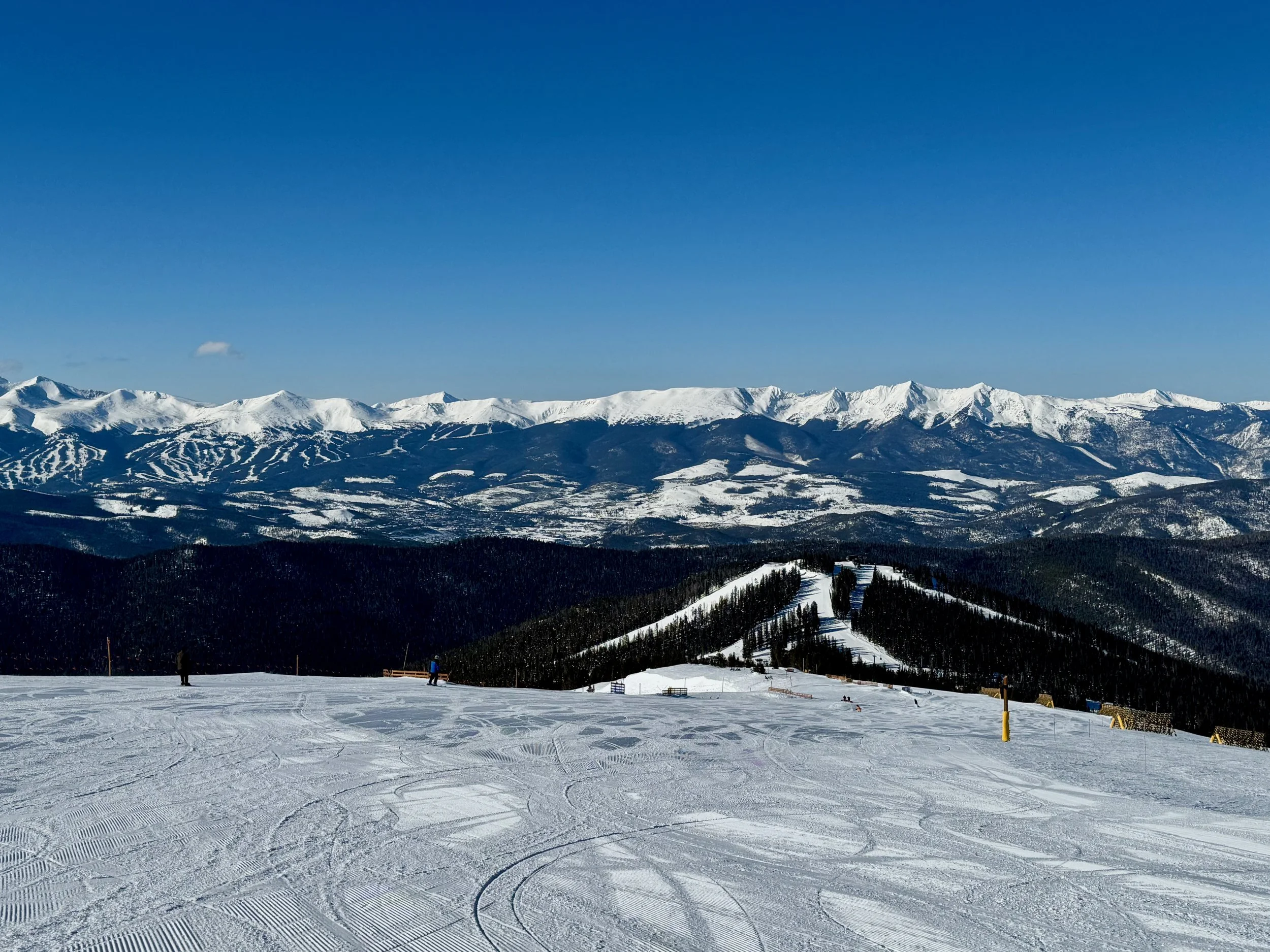
The rim of Bergman Bowl in Keystone, Colorado is 12,282 feet (3,744 meters) and above treeline.
Altitude also shapes the terrain you'll ski. Above treeline, you get the wide-open bowls, big views and high-alpine feel many skiers travel west for. Below it, you get tree-lined trails and glades. Where the treeline falls depends mainly on latitude: in Colorado, treeline is around 11,500 feet, while in the Canadian Rockies it's closer to 7,900 feet. That's why Lake Louise, despite its lower elevation, offers plenty of above-treeline bowl skiing on its upper mountain. The Swiss Alps, for example, are more similar to the Canadian Rockies than they are Colorado, with treeline averages at about 7,200 feet (2,190 meters). Those ranges are at about 47 degrees north as opposed to 39 degrees for Colorado (they also feature completely different species of trees and vegetation, which also affects the elevation of the treeline). All that above-treeline terrain helps give the Alps that distinctive, dramatic look of exposed rock and ice.
Keep in mind that above-treeline terrain is considerably more exposed. Wind can strip it down to hardpack or rock, especially early in the season, and on stormy days it's often the first terrain to close.
The downsides of going up top
Other than snow and terrain, there are a few other notable environmental quirks you will notice while skiing at high elevations:
Wind: upper lifts are the most likely to go on wind hold. Wind speeds can differ dramatically between the summit and the base. It is common to find still air at the base but strong gusts above treeline.
Cold: summit temperatures can be bitter even on a mild day at the base. Pack layers you can add and remove.
Flat light: above treeline, there are no trees to give definition to the snow, so overcast days can make it hard to see bumps and dips.
Sun: UV exposure rises with altitude. According to the World Health Organization, for every 1,000-meter increase in altitude, UV levels increase by 10% to 12%, and snow can reflect as much as 80% of UV radiation. Sunscreen and goggles are a must, even on cloudy days.
What to Consider When Evaluating a Destination
If altitude is a factor for you or anyone in your group — or you think it could be — run through these questions before you book:
What are the base and summit elevations of the resorts you're considering?
Don't wait until after you book to think about this. Knowing up front how high you may end up on your ski days is key to making a well-considered decision. We often hear from people who planned a ski trip without even thinking about the elevation, and were shocked to discover upon arrival that the altitude took a toll.
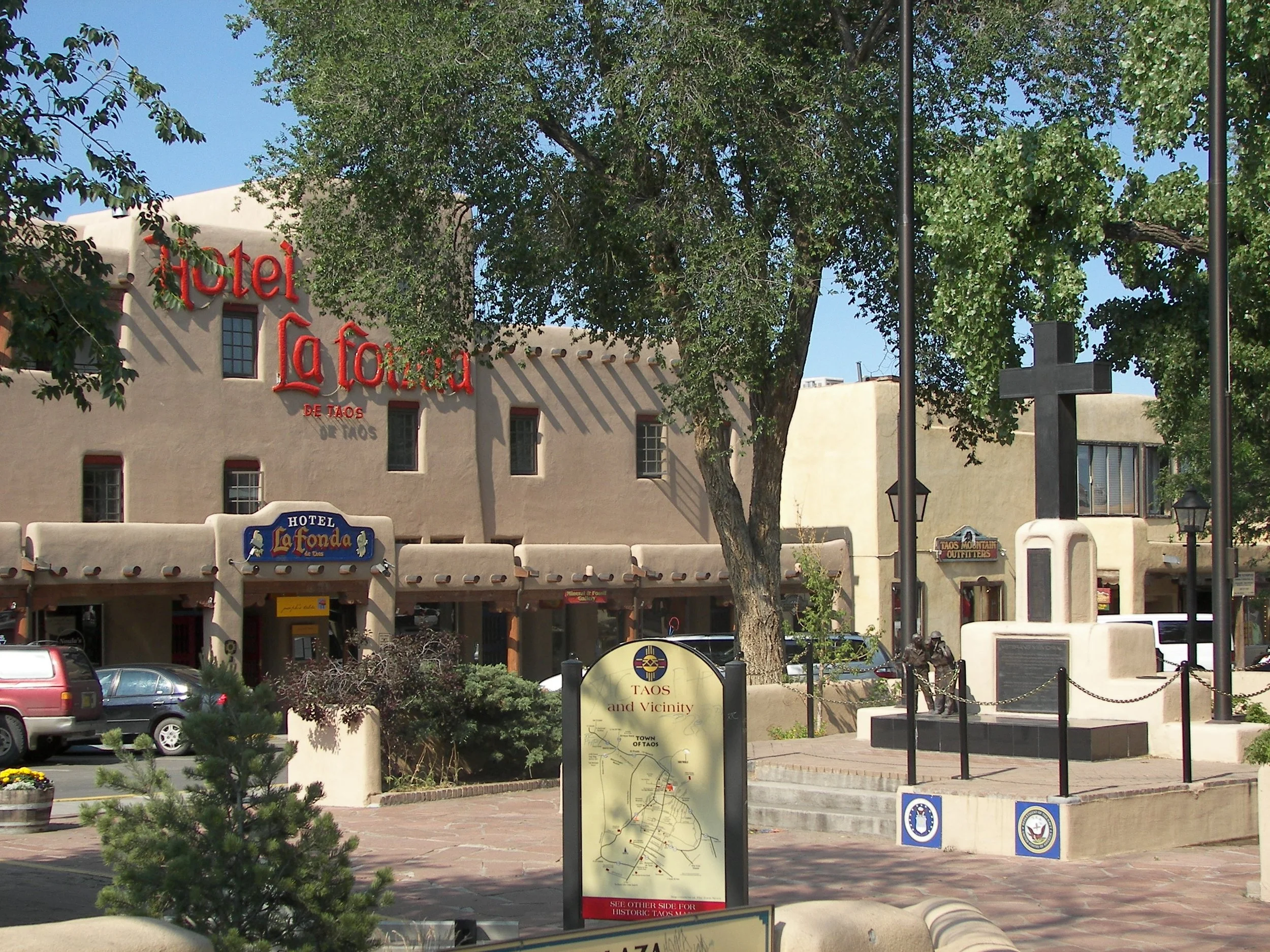
When skiing at Taos, you can opt to stay in the town rather than the resort and enjoy a much lower elevation.
Where will you sleep?
Base elevation matters, but your lodging elevation matters more. You'll spend far more hours sleeping, eating and relaxing than skiing. Some resorts give you a choice: at Taos, you can stay slopeside at about 9,200 feet or in the town of Taos, more than 2,000 feet lower. (We've done the latter.) In Summit County, nearby towns can offer a modestly lower alternative to staying in Breckenridge itself.
In Europe, this is usually less of an issue. Aside from a few purpose-built ski resorts the vast majority of mountain lodging in the Alps is down in the valleys, far below most of the trails.
How much of the mountain is above treeline?
High, open bowls are spectacular on a bluebird day. But they're also the first terrain to close in high winds or poor visibility. If the upper mountain is the main draw, make sure there's enough good terrain below treeline to fill a stormy day.
When are you going?
Early- and late-season trips favor higher resorts, which tend to open earlier and hold their snow longer. If you're booking for Thanksgiving or April, elevation is a real advantage. (See our Thanksgiving terrain article.) In midwinter, it matters less.
Who's coming?
Young kids, older travelers and anyone with health concerns may feel the altitude more, or face more risk. More on that in the next section.
What's your history?
If you've struggled at altitude before, take that seriously. A moderate-elevation resort might give you a better trip than a famous high one. Our Planning Guide lists a few lower-elevation options in North America, but based on our High Altitude Resort page you may also want to consider a trip to Europe.
Planning and Preparing for a High-Elevation Ski Trip
The good news is that altitude is predictable, and you can plan around it. In a well-known study of visitors to Colorado resort towns between 6,300 and 9,700 feet, about a quarter developed acute mountain sickness, most within the first 12 hours. For most, that meant headaches, fatigue and a rough night or two rather than anything dangerous. But it was enough to cut into their activities. A few smart choices can make a big difference.
Build your itinerary around it
The CDC advises against traveling from a low elevation to above 9,000 feet in one day, and recommends spending a few days at 8,000–9,000 feet first if possible. Most ski vacations don't allow for that, but there are easy compromises:
Stage overnight. If your arrival city is at a significantly lower elevation, stay there for the first night. In Colorado, for example, spending your arrival night in Denver (5,280 feet) before heading up to the mountains gives your body a head start. (Flying into Eagle makes this step impractical — more on that in our forthcoming article on flying into Eagle versus Denver.)
Sleep lower. The CDC also suggests taking day trips to a higher elevation and then returning to a lower elevation to sleep — which is not always easy. In Summit County, towns like Frisco and Silverthorne sit a few hundred feet lower than Breckenridge, a modest help at best. But Utah gives us a prime example of where this can work well: you can combine “staging” with “sleeping lower” if you’re skiing around Salt Lake City. The elevation there is around 4,300 feet and there are at least six major ski resorts that could be considered reasonable day trips from the city. There can be a catch to this, though. Traffic to some of those resorts (particularly Alta and Snowbird, the two Little Cottonwood Canyon resorts) on a weekend or a powder day can make even a short trip a headache.
Take it easy on day one. Plan a half day, mellow terrain, or a late start for your first day on the mountain. You'll likely get more skiing out of the whole trip.
Before you go
If you've had trouble at altitude before, or you're heading to one of the very high resorts, talk to your doctor. Medicines are available to prevent acute mountain sickness and shorten the time it takes to get used to high elevations. Your doctor can tell you whether one makes sense for you.
Some travelers need to be especially careful. According to the CDC, people with heart or lung disease should talk to a doctor familiar with high-altitude medicine before their trip, and people with diabetes need to be aware that their illness may be difficult to manage at high elevation. Pregnant travelers should also check with their doctor.
And remember our colleague: being in great shape helps, but it’s no guarantee.
Once you arrive
Go easy on alcohol. The CDC recommends no alcohol or heavy exercise for at least the first 48 hours above 8,000 feet. We know, it's vacation. But that first-night après session will cost you more at altitude.
Drink water. The air is dry, and you'll lose more fluid than you realize. We received a helpful tip from an Instagram follower (@jochskis) who suggests pounding coconut water after landing (or another electrolyte-replacement drink).
Expect rough sleep. Restless nights are one of the most common altitude complaints, and one many people don't see coming. On our first high-altitude trip, sleeping at about 8,000 feet, we barely slept at all the first night (which really put a damper on our plans to ski first-to-last chair the next day). Now we know to expect it and try to stage outside the mountains for one night or sleep at a lower elevation, if possible. Regardless, we have found that sleep usually improves after a few nights.
Know the warning signs
Acute mountain sickness is the mildest form of altitude illness. Symptoms include headache, tiredness, lack of appetite, nausea, and vomiting. Young children who can't talk yet may just seem fussy. Mild cases usually resolve within a couple of days.
Watch for symptoms getting worse instead of better. The CDC says a person whose symptoms worsen while resting should travel to a lower elevation. More serious forms of altitude illness are rare but dangerous. Extreme fatigue, confusion, and loss of coordination, or shortness of breath, weakness, and cough, mean the person needs to get to a lower elevation immediately and seek medical care.
What to pack
Sunscreen and SPF lip balm (see the UV section above)
Good goggles and sunglasses
Saline nasal spray, since dry mountain air causes nosebleeds for some people
A small travel humidifier, or ask your lodging if they provide one
What about those oxygen bars?
You'll see oxygen bars and canned oxygen sold all over ski towns, often marketed for altitude sickness — but the evidence is weak. One University of Colorado researcher notes there isn't good evidence that adding more oxygen onto normal levels helps the body physiologically. Any relief tends to be short-lived, and symptoms often come back. Save your money, and use the strategies above instead.
The Bottom Line
We are the first to admit that skiing in the high alpine is exhilarating. You truly feel like you're on top of the world. However, there is a trade-off. The higher resorts give you colder temperatures, more reliable snow and longer seasons. This is a particular benefit if you're traveling early or late in the year. But your body may pay the price, especially in the first 24 to 48 hours.
For most visitors, that price is manageable. The complaints we hear most often are headaches, a rough night or two, and a slower first day. Perhaps you’ll feel a little more winded on those long runs than you’re used to when skiing at lower elevations. But as you acclimate to the altitude, the symptoms should fade.
You don't need to avoid high-altitude resorts. In fact, there are plenty of reasons to seek them out. But you do need to plan for them. Know where you'll sleep, build in an easy start, go easy on the après the first night, and talk to your doctor if you've had trouble before.
Do that, and the altitude becomes just one more factor in your planning.
Skiing at Altitude: Frequently Asked Questions
At what elevation does altitude sickness start?
According to the CDC, any unacclimatized traveler going to a sleeping elevation of 8,000 feet or higher — and sometimes lower — is at risk for altitude illness. Many major Colorado ski towns sit above that line.
How long does it take to adjust to the altitude?
For most people with mild symptoms, the worst is over within a day or two; the CDC notes that mild cases usually resolve within a couple of days. Some people take longer to feel fully normal, especially when it comes to sleep.
Should I stay in Denver the first night?
If your schedule allows, it's a smart move. The CDC advises against traveling from a low elevation to above 9,000 feet in a single day. A night in Denver, at 5,280 feet, gives your body a head start before you head to the mountains.
Can kids get altitude sickness?
Yes. Children get the same symptoms as adults, and the CDC notes that children who can't talk yet may just seem fussy. If you're bringing young kids to a high-elevation resort, plan an easy first day, watch them closely and talk to your pediatrician before you go.
Does altitude affect snow quality?
Generally, yes. Higher elevations are colder, so more precipitation falls as snow, and it holds up better once it lands. But altitude doesn't fully define how much snow falls. Storm track and geography often matter just as much, if not more.