

Planning Guide - Choose the Mountain

Now for the fun part.
This is where you get to do a deep dive on the trail maps, picturing yourself standing at the top of an iconic trail about to go down for the first time. Or simply taking in the view of the snow covered peaks that surround you. It's time to figure out where you're actually going to go on this trip.
We aim to help you do this in a somewhat objective fashion. Yes, we are going to try to help you align your thinking around a few important characteristics. But the ski experience simply cannot be boiled down to numbers on a chart. There is too much that goes into it and too much subjectivity to make this a science.
Our goal is to outline the big things that you should be considering, and how they apply to your specific situation. But in the end, if you have always wanted to ski Steamboat, for example, that may be the best choice for you no matter what other factors you've taken to consideration.
Review the landscape
North America has over 800 separate ski resorts. There are nearly 4,000 in Europe. Of course, many of those are small, day mountains and more than a few are private, members only clubs.
Destination ski resorts worth spending the considerable amounts it takes to travel to are much fewer and farther between. But there are still many to choose from. So, how do you cut through the chaff and end up with a manageable set of possibilities for you?
Begin with a review of the Destination guides available on River Run Ski. We do deep dives on destination ski resorts from the perspective of the typical visitor -- not a local or a professional skier. We hope to reflect the experience of visiting these resorts the way you'll encounter them.
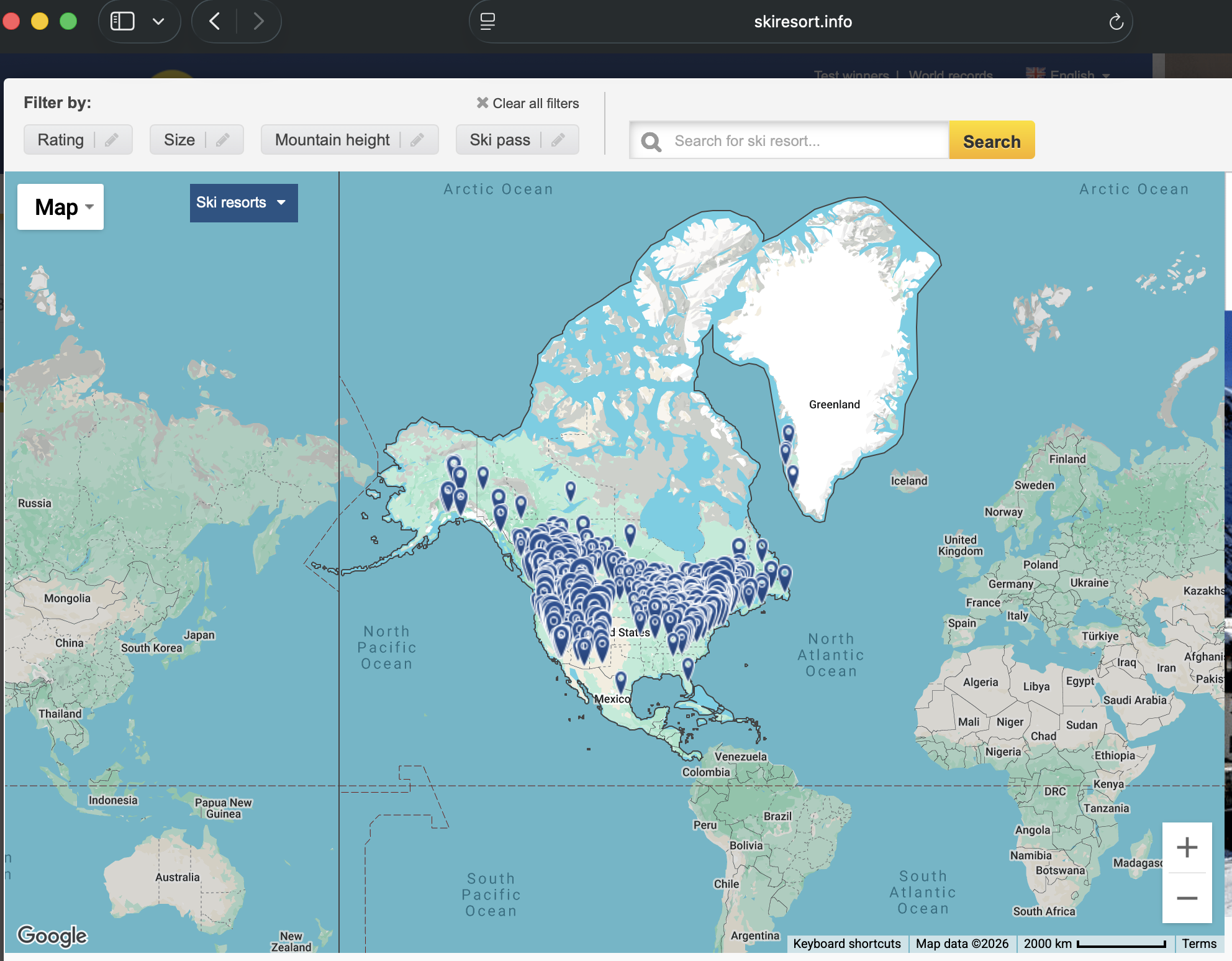
After that, you can begin to explore your options further. A site such as www.skiresort.info can be an excellent starting point, if you’re willing to put some legwork in. It may not have the slickest and prettiest UI, but it does contain an absolute treasure trove of information and will give you a great starting point for your search. The site is also worldwide, with detailed information not only on North America, but also for Europe and beyond.
There are other resources available online to expand your thinking, depending on what you're trying to compare:
If you're weighing pass options:
Vail Resorts — the Epic Pass network
Alterra Mountain Company — the Ikon Pass network
Indy Pass and The Mountain Collective — independent-resort alternatives
If you've narrowed to a region:
Ski Utah, Colorado Ski Country USA, Ski California — regional guides covering everything in that state
Between skiresort.info and these, you should have more than enough to work with. This is the point where you consider if you want to revisit a resort you've already been to, or if you're willing to travel further afield (Europe? Japan?) for this trip.
Create your working list
You want to identify a set of 4-5 potential resorts or regions that you can explore further with a more comprehensive evaluation. This is your “short list” that you can assess against the trip’s objectives and ultimately find an ideal destination. To get to that point, you may want to start with a few more — about 7-8 strong candidates.
Do your research on these — review websites and trail maps, re-read our Destination Guide for your chosen options, and seek out You Tube reviews and video footage. Just from this effort you’ll get a good, early sense of the character and layout of each resort you’re considering.
Use this research to filter down your 7-8 candidates to your short list.
Megapass Consideration
For the modern skier, purchasing a season pass like Epic or Ikon acts as an automatic filter. If you have already invested hundreds of dollars upfront, it makes total financial sense to build your itinerary around where you can ski for “free” (or at least feel like you are). This financial shortcut instantly narrows down an overwhelming continent of choices into a highly manageable shortlist. It takes the guesswork out of budgeting for lift tickets, but it also means you are letting a corporate portfolio dictate your winter plans.
This constraint is not necessarily a bad thing, given that both dominant passes boast world-class destination networks spanning from coast to coast. The key is understanding how to maximize the specific flavor of the pass you hold. An Epic Pass holder will naturally find themselves leaning heavily toward iconic, tightly clustered mega-resorts in Colorado, Tahoe, and British Columbia. An Ikon Pass holder, by contrast, unlocks access to legendary, independent powder havens across Utah, Jackson Hole, and the Pacific Northwest. Embracing your pass doesn't ruin your options; it simply gives your trip planning a clear, budget-friendly trajectory from day one.
Compare to your Goals
Remember Step 1 - Define the Trip? Now is a good time to go back and check in with your answers, as that will certainly help guide you as you filter through your options. Let’s go through some and discuss the implications for Choosing your Mountain:
Group dynamics
The occasional solo venture aside, most ski trips remain group trips. Much of your planning, research and negotiation energy will be spent forging a compromise among the group's competing interests. Anyone who has ever planned a group dinner knows that it’s impossible to please everyone. Planning an expensive vacation like a ski trip is exponentially more challenging. Traveling with a group magnifies the fun but multiplies the headache — especially for the organizer.
While solo trips are not the norm these days, if you have the opportunity to plan and take one someday I would urge you to consider doing it. You're free to choose the perfect destination, start and stop your day whenever you wish, and there's something rather cathartic about completing a long summit-to-base run solo, alone with your own thoughts. For more on how to plan a fantastic solo trip, look for an upcoming article on the topic on our site.
When it comes to planning the best vacation for your group, consider a few of the questions we asked when we defined the trip.
Knowing what the group members want to do will help you target resorts that will meet as many of the goals of the group as possible.
Eight factors to weigh
Compare Your Options
Tap any card to jump straight to that section.
Group Size
Bigger groups narrow your lodging and transport options fast.
Ski Resort or Region
One mountain for a week, or several in a few days?
Appeal to Everyone
Mixed-ability groups need mountains built for all levels.
Après-ski
Nightlife and dining vary widely from resort to resort.
Getting to the Resort
Airport-to-slope time can eat a full vacation day.
Altitude Implications
Sleeping high can hit unacclimated travelers hard.
Budget Constraints
Real costs vary more between resorts than people expect.
Climate and Weather
Timing your trip to the snow, not just the calendar.
Group Size
The size of your traveling party can limit your options in several ways. The first are related to the logistics and mountain access.
A larger, more geographically spread out group of travelers may need to eliminate some options simply because it's too challenging for some group members to get there. For example, Whistler could be a fantastic option for a small group comprised entirely of people living near San Francisco, as they can easily take one of several nonstop flights. But if this was a much larger group of people and they were spread all across the United States? It becomes much more challenging to coordinate the travel. Some may even need to take three-leg flights which can take up an entire day.
Larger groups also present a problem when it comes to actually traveling to the resort. Transporting more than four or five people along with skis, boot bags, and luggage isn't really feasible in a rental car any longer. Your best option is to find a resort reachable by bus/shuttle. Or, renting multiple cars.
Aside from travel and logistics, group size also affects the type of resorts you should be considering. Small groups (a couple, or a family of four) may find it's the most cost effective to book a hotel room or a small condo as opposed to a chalet or house. But not every destination ski resort has a wide range of slopeside hotels or condos. Some resorts are better positioned to accommodate smaller groups with lodging stock concentrated on hotels and condos, and some are better positioned for larger groups with large standalone houses or chalets available for short-term-rental.
Ski Resort or Region
Bear in mind, "choosing a mountain " is a an oversimplification. Most destination resorts in North America and Europe are comprised of several mountains, of course. But beyond that there are many places where you can reasonably ski at multiple different world class resorts within the confines of a long weekend or a 3 or 4 day trip.
As mentioned in our logistics guide, there are six world-class resorts within easy reach of Salt Lake City. But for those who want to really get out and broaden their horizons, consider Lake Tahoe -- home to 14 fantastic ski resorts, each with their own culture and character. You could also ski the Powder Highway in British Columbia or the Big Three in Banff, Canada (Destination Guide coming soon). You may decide to just go visit a region rather than a specific mountain or specific resort.
On the other hand, there are plenty of options to consider where you can ski for a week and still not get bored. Massive resorts such as Whistler Blackcomb, Vail, Park City, Palisades Tahoe or Mammoth will keep a big group entertained for days.
Appeal to Everyone
If you have one or more first-time skiers in your group, you're going to want to select a mountain that embraces all ability levels and is designed to please everyone.
Virtually all destination resorts have worked very hard in recent years to diversify their terrain. There aren't many mountains left that are for "experts only"-- but there is still a wide range among the resorts as to the degree and access accessibility of beginner terrain. And some resorts are much more geared around instruction than others.
When we have a diverse group of ages and abilities, we often recommend a resort like Beaver Creek, Colorado. Beaver Creek has a gondola to take beginners to the learning area, which is much more approachable than trying to teach a new person how to get on or off a lift. And they have beginner terrain throughout the resort, including from the summit. They even have high alpine bowl skiing for beginners at McCoy Park.
In contrast, a group of expert, adventurous skiers is likely to have a vastly better time at Jackson Hole or Snowbird or Kicking Horse than at a Beaver Creek - for exactly the opposite reasons.
Aprés-ski
At River Run Ski, we generally like to focus the most on the ski experience itself, but when you're on vacation, you may like to have a little fun after hours as well. Après-ski activities have become intertwined with many people’s idea of a great ski trip, so if you or your group is heavily invested in partaking in social activities after (or during) a long day on the slopes, take this in to consideration.
Each resort has its own personality and vibe, but a few stand out as real trailblazers when it comes to creating a true après-ski vibe.
Within North America, you may want to take a close look at Aspen Snowmass, Vail, Breckenridge, Park City or Jackson Hole. Each has cultivated a different aprés-ski culture, on a range between “Luxe European” to “Wild, Wild West.” On one end you have Aspen Snowmass, which truly emulates the lavish and high energy party scene of many European resorts, complete with an afternoon dance party and champagne spray. The opposite would be Jackson Hole which embraces its old west heritage and saloon culture.
In between you have Vail, Breckenridge and Park City — all notable for the sheer size, diversity and density of their bars and restaurants. Vail features a large, walkable European-style village teeming with patios, fire pits and live music. Breckenridge and Park City both have fully developed towns right at the base. Notably, roaming around Park City in the evening is an experience that many skiers want to have in their lifetime.
While these are some prime examples of resorts with a reputation for nightlife and social events, just about every resort will have something to keep you entertained in the off hours. For this reason, we don’t recommend putting too much weight behind the apres activity availability when choosing your mountain. It could just be the final factor that tips the scale in favor of one destination over other candidates.
Getting to the Resort
By their very nature, Ski resorts are often remote and difficult to get to. Geography and geology conspire to constantly present challenges that even our most advanced, modern engineering and public works techniques can't overcome. One of the most disappointing things in destination travel is to successfully make it thousands of miles through the air, only to encounter that the steep mountain pass you need to drive over to get to your resort is closed due to weather, or a rock slide.
It is for this very reason that savvy travelers put a premium on mountain accessibility. We have already discussed flight logistics and how nonstop flights can reduce your risk of missing part of your vacation, but the same is true with mountain accessibility. At the very least, you need to be aware of the risks and challenges in getting to certain resorts, and factor that in to your decision making.
Some resorts are quite notorious for shortening ski trips due to ground transfer complications, with three of the most notorious being in Colorado: Telluride, Crested Butte and Steamboat. This is mainly due to the Denver airport being one of the busiest hubs in the world for air traffic and exceptionally easy to fly in to — but located in the eastern side of the state in the plains. So journeys to the more remote Colorado resorts entail hours of mountain driving on narrow roads.
Conversely, resorts such as Banff Sunshine Village offer comparatively easy access directly from a major airport (Calgary) with Ski Lake Louise just a bit farther north. And it is difficult to imagine a major ski resort easier to access than the two world class resorts that call Park City their home (Park City Mountain Resort and Deer Valley). You can take public transportation directly from the SLC airport to the town center — and Park City Mountain Resort has a lift base station right in the middle of town. If you choose to drive yourself it can take less than 40 minutes with no traffic.
That’s not to say that a huge snowstorm or major vehicle accident wouldn’t throw a wrench in to your plans, that is always a possibility. But the risks of that happening are much lower for these resorts.
For further information as well as more detailed recommendations and cautions, look for our forthcoming articles:
Are we there yet? — The Most Challenging Ski Resorts to Access
On the Lift by Noon — The Easiest Ski Resorts to Access
Altitude Implications
A few years ago, a work colleague (yes, we do have real jobs) planned a week long ski trip to Breckenridge. An accomplished skier with over 40 years of experience, he was capable of taking on any terrain at that resort -- but he had never skied there before. He was also a semi-pro cyclist and in fantastic physical and cardio health.
The base at Breckenridge lies at 9,600 feet. The summit of Peak 8 tops out a few feet shy of 13,000 feet. My colleague lives at around 150 feet — essentially sea level. He lasted all of half a day on the mountain before having to return to his rental condo due to a crippling migraine.
Two sleepless nights and uncomfortable days later, he left Breckenridge and descended down to the relative safety of Denver, where he improved. But it was too late to salvage the ski trip -- his week long vacation that cost thousands ended up being less than three hours. Despite being in top physical shape, his body was simply not prepared for the altitude and he developed early AMS (Acute Mountain Sickness).
Although this reaction to the altitude is not typical, anyone who lives at a low altitude and travels, sleeps or exerts themselves at a high altitude is going to be impacted. Common complaints run from insomnia and dehydration to increased heart rate, breathlessness, fatigue and headache.
If you’ve skied at elevation in the past and had issues, we highly recommend you discuss any potential trips with your doctor or medical professional beforehand. There is much you can do to both prepare for a trip and to mitigate the impacts once you arrive.
Check out our Skiing at Altitude article for a deeper dive in to the topic.
When it comes to Choosing your Mountain, make sure you take a good look at the altitude of the resort — and not just the summit, but the base as well. Most likely you’ll be staying and sleeping near the base elevation, and more of your time on your trip will be spent not skiing than on the mountain.
The highest altitude base and summit areas in North America are typically in Colorado. Two to watch out for are Breck and Telluride:
Breckenridge (Colorado): Summit 12,998 feet / Base 9,600–9,950 feet
Telluride Ski Resort (Colorado): Summit 13,150 feet / Base 8,725–9,545 feet
Three other very high elevation resorts are Silverton, Loveland and A-Basin. However, these three are really focused on day skiers and do not have much or any base-area or on mountain lodging. This means you’d be staying and sleeping at a lower elevation than the base area would imply.
Silverton Mountain (Colorado): Summit 13,487 feet / Base 10,400 feet
Arapahoe Basin (Colorado): Summit 13,050 feet / Base 10,520–10,780 feet
Loveland Ski Area (Colorado): Summit 13,010 feet / Base 10,600–10,800 feet
Please keep in mind the elevation of your resort options when making your choices. And don’t assume that just because you are not visiting one of these top five that you won’t have any altitude effects. Even at a “low” altitude (by western US standards) resort such as Park City or Deer Valley in Utah, skiers who are used to skiing or living closer to sea level will notice the difference.
If you have a history of altitude sickness but still want to have a great trip, consider one of these three options:
Whistler Blackcomb (British Columbia): Summit 7,493 feet / Base 2,214 feet
Whitefish (Montana): Summit 6,817 feet / Base 4,464 feet
Alyeska (Alaska): Summit 3,939 feet / Base 250 feet (!!!)
Budget Constraints
Skiing is an expensive endeavor even without the travel. Add in plane tickets, rental cars, baggage fees, and lodging costs and it can quickly become cost prohibitive for most of us.
While there is no magic wand we can wave that will change a $10,000 ski trip to $500, there are some things to be aware of so you don’t lock yourself into an unaffordable vacation, and some advice we can pass on that can help reduce your costs.
First off, consider all costs involved in a ski trip when choosing your mountain. We are conditioned to think that we have unlocked some great “deal” on one aspect of the costs which will somehow make up for other exorbitant expenses. It won’t. The primary offenders of this are Lift Tickets and Airfare.
Due to well-publicized price hikes in walk up lift ticket prices, many skiers have begun targeting independent and potentially smaller resorts that have more affordable walk-up ticket rates. Of course you can save some money that way, but be aware of other cost drivers — particularly lodging and transportation costs — as saving $600 on lift tickets is hardly worthwhile if your airfare costs $1000 more or you are forced to pay escalated lodging costs due to lack of available rooms at your resort.
The same can be said for airfare — any savings you may be thinking you’re getting on airfare can easily be chewed up and surpassed if the resort costs or transportation costs are high.
Secondly, be aware of the drivers that increase the costs at certain resorts/regions:
Lodging diversity — Resorts with a wide mix of different types of lodging (hotels, condos, chalets/houses) tend to be cheaper of a per person / per night basis. The reason is two-fold:
When the supply of lodging options is high, competition can drive the price down
It’s easier to “right-size” your lodging when you have a wide variety of choices. For a group of 8, it will almost certainly be the most cost efficient to rent a chalet or house, whereas for a couple you may find it’s cheapest to get one hotel room for a week A group of 4 may find that a 2-BR condo fits the bill.
Proximity to lifts — Convenience is key when you want to maximize your time on the slopes. But you pay for that convenience. Lodging at resorts with luxury, ski-in/ski-out lodging or a dense walkable village right at the base tend to be more expensive than resorts with more spread-out lodging accessible only by shuttle or ‘drive and park.’
Time of year — It goes without saying that costs for *everything* are high during Holiday travel -- but take the time to look at the Calendar of Events for your resort and nearby area to ensure your travel dates don't overlap with major or popular happenings. Beaver Creek, for example, typically hosts a major World Cup series of races in early December. And of course the Sundance Film Festival used to completely take over Park City and Deer Valley until it moved to Boulder beginning with the 2027 festival. But events like those can mean completely sold out lodging or sky high prices.
You should also be aware that there are simply some resorts that have a well-earned reputation for being high-end, exclusive and pricey:
Aspen Snowmass (Colorado): The premier destination for luxury winter travel, catering heavily to elite travelers. The historic base town features designer boutiques and high-end dining. With premium lodging rates regularly crossing into four figures per night, it stands as one of the most exclusive mountain escapes worldwide.
Deer Valley (Utah): This snowboard-free mountain focuses on top-tier guest service, offering ski valets and heated walkways. To eliminate crowds, daily lift tickets are strictly limited and priced at a premium. The base village consists almost entirely of upscale five-star hotels and luxury chalets.
Beaver Creek (Colorado): Built specifically for travelers seeking a pampered experience, this resort emphasizes comfort and high-end amenities. Open-air escalators effortlessly carry skiers to the slopes, and complimentary warm cookies are served daily. The luxury perks match peak walk-up prices that rank among the continent's highest.
So what's the easiest way to avoid falling into a financial trap as you choose your destination? You're doing it right now by reading this guide and following our advice:
Understand your goals
Understand your limitations
Research fully and understand your costs
And finally, complete your planning as early as possible. The concept of a “last minute deal” rarely applies when it comes to ski trips. The best deals in ski travel are often found in the summer time or ever in the spring. For a more detailed discussion of this, see our post on Winning the Offseason.
Climate and Weather - Where is the Snow?
Calendar dates dictate your destination options just as much as your budget or skill level. It is a common mistake to assume that a massive winter storm in January guarantees excellent skiing across the entire continent. North American mountain ranges peak at vastly different times. If your vacation dates are locked in, you must align your geography with historical weather patterns to ensure you actually find the deep coverage and soft powder you are paying for.
This alignment is most critical during the early shoulder season (November through mid-December) and the late spring stretch (late March through April). Early-season travelers should target high-altitude interior resorts, particularly in Colorado and parts of Utah, where cold temperatures allow for aggressive early snowmaking and high base elevations preserve natural early snowfalls. Alberta and interior BC are also good options. Conversely, if you are planning a spring break trip, you want to shift your focus to high-latitude regions like western Canada or the Pacific Northwest, or look for resorts with a high percentage of north-facing terrain that shields the snowpack from the harsh spring sun.
Tying it all together
Choosing your mountain is more of an art than a science, but it’s an informed art. By evaluating your options against the goals of your trip you should be able to narrow down your options from your “Short List” to one or two final candidates. Consume every bit of content you can on these options — rewatch all those YouTube videos, make sure you know the event calendars, the average annual snowfall, the best months to visit, maybe even take a look at the trail map and sketch out what your first day may look like.
Consider all the factors that we’ve outlined, plus anything else that may be important to you (or your group members) and make your final selection.